
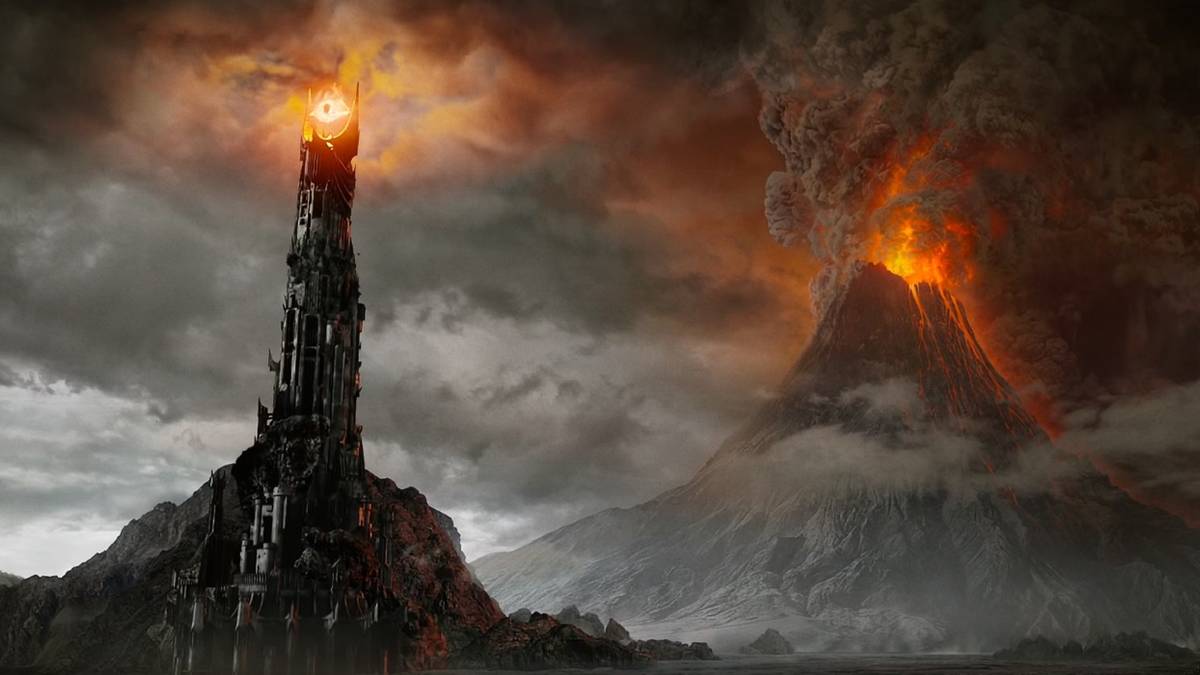
J.R.R. Tolkien Originally Intended ‘The Two Towers’ to Refer to Minas Morgul, Not Barad-dûr
New evidence reveals that J.R.R. Tolkien initially envisioned the “two towers” of his epic novel as Orthanc and Minas Morgul, a departure from the film adaptation’s focus on Orthanc and Barad-dûr, and sheds light on the author’s complex relationship with the title itself.
Despite Saruman’s declaration of “the union of the two towers” in The Lord of the Rings: The Two Towers, referencing Orthanc in Isengard and Barad-dûr in Mordor, Tolkien’s original intent differed. Extensive notes and letters discovered among Tolkien’s archives demonstrate that while Orthanc was always intended as one of the towers, he initially paired it with Minas Morgul, the fortress of the Nazgûl. This is visually confirmed by the original dust jacket illustration for the book, which depicts Orthanc alongside a white tower bearing the symbols of the moon and nine rings – clearly representing Minas Morgul.
In a note added to a draft of The Fellowship of the Ring in February 1954, Tolkien explicitly stated that “The second part is called THE TWO TOWERS, since the events recounted in it are dominated by ORTHANC, the citadel of Saruman, and the fortress of MINAS MORGUL that guards the secret entrance to Mordor.” Tolkien himself struggled with the title, even briefly considering the Tower of Cirith Ungol as an alternative, and acknowledged the ambiguity in letters to his editor, Rayner Unwin. This discovery offers a deeper understanding of Tolkien’s creative process and the evolution of his iconic work. For more on Tolkien’s worldbuilding, explore the resources at The Tolkien Society.
Peter Jackson’s film adaptation understandably chose Barad-dûr to complement Orthanc, given the narrative structure and visual impact required for the screen. However, Tolkien’s original vision highlights the nuanced details often lost in adaptation. This revelation underscores the importance of examining primary sources when interpreting classic literature, and provides fans with a new layer of appreciation for the depth of Tolkien’s creation. You can revisit the film adaptation of The Lord of the Rings: The Two Towers on Max.
Experts say this discovery will likely fuel further debate and analysis among Tolkien scholars and fans alike, as they re-examine the text and artwork through this new lens.
