
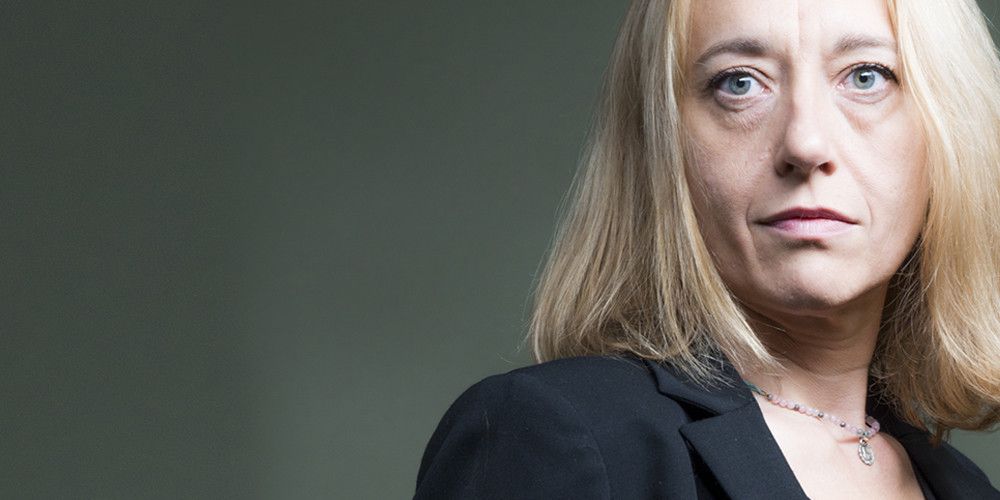
Virginie Despentes has spoken out in a powerful video posted to La Grande Librairie’s social media channels, comparing Vincent Bolloré’s actions at Grasset to predation.
In the clip, filmed Wednesday morning and shared across platforms, the author of King Kong Theory and Vernon Subutex stated plainly: “This isn’t a war, it’s predation. If it uses the same word as sexual predation, it’s because it’s the same mechanism — abusing power to strip someone of their humanity.”
Despentes, who had been under contract with Grasset for thirty years, addressed the camera directly in what the outlet described as a “Droit dans les yeux” sequence — face-to-face, and unflinching.
Her remarks came two days after her appearance on Quotidien (TMC), where she discussed the abrupt removal of Olivier Nora as head of Grasset by Bolloré, owner of Hachette. The decision followed Nora’s refusal to publish a travel narrative by Nicolas Diat, an editor linked to far-right figure Jordan Bardella.
The author emphasized that her response was not isolated but part of a broader movement. A week prior, she had helped initiate an unprecedented mobilization of Grasset authors, joining colleagues including Colombe Schneck, Vanessa Springora, Tania de Montaigne, and Anne Berest in protest.
Despentes confirmed she had left the publisher, along with approximately 240 other authors, in solidarity after Nora’s dismissal. She reiterated her call for a “conscience clause” in publishing contracts — a provision allowing writers to terminate agreements and reclaim rights if major changes occur in editorial direction, leadership, or contractual terms.
Such a clause currently exists for journalists but not for novelists, a gap Despentes and others are seeking to close. Five days after Nora’s removal, she and 300 writers from various publishing houses signed a petition demanding this safeguard.
The author framed the conflict not as a personal dispute but as a systemic issue, describing Bolloré as embodying the influence of far-right-aligned financial elites. “We can invent something else,” she said. “We can unite.”
Her video, posted at 4:09 p.m. On April 22, 2026, quickly circulated online, drawing sharp attention to the growing tension between creative independence and corporate control in French publishing.
