
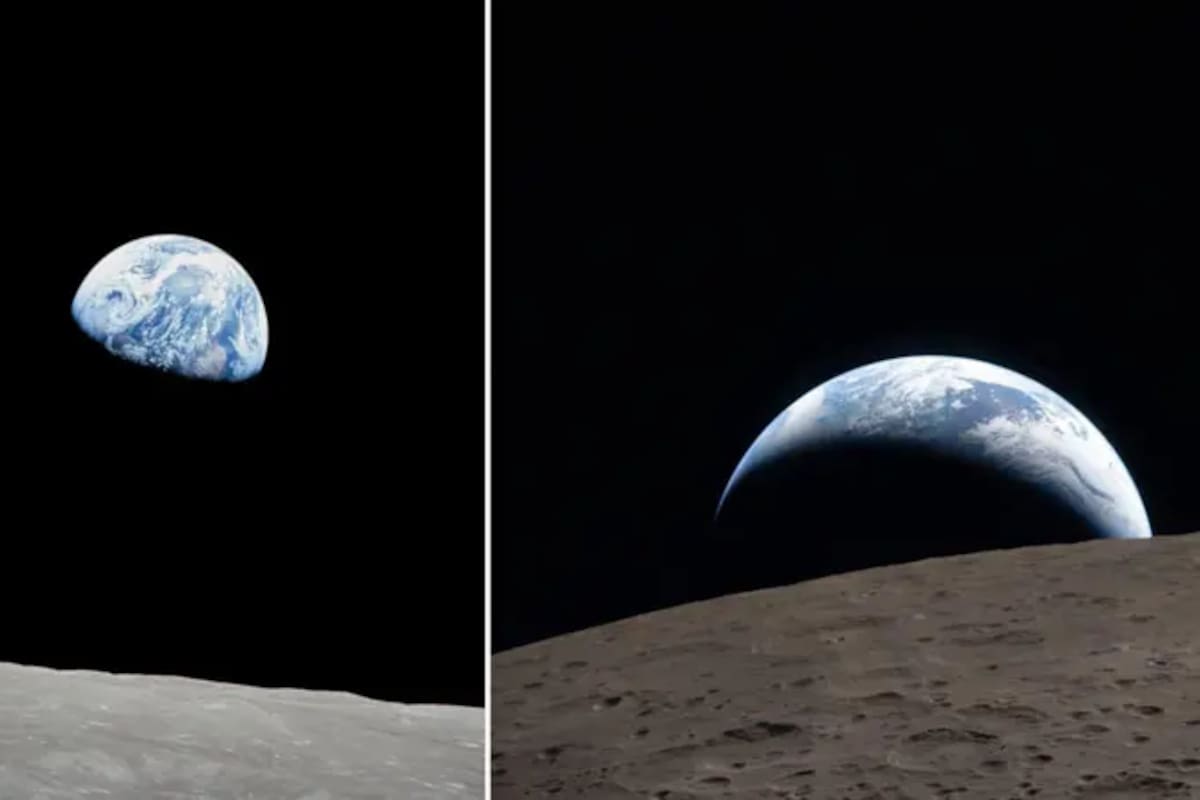
April 21, 2026 – A side-by-side comparison of iconic Earth images captured nearly six decades apart reveals striking visual changes to our planet, as highlighted in a recent feature examining photos from NASA’s Apollo 8 mission and the Artemis II crew’s lunar flyby.
The Apollo 8 mission, which launched in December 1968, marked humanity’s first journey beyond low Earth orbit and provided the world with its first glimpse of Earth rising over the lunar horizon. Fifty-eight years later, the Artemis II crew—comprising NASA astronauts Reid Wiseman, Victor Glover, and Christina Koch, along with Canadian Space Agency astronaut Jeremy Hansen—repeated the trajectory during their 10-day mission, capturing updated views of Earth from deep space.
According to reports, the Artemis II mission launched on April 1, 2026, from Launch Complex 39B at NASA’s Kennedy Space Center in Florida. The crew completed a circumlunar flight using a free-return trajectory before preparing for splashdown in the Pacific Ocean off the coast of San Diego, scheduled for 3:07 p.m. Local time on April 10, 2026.
While Apollo 8’s images became enduring symbols of the space age and environmental awareness, the Artemis II photographs offer a contemporary perspective, showing Earth’s evolving surface and atmospheric patterns. The comparison underscores both technological progress in space imaging and the visible transformations of our planet over nearly six decades.
The Artemis II mission serves as a critical test flight for NASA’s deep space exploration systems, paving the way for future crewed landings under the Artemis program. Though no lunar landing occurred during this mission, the flight validated key systems ahead of Artemis III, which aims to land astronauts on the Moon’s surface by mid-2027.
As the crew prepared for return, mission officials emphasized that success would only be declared after safe recovery and medical evaluation. “The moment we can start celebrating will be when we have the crew safely in the recovery ship’s medical bay,” said a NASA associate administrator during a pre-splashdown briefing.
The visual legacy of Apollo 8 continues to inspire, while Artemis II adds a new chapter—one that reflects not only advances in spaceflight but similarly a changing world seen from afar.
