
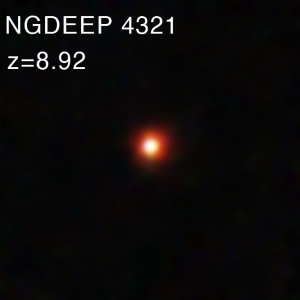
Newly observed red dots by the James Webb Space Telescope, appearing hundreds of millions of years after the Big Bang, may be nascent black holes formed through the direct collapse of cold hydrogen clouds, according to new simulations. If confirmed, this would represent a significant breakthrough in understanding the evolution of the early universe.
The James Webb Space Telescope was designed to peer into the universe shortly after the Big Bang, with scientists hoping to finally reveal what conditions were like in those early moments. However, the telescope is revealing unexpected phenomena, raising as many questions as it answers – a common occurrence in scientific discovery.

Fabio Pacucci. Kredit: Harvard University.
Among its discoveries, Webb has detected previously unknown, bright red astrophysical objects in the universe as it existed just a few hundred million years after the Big Bang. These objects, dubbed Little Red Dots, have puzzled scientists. Initial theories suggested they were extreme star-forming regions, but this doesn’t align with cosmological models that predict massive galaxies couldn’t have formed for at least a billion years post-Big Bang.

Ilustrace černé díry přímého kolapsu. Kredit: NASA/CXC/M. Weiss, Wikimedia Commons, CC BY-SA 4.0
Alternative theories proposed they could be quasars, but this also clashes with cosmological models, as the Little Red Dots are observed in such a young universe that supermassive black holes – found at the heart of quasars – wouldn’t have had time to develop. Avi Loeb has suggested they might be supermassive stars from the earliest population of the universe with zero metallicity and masses of millions of Suns.
Fabio Pacucci from the Harvard & Smithsonian Center for Astrophysics (CfA) and Black Hole Initiative ( BHI ) at Harvard University, along with his colleagues, believes the Little Red Dots are actually direct collapse black holes. This would be a significant finding. These are hypothetical black holes thought to form in the early universe through the collapse of an entire cloud of cold hydrogen. They would be incredibly massive from the start, potentially hundreds of thousands of times the mass of our Sun.
If this scenario holds true, it would mean that very massive black holes could have appeared in the young universe almost instantaneously. Researchers reached this conclusion through simulations of radiation and hydrodynamics. The simulation results, which align with observations, point to direct collapse black holes actively consuming matter from their surroundings. The findings suggest a new pathway for black hole formation in the early universe. If Pacucci and his team are correct, it’s a cause for celebration.
Video: Fabio Pacucci- The hunt for the first black holes in the universe
Video: Can a black hole be destroyed? – Fabio Pacucci
Literatura

