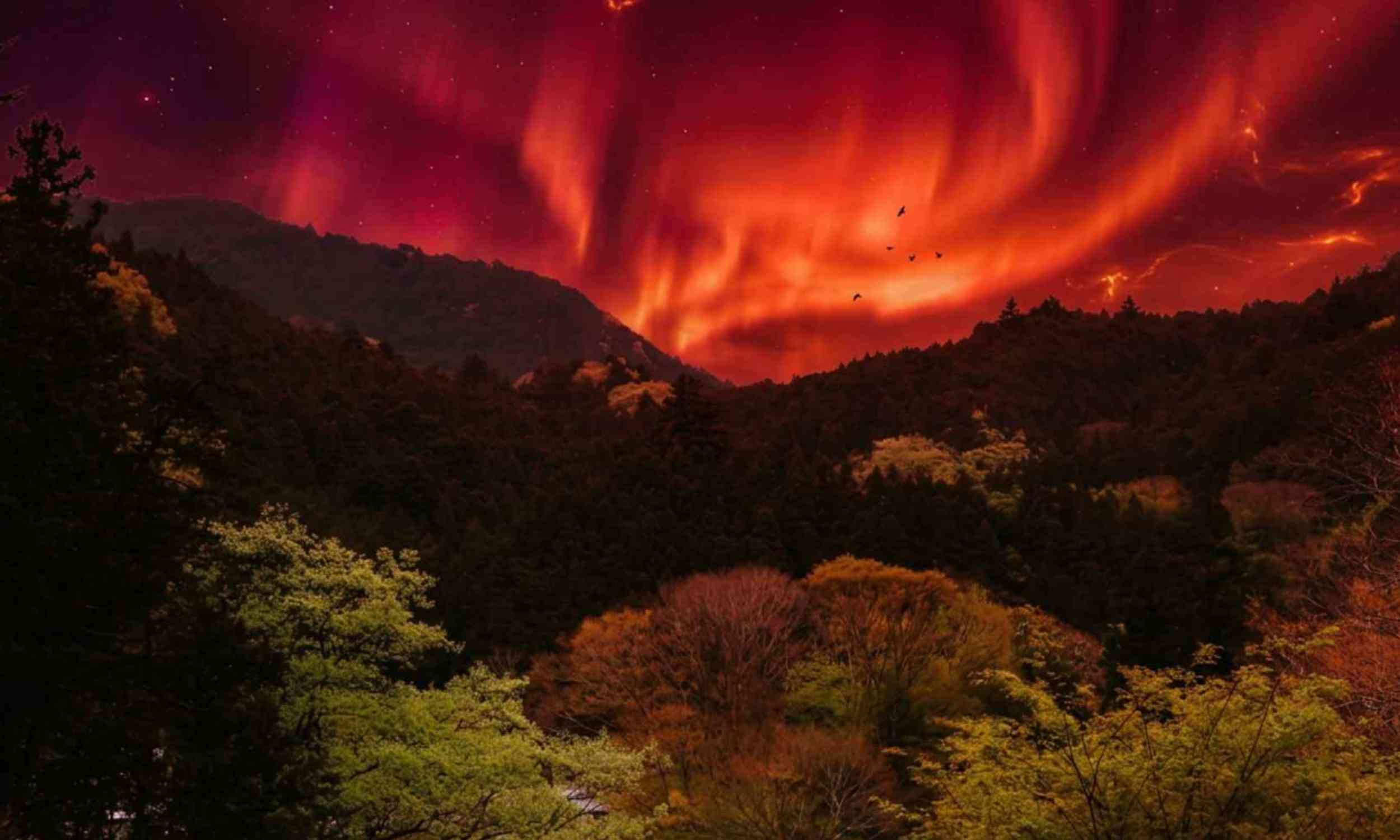
A solar storm so powerful it painted the medieval skies of Japan blood-red has been uncovered by scientists using ancient trees and 800-year-old diaries, revealing a hidden threat to future astronauts and lunar missions. Researchers at the Okinawa Institute of Science and Technology (OIST) linked a spike in carbon-14 trapped in buried asunaro trees to a solar proton event (SPE) between 1200 and 1201 CE, a period when court astronomers and poets recorded eerie red auroras over Kyoto.
How a Poet’s Diary Led to a Scientific Breakthrough
The discovery began with a single sentence in the Meigetsuki, the diary of Fujiwara no Teika, a 13th-century Japanese poet and courtier. In February 1204, Teika wrote of “red lights in the northern sky over Kyoto”—a phenomenon that terrified medieval observers but left no obvious modern explanation. The OIST team, led by Professor Hiroko Miyahara, cross-referenced Teika’s account with Chinese chronicles describing similar low-latitude auroras and records of unusually large sunspots from the same era. What they found was a solar storm so intense it defied conventional detection methods.
cluster source: Indian Defence Review
“Previous studies on historical SPEs have focused on rare, extremely powerful events,” Miyahara explained in the Proceedings of the Japan Academy, Series B. “Our paper provides a basis for detecting sub-extreme SPEs—events that occur more frequently and are around 10-30% of the size of the most extreme cases, but still hazardous.” The key was refining a method to measure carbon-14 spikes in tree rings with unprecedented precision, revealing storms that had previously slipped through the cracks of historical records.
—Fujiwara no Teika, Meigetsuki, February 1204
The Hidden Danger in “Sub-Extreme” Solar Storms
The storm of 1200 CE wasn’t the most catastrophic in history, but it was far from harmless. Solar proton events like this one hurl charged particles toward Earth at speeds nearing 90% the speed of light, capable of penetrating spacecraft shielding and exposing astronauts to lethal radiation doses. In 1972, SPEs erupted between the Apollo 16 and Apollo 17 missions—had astronauts been on the Moon during those events, the consequences could have been fatal. With NASA, SpaceX, and other agencies planning crewed lunar missions in the coming decades, understanding these “sub-extreme” storms is critical.
NASA
What makes this discovery particularly valuable is the method itself. By analyzing buried asunaro trees from Aomori Prefecture—preserved in waterlogged soil for centuries—the OIST team detected carbon-14 spikes invisible to older measurement techniques. These trees, related to Japanese cypress, act as natural dosimeters, capturing atmospheric carbon-14 produced when high-energy solar particles collide with nitrogen in the upper atmosphere. The result? A timeline of solar activity stretching back millennia, with the 1200 CE event marking a period of unusually intense activity.
Why This Matters for Modern Space Exploration
The implications for space travel are immediate. While Earth’s magnetic field shields most of us from solar radiation, astronauts on the Moon or Mars have no such protection. The 1200 CE storm, though less severe than the most extreme SPEs, would still have posed serious risks to unshielded crews. “These sub-extreme events are more challenging to detect,” Miyahara noted, “but our method now allows us to efficiently identify them and better understand the conditions under which they occur.”
Scientists Warn: A Solar Superstorm Could Hit Earth Any Day
The findings also challenge earlier assumptions about solar activity patterns. Researchers had long believed that only the most extreme storms—those capable of disrupting global power grids or disabling satellites—were worth tracking. But the 1200 CE event suggests that smaller, more frequent storms may be just as dangerous for astronauts. As space agencies race to establish lunar bases, this data could inform shielding designs, mission scheduling, and even real-time warning systems.
What Happens Next: The Race to Predict Solar Storms
With the method validated, the next step is applying it to other historical periods. The OIST team is now expanding their analysis to other preserved wood samples, including cedar and pine, to build a more comprehensive picture of solar activity over the past millennium. If they can correlate these events with historical records of crop failures, magnetic disturbances, or even societal upheavals, it could provide a new lens for understanding how solar storms have shaped human history.
What Happens Next: The Race to Predict Solar
For now, the 1200 CE storm stands as a stark reminder of how little we still know about our nearest star. While modern satellites and ground-based observatories monitor solar activity in real time, the unpredictability of SPEs means that astronauts will always face some level of risk. The question is no longer if another major storm will hit, but when—and whether humanity will be ready.
Key Takeaways: The Science Behind the Discovery
Carbon-14 as a solar storm detector: When high-energy particles from the Sun collide with Earth’s atmosphere, they produce radioactive carbon-14, which gets absorbed by trees and preserved in their rings.
Sub-extreme SPEs are a real threat: These storms, though less severe than the most extreme events, can still expose astronauts to dangerous radiation levels.
Historical records + science = breakthrough: By combining medieval diaries with ultra-precise carbon-14 measurements, researchers uncovered a storm that had been overlooked for centuries.
Future lunar missions at risk: The discovery underscores the need for better shielding and warning systems as space agencies plan crewed trips beyond Earth’s magnetic field.
The research was published in the Proceedings of the Japan Academy, Series B, marking a turning point in our understanding of solar history. As Professor Miyahara’s team continues to refine their methods, one thing is clear: the Sun’s behavior is far more complex—and far more unpredictable—than we once thought.
Sophie Williams is the Tech Editor at Headlinez.News, covering innovation, artificial intelligence, cybersecurity, and emerging technology trends. Before joining the publication, she worked as a technology correspondent and product analyst for multiple tech-focused media outlets. With a background in computer science and digital media, Sophie bridges technical depth with accessible reporting, bringing readers closer to the technologies transforming everyday life.
Expertise: Artificial intelligence, consumer tech, cybersecurity, startups, digital transformation.
Location: San Francisco, California, USA