
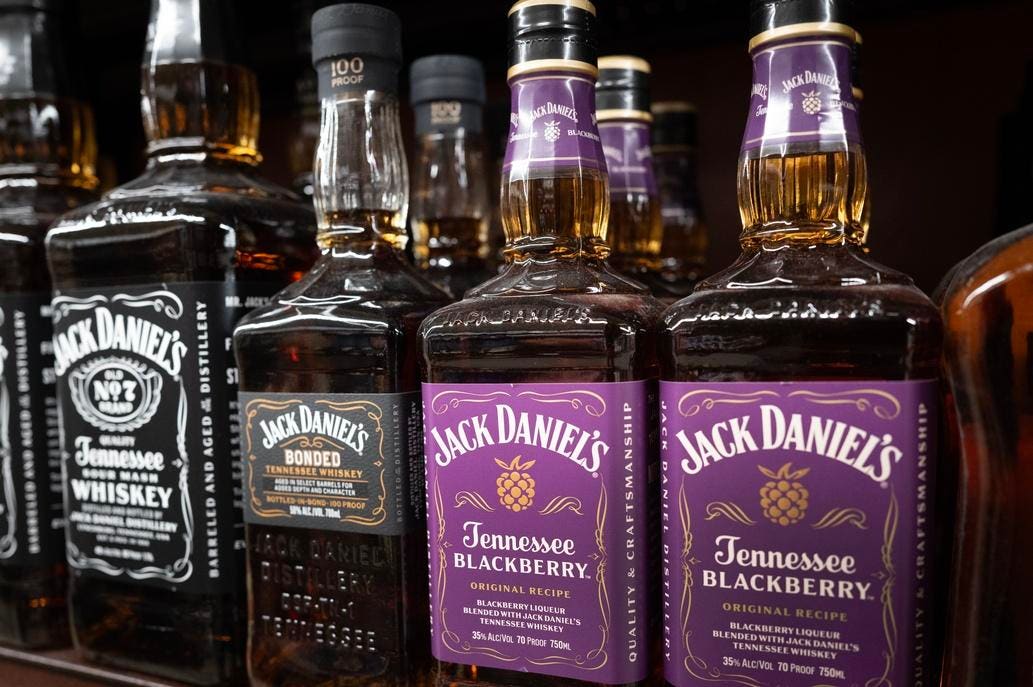
Brown-Forman Corporation reported fiscal fourth-quarter profit of $54 million on Thursday, but the results fell short of Wall Street expectations as Jack Daniel’s sales declined amid broader trends in alcohol consumption. The Louisville-based company’s stock rose slightly following the release of its financials, though it remains below key 2026 highs.
Sales Decline and Strategic Shifts
Jack Daniel’s, the iconic whiskey brand owned by Brown-Forman, experienced a 7% drop in U.S. net sales for the fiscal year ending in 2026, driven by reduced consumer demand and the termination of a partnership with Korbel Champagne Cellars. The company attributed the decline to “lower volumes” of its core product, with depletions—industry metrics for consumer demand—falling 3% year-over-year. However, Brown-Forman’s overall whiskey sales grew 1% due to the launch of Jack Daniel’s Tennessee Blackberry, a new flavor designed to attract younger or non-traditional whiskey drinkers.

“The introduction of Jack Daniel’s Tennessee Blackberry represents a strategic pivot to counter declining sales in the whiskey category,” said a spokesperson for the company, per the first source. The move aligns with broader efforts to diversify its portfolio, as the premium Woodford Reserve brand continued to see growth. Meanwhile, pre-made alcoholic beverages, including the New Mix brand in Mexico, saw rising demand, while Jack Daniel’s ready-to-drink cocktails declined by 5% in net sales.

According to Brown-Forman’s Q4 2026 10-K filing, the partnership with Korbel Champagne Cellars was terminated in January 2026, citing “strategic realignment” to focus on “core brand initiatives.” The filing also noted that the decline in Jack Daniel’s sales was partially offset by a 4% increase in international markets, though export volumes to Europe fell 19% year-over-year, as reported by the Distilled Spirits Council of the United States (DSC). In a March 2026 earnings call, CEO Mike Weinrich emphasized that the company “remains committed to innovation, particularly in product diversification, to mitigate macroeconomic headwinds.”
Industry analysts have noted that the partnership termination with Korbel, which had supplied sparkling wine for Jack Daniel’s ready-to-drink products, disrupted a key distribution channel. “The loss of Korbel’s supply chain created a gap in the RTD segment, which Brown-Forman has struggled to fill,” said Sarah Lin, an analyst at Goldman Sachs, in a May 2026 report. “This underscores the risks of relying on third-party partnerships in a volatile market.”
Market Reactions and Financial Outlook
Despite the challenges, Brown-Forman’s total net sales rose 2% to $912 million in the fiscal fourth quarter, surpassing analyst forecasts of $879.9 million. The company’s annual profit reached $715 million, or $1.53 per share, with revenue totaling $3.93 billion. However, the results underscored the headwinds facing the spirits industry, as declining alcohol consumption in the U.S. persisted. A Gallup poll from August 2025 revealed that only 54% of Americans consume alcohol, a record low since 1939, with beer remaining the most popular choice at 38% compared to 30% for liquor.

Brown-Forman’s stock price edged up to $25.29 per share on Thursday, though it remains below the $28.46 intraday high seen in March during merger discussions. The company had previously rejected a $15 billion takeover bid from Sazerac earlier this year, and talks with Pernod Ricard, the maker of absinthe, also collapsed in April. These developments highlight the volatile landscape for beverage companies as they navigate shifting consumer preferences and regulatory pressures.
In a May 2026 regulatory filing, Brown-Forman disclosed that it had received multiple unsolicited takeover proposals, including one from Sazerac in February 2026, which the board rejected “due to undervaluation and strategic misalignment.” The company also noted that it had initiated a review of its “capital structure and potential strategic alternatives” in response to market conditions, as outlined in its April 2026 proxy statement. Meanwhile, shares of Brown-Forman have underperformed the S&P 500 Food & Beverage Index by 12% year-to-date, according to Bloomberg data.
Industry Challenges and Export Trends
The challenges faced by Brown-Forman reflect broader struggles in the U.S. whiskey industry. Export data from the Distilled Spirits Council showed a 19% decline in whiskey exports in 2025, with a 35% drop in shipments to the European Union. This trend has intensified competition among U.S. distillers, who must balance domestic demand with international market fluctuations. For Brown-Forman, the focus on innovation—such as the blackberry flavor—may be critical to maintaining relevance in a saturated market.
“The whiskey category is increasingly fragmented, and brands must innovate to capture new audiences,” said an industry analyst quoted in the first source. “Jack Daniel’s is betting on novelty to reverse its sales slide, but long-term success will depend on whether the product resonates beyond initial curiosity
