
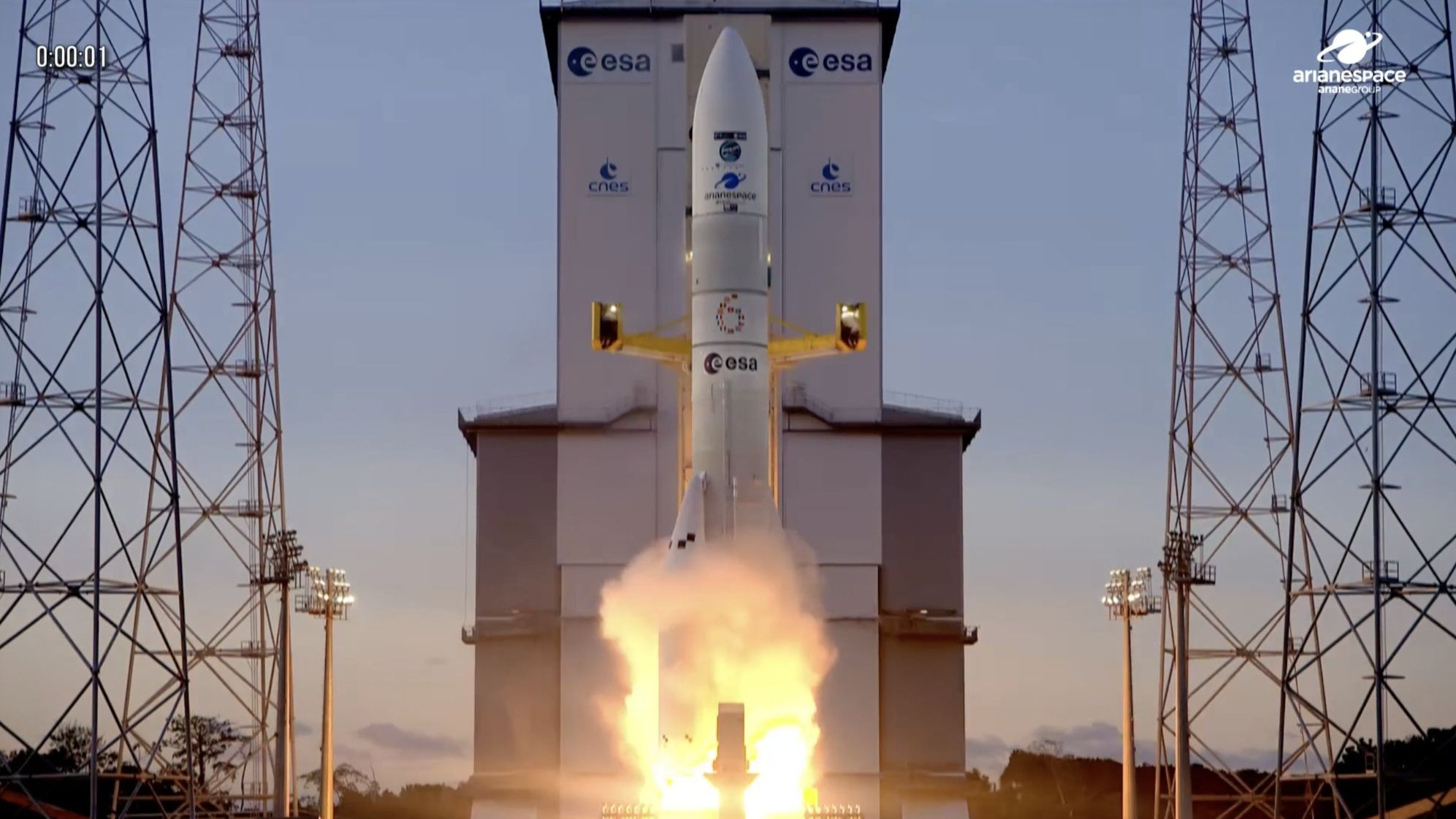
Ariane 6 Successfully Launches Sentinel-1D Earth Observation Satellite
Europe’s Ariane 6 heavy-lift rocket successfully launched today, November 4, 2025, carrying the Sentinel-1D Earth observation satellite to low Earth orbit.
The Ariane 6 lifted off from Europe’s Spaceport in Kourou, French Guiana, at 4:02 p.m. EST (2102 GMT; 6:02 p.m. local time). Approximately 33.5 minutes after liftoff, at an altitude of 440 miles (708 kilometers), the satellite deployed as planned. This launch is a crucial step in bolstering Europe’s independent access to space and its capacity for environmental monitoring.
Sentinel-1D is part of the European Union’s Copernicus Earth-observation program, and will replace Sentinel-1A, which has been in orbit for 11 years. The Sentinel-1 series utilizes radar imagery, operating in all weather conditions, day and night, providing vital data for disaster response, environmental agencies, and climate scientists. The satellite is equipped with both a C-band synthetic aperture radar (SAR) instrument for high-resolution imagery and an Automatic Identification System (AIS) to track ships. You can learn more about the Sentinel-1 mission on the European Space Agency website.
This successful launch marks the third consecutive successful operational flight for the Ariane 6, the successor to the Ariane 5 which retired in July 2023. Europe has now completed five orbital missions in 2025, including two launches by the Vega C smallsat launcher. Agency officials stated that Sentinel-1D will work in tandem with Sentinel-1C to generate timely data.
