
AC Milan defender Davide Bartesaghi is quickly emerging as a key player for the Rossoneri, underscored by a two-goal performance in a 3-1 victory over Sassuolo on January 24, 2024. The 20-year-oldS goals not only secured crucial points for Milan but also marked him as the youngest Italian to score in serie A since legendary defender Paolo Maldini in 1987, highlighting a potential new star in Italian football. This report examines Bartesaghi’s development from his youth academy days through his recent successes, and assesses his role within coach Allegri’s tactical setup.
Davide Bartesaghi, the young AC Milan defender, is quickly becoming a key figure for the Rossoneri after a stunning brace in their recent 3-1 victory over Sassuolo. The goals, scored on January 24, 2024, not only secured three points for Milan but also marked Bartesaghi as the youngest Italian player to score in Serie A since Paolo Maldini in 1987.
The 20-year-old’s rise has been closely watched since his days with Milan’s youth setup, Milan Futuro, in Serie C. A match against Ascoli on January 19, 2023, provided an early glimpse of his potential, showcasing both his technical skill and areas for development. He came on as a substitute in the 19th minute, displaying impressive ball control but struggling at times against the opposing right back, Manuel Alagna.
Give or receive a subscription to Ultimo Uomo this Christmas. It’s the easiest way to solve the “Christmas” question, feeling at peace with yourself and the universe (and, let’s be honest, with us too). Plus, Ultimo Uomo has enriched its offer this year: three different subscriptions, all with better deals than before, for even more exclusive content.
A tactical shift under coach Oddo, who replaced Bonera, saw Bartesaghi deployed as a left-sided center back in a 3-5-2 formation during a match against Pineto on March 11, 2023. The move proved effective, allowing Milan to leverage his technique and vision in possession. He operated almost as a playmaker from that position, dictating play from the back and showcasing a level of control rarely seen in Serie C.
Bartesaghi’s ability to drive forward with the ball, combined with his composure in tight spaces, quickly established him as a standout player in that role. His performance highlighted a clear advantage over his peers, suggesting he was a class above in Serie C when playing as a left center back.
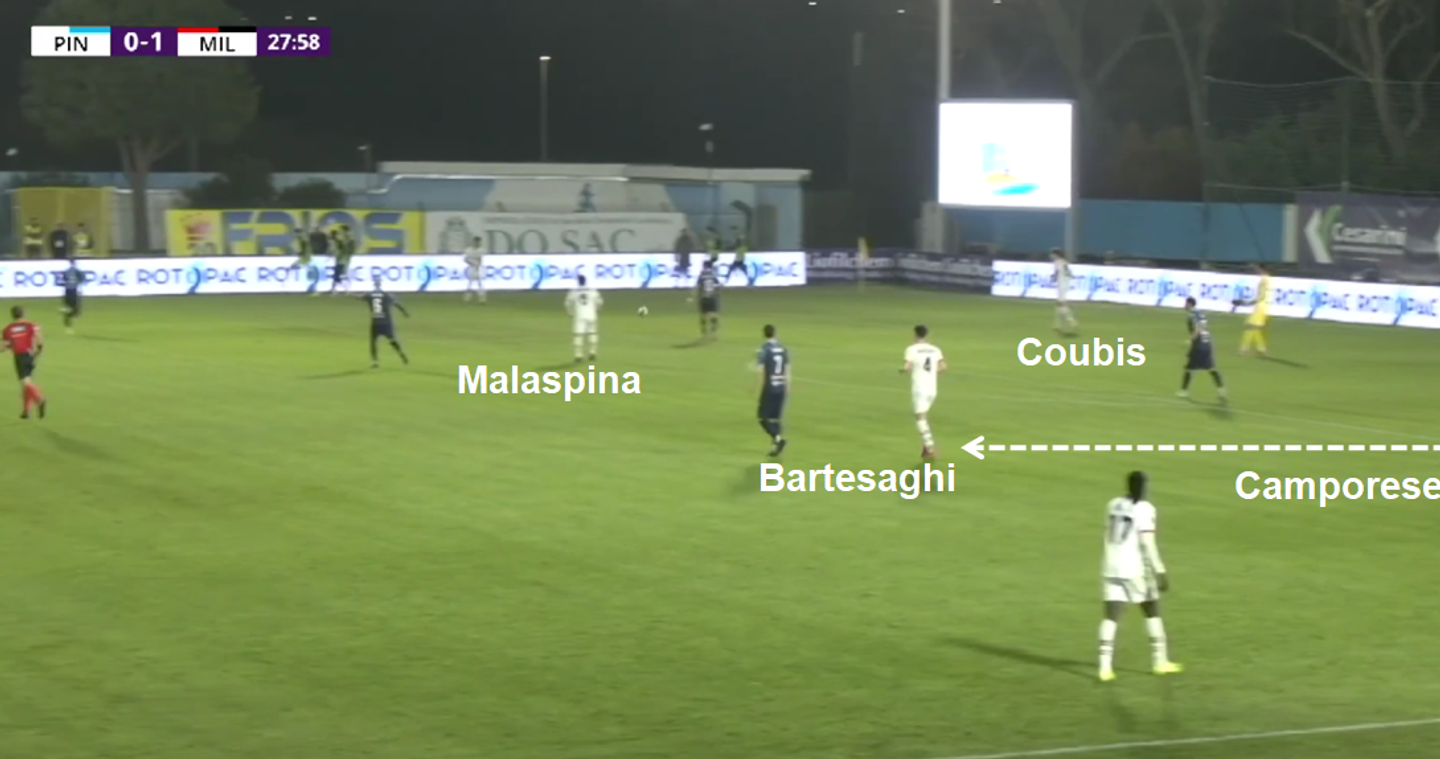
Camporese (the central defender) moves out of frame, with Bartesaghi joining play alongside midfielder Malaspina.
These early observations, from matches nearly a year ago, now seem particularly relevant in light of his recent success. They underscore both the strengths and weaknesses that are currently being discussed as Bartesaghi establishes himself as a regular starter for a Milan side challenging for top honors in Serie A.
The transformation has been remarkable. Initially, concerns about his physical conditioning hindered his ability to consistently break into the first team. He appeared to lag behind players like Alex Jimenez in terms of athleticism. Now, thanks to significant physical gains, Bartesaghi is a mainstay in the starting lineup under coach Allegri.
This isn’t simply about the two goals against Sassuolo – it’s a testament to his overall development and a reversal of earlier assessments. When Milan sold Jimenez to Bournemouth on loan with an option to buy in August, the left-back position was considered the most vulnerable area of the squad. Now, with Bartesaghi’s emergence and some adaptation challenges for Athekame, the right-back spot, occupied by Saelemaekers, appears to be the area of greatest concern.
The goals against Sassuolo were significant in their own right. His first came from a well-timed run onto the far post, while the second involved a clever inside run and a triangle combination with Pavlovic and Nkunku. Both finishes demonstrated the precision of his left foot, finding the corners of the goal beyond the reach of goalkeeper Muric.
THE IMPORTANCE OF BARTESAGHI TO MILAN
Beyond his talent, Bartesaghi represents a success story for Milan’s youth academy. He’s a local Lombardy native who has risen through the ranks, demonstrating the club’s growing commitment to developing homegrown talent. This narrative, alongside that of Gabbia, adds another layer of significance to the club’s youth project, which faced a setback with the recent relegation to Serie D.
“Playing in the derby as a starter is a dream I’ve had since I was a child, because I’ve always been a Milan fan, just like my father Daniele,” Bartesaghi said recently. “Hearing my name chanted by the curva… it gave me chills,” he added after the brace against Sassuolo. Bartesaghi, it seems, is living the dream.
While the excitement is palpable, a measured perspective is needed. Statistical comparisons to Maldini are premature, echoing the pitfalls that hampered the career of De Sciglio. Time will tell, but caution is warranted.
Allegri has primarily utilized Bartesaghi as a left-back, as a potential successor to Theo Hernandez, seemingly favoring him over Estupiñan due to his perceived defensive reliability. Interestingly, last season Bartesaghi struggled defensively, receiving a controversial red card against Lecce and being caught out of position on Carranza’s goal against Feyenoord, which eliminated Milan from the Champions League.
However, Allegri values Bartesaghi’s composure on the ball – a quality that contributes to the team’s overall stability. He appears more assured than Estupiñan under pressure, displaying greater precision in his control and passing, both in build-up play and in advanced areas. While Estupiñan may be more effective at delivering crosses on the run, Bartesaghi excels at crossing after receiving the ball in a more advanced position, similar to Dimarco.
Bartesaghi himself has stated that Spinazzola is the Serie A player he most admires, a left-back who, particularly after a serious injury, has adapted his game to receive the ball higher up the pitch, relying more on his technique and positional awareness.
Milan can afford a less explosive left-back because the team’s attacking threats often come from Rabiot, when fit, or Leao. The wing-backs are also supported by the forward runs of the two center backs. This was evident in the goal against Lazio, which originated from a cross by Tomori on the opposite side.
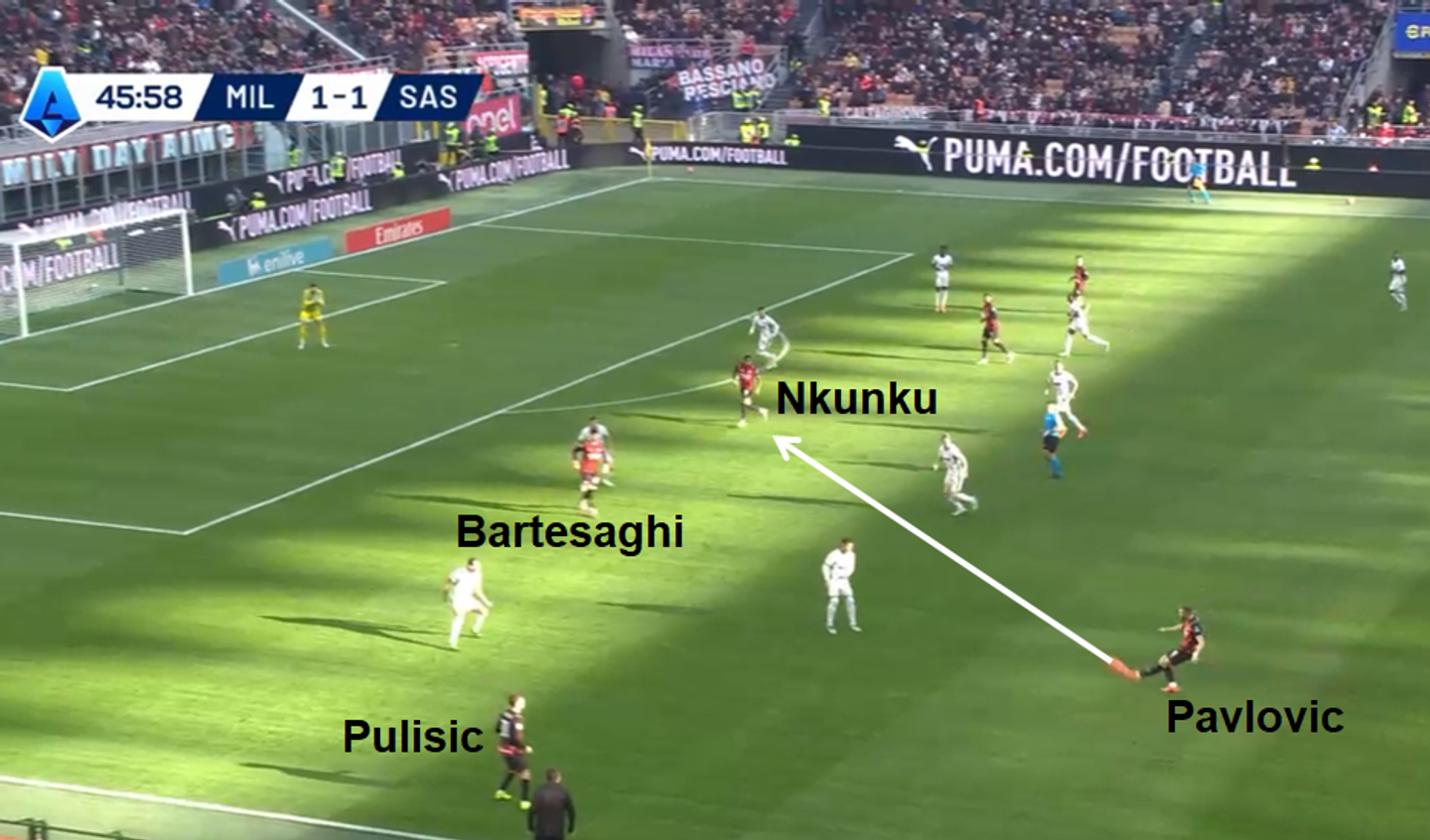
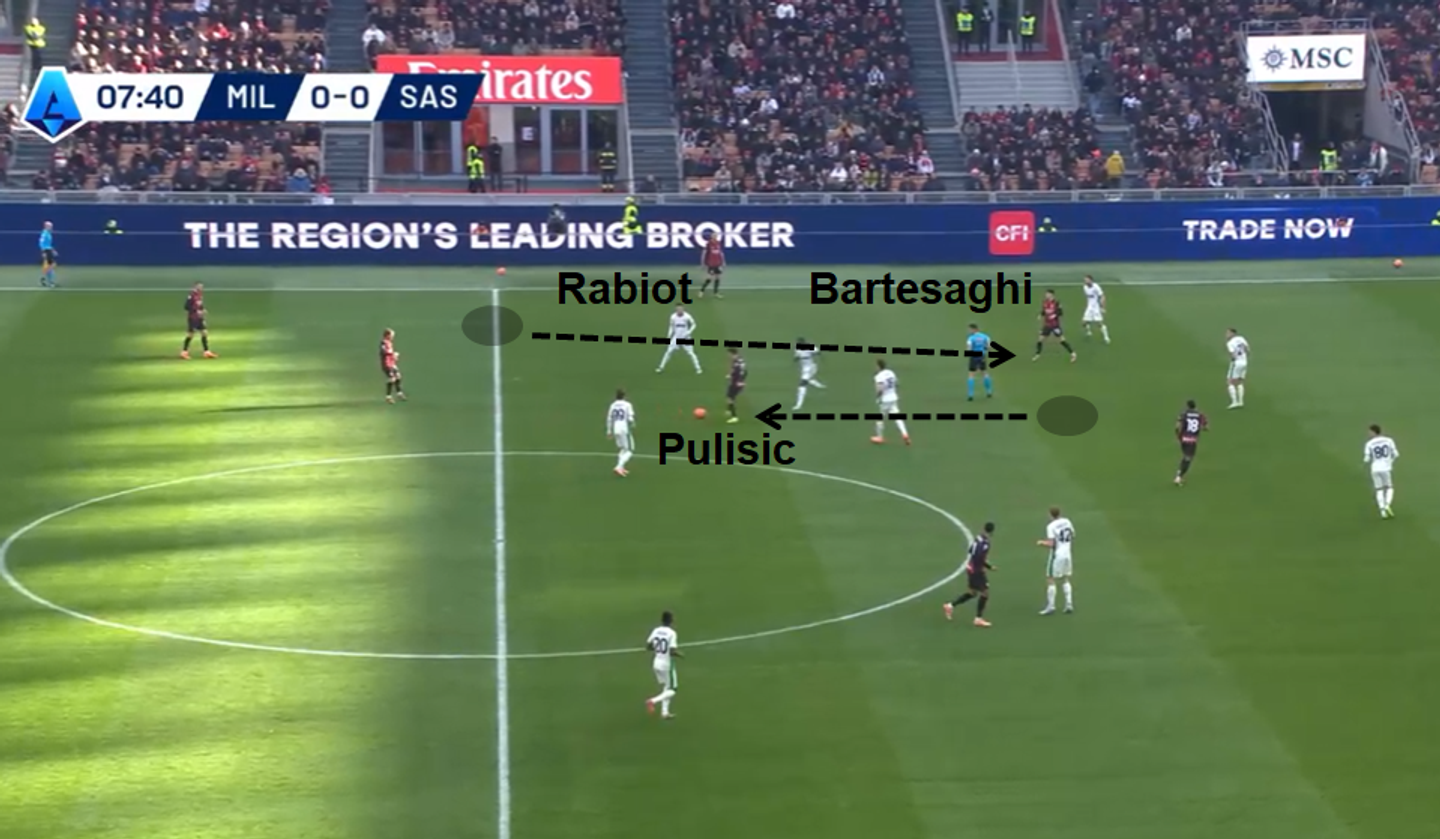
The second goal against Sassuolo stemmed from this positional fluidity, allowing Bartesaghi to attack a more central corridor. The other image shows him driving into the box, unafraid to receive the ball with his back to goal.
As Emanuele Mongiardo wrote, Milan “has more spontaneous moments of brilliance[[than Bologna and Como, n.d.a.], more closely linked to the way its players relate to the ball.” The same piece noted how Rabiot often drops deep into midfield to support the build-up, creating space for Bartesaghi to make forward runs from the start of the attack.
The same applies against compact defenses, such as Torino, where Pavlovic can drift wide and advance his position during build-up play. The aim, from Bartesaghi’s side, is always to allow him to deliver crosses from a static position, utilizing the precision of his left foot, rather than on the run.
He also frequently takes set pieces, even ahead of more established players, demonstrating Allegri’s trust in his ability in these situations. According to WhoScored, Milan is only 15th in Serie A for crosses per game and lacks a consistent goal-scoring center forward to capitalize on them. However, it’s reasonable to assume the two are interconnected.
In any case, Bartesaghi has a strong left foot when crossing: according to Hudl StatsBomb, he is by far the player at Milan who delivers the most crosses, and in Serie A, among players who cross frequently, he is one of those with the best success rates (47%).
FUTURE PROSPECTS
In an era where Italian football is often criticized for producing one-dimensional players, Bartesaghi stands out as a creative and technically gifted left-back. Only time will tell if he can evolve into a player more akin to Calafiori, a deep-lying playmaker, or Dimarco, a dynamic attacking threat. For now, his development will largely depend on the tactical context, the players around him, and the overall team strategy.
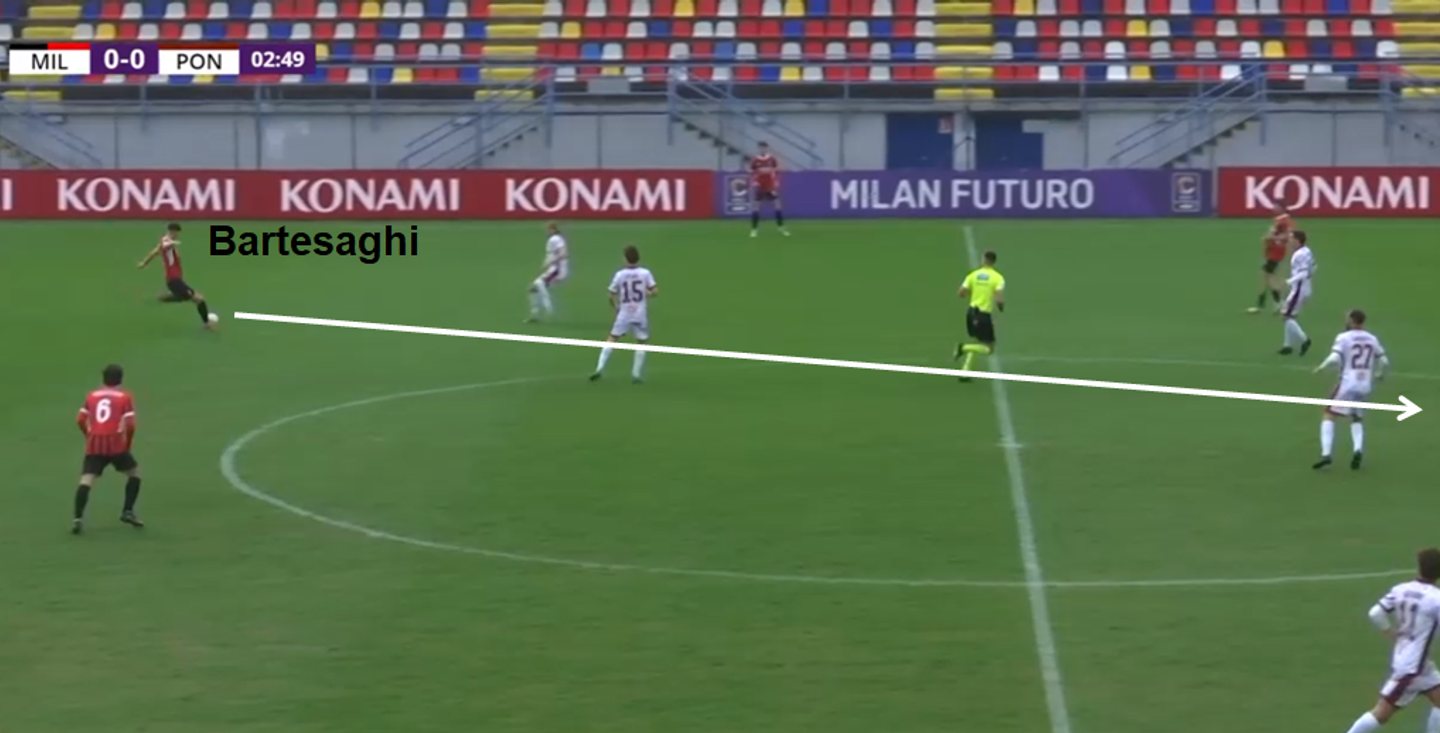
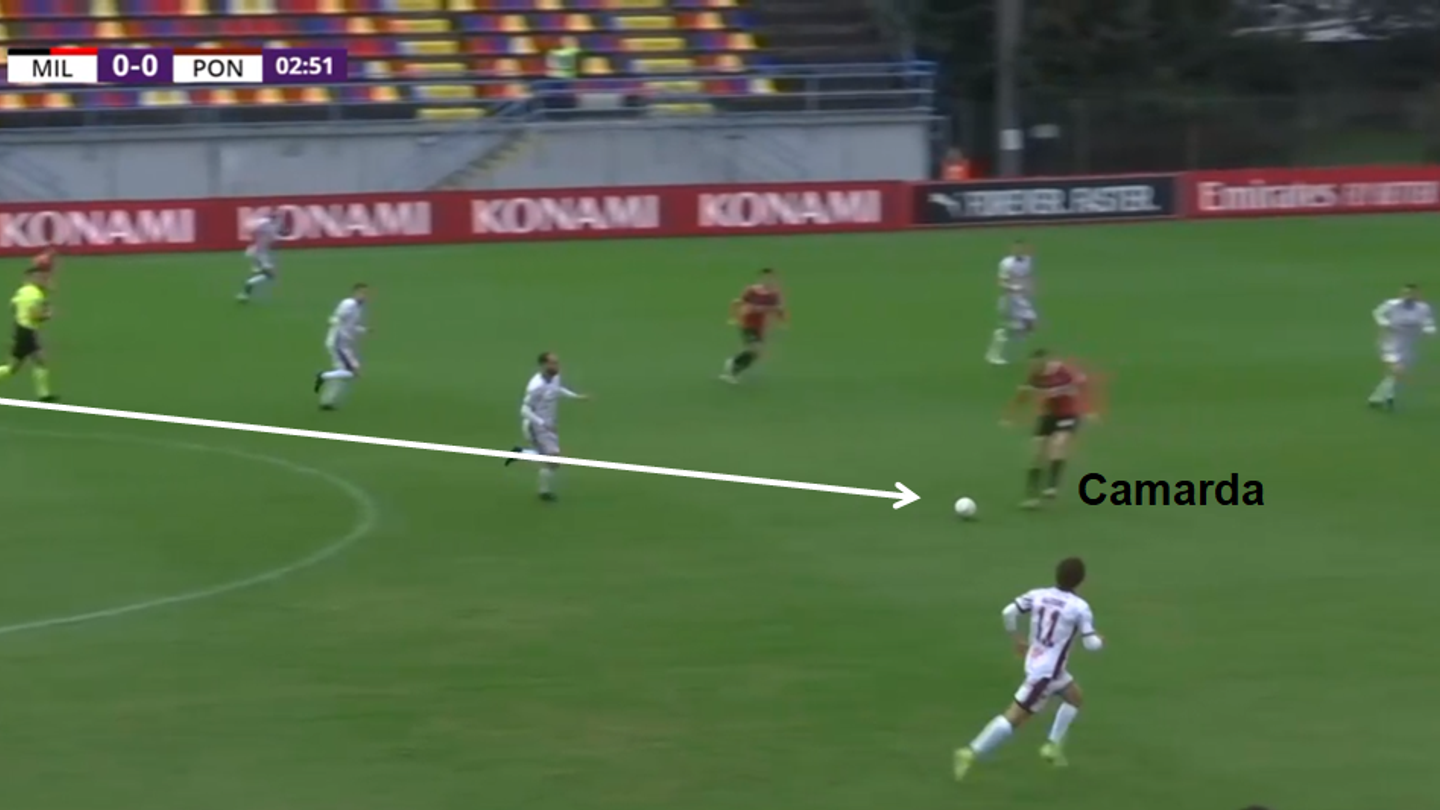
A through ball into the channels is one area where Bartesaghi can improve (he’s yet to complete one in Serie A). It’s a resource he possesses, as these examples from his time with Milan Futuro demonstrate.
It’s unlikely Bartesaghi will become a top player in a traditional back four, where athleticism and pace are paramount. His dribbling is neat and controlled in tight spaces, but lacks the explosive bursts of Theo Hernandez, Alphonso Davies, or Nuno Mendes. While approaching 20, Bartesaghi is already physically developed and may have limited room for improvement in terms of top speed, a quality that typically emerges at this age.
Bartesaghi is currently playing as a left-back in a four-man defense for Italy’s Under-21 team under Silvio Baldini, on the opposite side of another promising full-back with different qualities, Palestra. In qualifying matches for the 2027 European Championship, the “Azzurrini” don’t push their full-backs forward aggressively, instead relying on their wingers, Cherubini on the right and Koleosho on the left, to provide width, which suits Bartesaghi’s style.
In that role, Palestra appears more self-sufficient, more independent of the context. He can play higher up the pitch due to his excellent dribbling skills, but can also be effective in a back four, starting from deep and getting forward like a train. In short, there’s an athletic difference between the two that defines them as players.
Questions remain about his defensive qualities, particularly in one-on-one situations. Bartesaghi could potentially play as a left center back in a three-man defense in Serie A, perhaps in the event of Pavlovic’s absence, but would need concrete support in marking from the other two central defenders. He can’t currently guarantee the same level of solidity as the Serbian in individual duels, despite having played as a center back in Primavera and Serie C.
However, highlighting Bartesaghi’s technical abilities is the responsibility of all his current and future coaches, potentially including those of the national team. Especially because in the context of Italian football in the 2020s, seeing a new talent emerge who can master the game through technique is no longer a given.
The two goals against Sassuolo, however, are a positive sign, marking a starting point and a moment of individual brilliance. The result is a boost for Milan fans and a glimmer of hope that a turning point for Italian football may be on the horizon, alongside talents like Palestra, Pio Esposito, and Camarda.
