
A remarkably well-formed spiral galaxy, dubbed Alaknanda by its discoverers, is challenging established theories about the early universe. Located 1.5 billion years post-Big Bang,the galaxy’s surprisingly mature structure was identified by a team of Indian astronomers using data from the James Webb Space Telescope. This discovery suggests galactic growth may have occured far more rapidly than previously understood, prompting a reevaluation of current cosmological models.
A spiral galaxy, remarkably similar to our own Milky Way, has been observed at a time in the universe when such structures were not expected to exist. Astronomers in India identified the surprisingly mature system just 1.5 billion years after the Big Bang, a discovery that challenges current understanding of galactic evolution.
READ ALSO
The James Webb Space Telescope (JWST), capable of detecting the faintest light from the early universe, enabled researchers Rashi Jain and Yogesh Wadadekar to observe a galaxy astonishingly similar to our own. The telescope’s advanced capabilities are revolutionizing our understanding of the cosmos.
They named the galaxy Alaknanda, after the Himalayan river that is one of the twin headstreams of the Ganges, and whose name in Hindi also designates the Milky Way. The study, conducted at the National Centre for Radio Astrophysics of the Tata Institute of Fundamental Research (NCRA-TIFR) in Pune, was published in Astronomy & Astrophysics.
A Challenge to Existing Theory
For decades, astronomers have maintained that “grand design” spiral galaxies, with two well-defined symmetrical arms, require billions of years to form. This view held that the early universe should have been populated by chaotic, irregular structures still in the process of assembly.
Alaknanda contradicts these ideas. It exhibits two spiral arms winding around a prominent central bulge, and spans approximately 30,000 light-years. Furthermore, it’s forming new stars at a rapid pace – the equivalent of 60 suns each year, roughly twenty times the rate of the current Milky Way. An estimated half of its stars were born in just 200 million years.
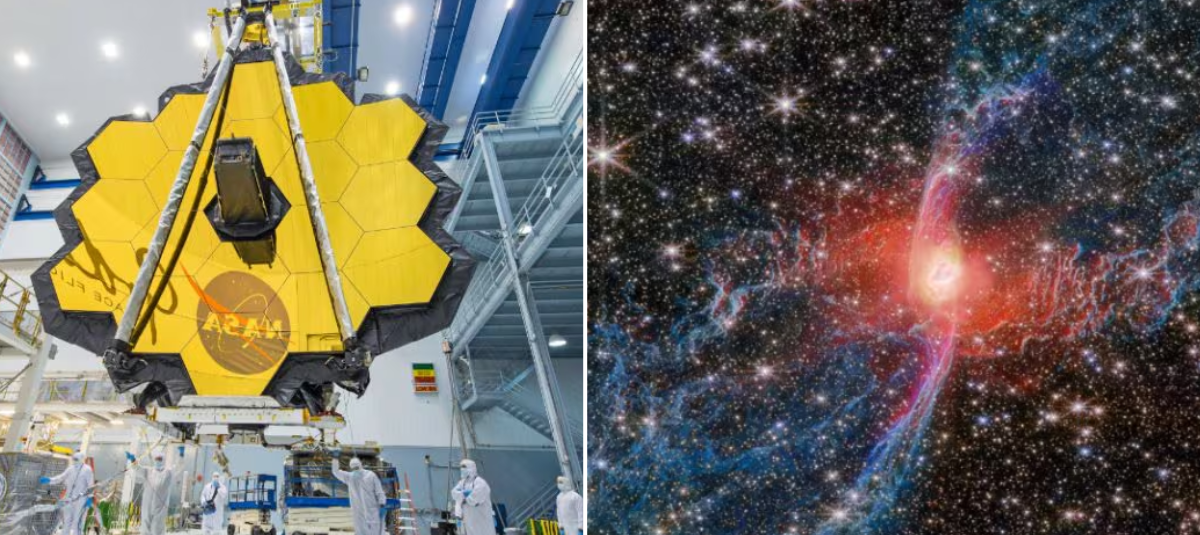
Image from the James Webb Space Telescope. Photo:Nasa
“Alaknanda possesses the structural maturity we associate with galaxies billions of years older,” explains Jain. “Finding such a well-organized spiral disk at this epoch tells us that the physical processes driving galaxy formation can operate much more efficiently than current models predict. It forces us to rethink our theoretical framework.”
A Cosmic Magnifying Glass
The galaxy is located in the direction of the Abell 2744 cluster, also known as the Pandora Cluster. The cluster’s immense gravity acts as a natural lens, magnifying the light from more distant objects – a phenomenon known as gravitational lensing. This effect allowed JWST to capture the spiral structure of Alaknanda with clarity.
Jain and Wadadekar analyzed images taken through 21 different filters, enabling them to accurately estimate the galaxy’s distance, dust content, number of stars, and the rate at which it has been forming them. The data comes from the JWST’s Uncover and MegaScience programs.
The finding adds to other recent observations revealing that the early universe was more mature than previously thought. While other disk-shaped galaxies have been identified at similar distances, Alaknanda stands out as one of the clearest examples of a grand design spiral at such an early stage.
“Alaknanda reveals that the early universe was capable of much faster galactic assembly than we anticipated,” says Wadadekar. “Somehow, this galaxy managed to assemble ten billion solar masses worth of stars and organize them into a beautiful spiral disk in just a few hundred million years. That’s extraordinarily fast in cosmic terms, and compels astronomers to reconsider how galaxies form.”
READ ALSO
Rewriting Cosmic History
The formation of its spiral arms remains an enigma. One possibility is that the galaxy grew steadily by feeding on streams of cold gas, allowing density waves to shape the arms. Another option is that a gravitational interaction with a smaller galaxy triggered the structure’s formation.
Future observations with JWST’s spectroscopic instruments or the ALMA radio telescope could measure the disk’s rotational speed and its level of internal order, determining whether its dynamics are “cold” or “hot” – a key to understanding its origin.
But beyond the structural mystery, Alaknanda’s existence redraws the timeline of the universe. It suggests that the conditions for forming complex structures – and eventually worlds like our own – may have appeared much earlier than imagined.
REDACCIÓN CIENCIA
