Astronomers have identified a massive,rotating structure of galaxies and dark matter spanning millions of light-years,offering a new outlook on the universe’s large-scale organization. The discovery, led by researchers at the University of Oxford, reveals a filament of at least 14 galaxies exhibiting coordinated rotation – a phenomenon previously unseen at this scale[[1]], [[2]], and [[3]]. This finding promises to refine our understanding of galactic evolution and the distribution of matter throughout the cosmos.
A rotating structure spanning millions of light-years has been identified by an international team of astronomers, revealing a previously unseen scale of cosmic organization. The discovery offers new insights into how galaxies acquire their spin and how matter is distributed throughout the universe.
Researchers led by the University of Oxford have uncovered a massive structure that appears to be rotating – a phenomenon not observed at this scale before. The cosmic formation is comprised of filaments of galaxies, gas, and dark matter, its presence revealed by the arrangement of the galaxies themselves and how their light patterns appear to telescopes. You can find more details about the research here.
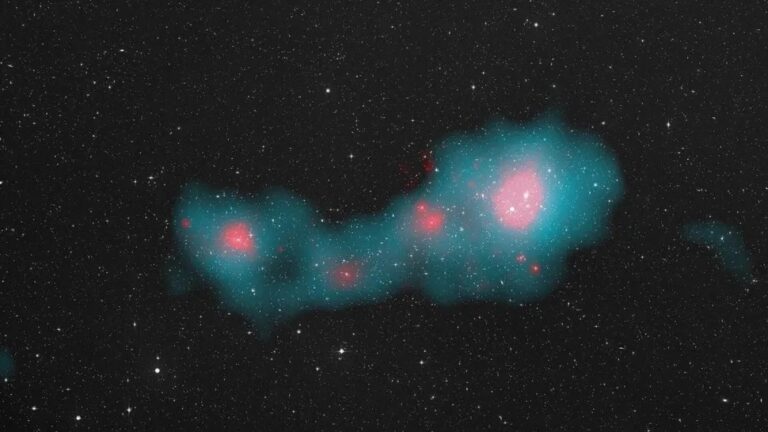
While cosmic filaments have been detected previously, they are typically smaller in size. This newly observed structure contains at least 14 galaxies arranged in a filament 5.5 million light-years long and 117,000 light-years wide. Both the structure and the galaxies within it are rotating in a coordinated fashion, with a rotational speed of approximately 110 km/s, according to dynamical modeling.
“It’s a bit like a roundabout with teacups. Each galaxy is like a teacup spinning around, but the whole platform – the cosmic filament – is also rotating.”
“This dual motion provides a rare glimpse into how galaxies acquire their rotation from the larger structures surrounding them,” explains Dr. Lyla Jung, a participant in the research, in a statement from the Royal Astronomical Society.
The researchers believe the structure is relatively young, and its galaxies are gas-rich, actively evolving systems. What makes the structure even more remarkable is that it’s part of an even larger cosmic web, containing approximately 280 galaxies stretching 50 million light-years in length – more than 500 times the diameter of the Milky Way.
These immense filaments play a crucial role in the universe, acting as cosmic highways or channels through which matter and gas flow, ultimately building galaxies. Understanding these structures is key to mapping the large-scale architecture of the cosmos.
“Cosmic filaments are the largest known structures in the universe: immense, thread-like formations of galaxies and dark matter that form a cosmic skeleton. These filaments act as ‘highways’ along which matter and momentum flow into galaxies.” – writes the Royal Astronomical Society.
(Photo: Lyla Jung)