
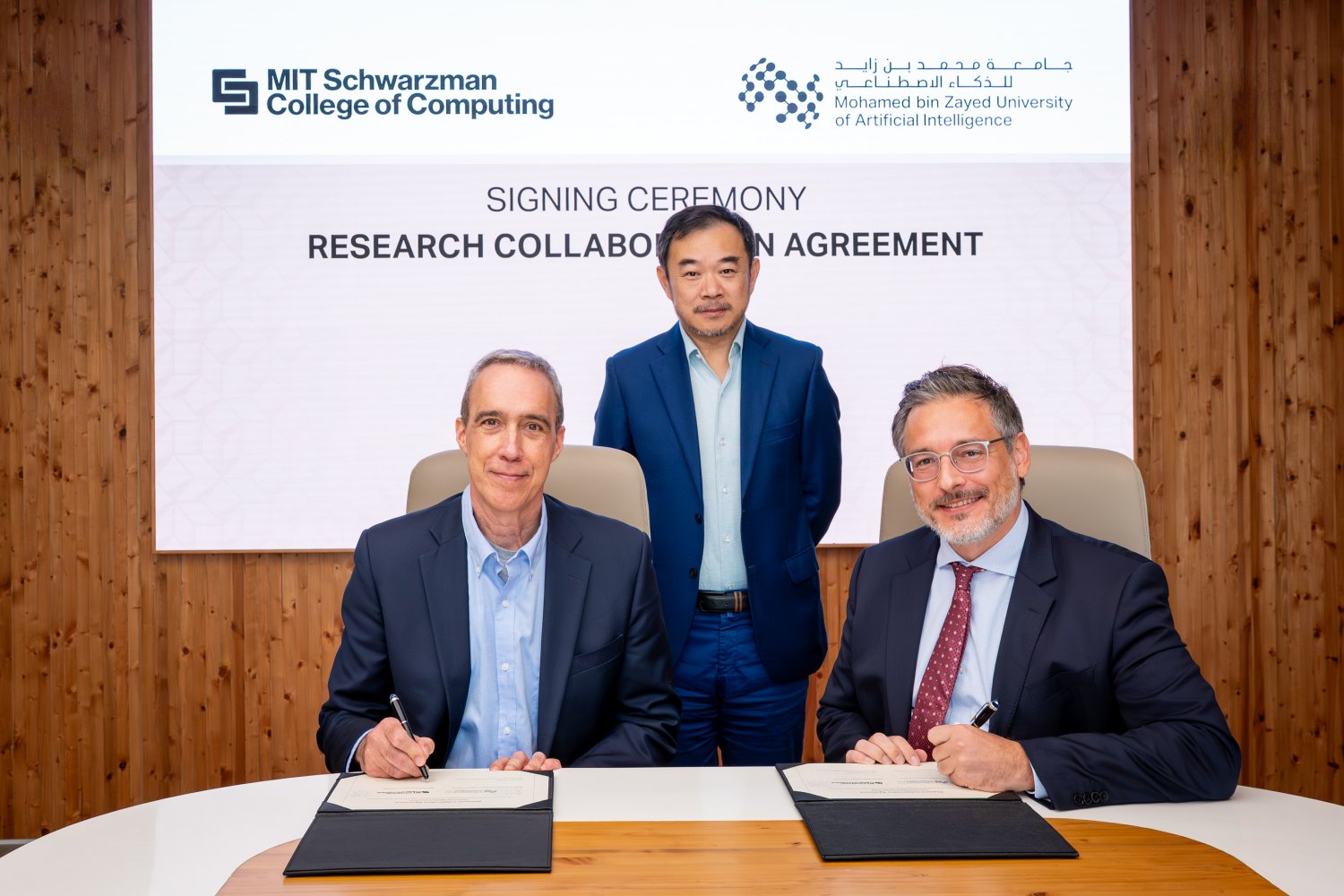
MIT and MBZUAI Launch Collaborative AI Research Program
A new partnership between the MIT Schwarzman College of Computing and the Mohamed bin Zayed University of Artificial Intelligence (MBZUAI) was launched today to accelerate advancements in artificial intelligence and its application to global challenges.
Under a five-year agreement, faculty, students, and research staff from both institutions will jointly conduct fundamental research focused on three core areas: scientific discovery, human thriving, and the health of the planet. The program, supported by MBZUAI based in Abu Dhabi, U.A.E., will fund multiple joint research projects annually, with findings published openly. This collaboration aims to address the growing need for responsible and impactful AI development as the technology rapidly evolves.
“Artificial intelligence is transforming nearly every aspect of human endeavor,” said Dan Huttenlocher, dean of the MIT Schwarzman College of Computing. “Our collaboration with MBZUAI reflects a shared commitment to advancing AI in ways that are responsible, inclusive, and globally impactful.” Eric Xing, president and university professor at MBZUAI, added, “By combining MBZUAI’s focus on foundational models and real-world deployment with MIT’s depth in computing and interdisciplinary innovation, we are creating a transcontinental bridge for discovery.” Researchers will explore areas like DARPA’s AI Exploration programs, furthering the field.
Philip Isola, Class of 1948 Career Development Professor at MIT, and Le Song, professor of machine learning at MBZUAI, will serve as academic directors overseeing the program on their respective campuses. Project selections will be determined by a steering committee comprised of representatives from both institutions, ensuring a balanced and focused research agenda. MIT’s Schwarzman College of Computing has been a leader in AI research for decades.
Officials stated that the collaboration will foster a continuous exchange of knowledge and expertise, driving innovation and ensuring AI breakthroughs are applied to address critical global issues.
The MIT Schwarzman College of Computing and the Mohamed bin Zayed University of Artificial Intelligence (MBZUAI) recently celebrated the launch of the MIT–MBZUAI Collaborative Research Program, a new effort to strengthen the building blocks of artificial intelligence and accelerate its use in pressing scientific and societal challenges.
Under the five-year agreement, faculty, students, and research staff from both institutions will collaborate on fundamental research projects to advance the technological foundations of AI and its applications in three core areas: scientific discovery, human thriving, and the health of the planet.
“Artificial intelligence is transforming nearly every aspect of human endeavor. MIT’s leadership in AI is greatly enriched through collaborations with leading academic institutions in the U.S. and around the world,” says Dan Huttenlocher, dean of the MIT Schwarzman College of Computing and the Henry Ellis Warren Professor of Electrical Engineering and Computer Science. “Our collaboration with MBZUAI reflects a shared commitment to advancing AI in ways that are responsible, inclusive, and globally impactful. Together, we can explore new horizons in AI and bring broad benefits to society.”
“This agreement will unite the efforts of researchers at two world-class institutions to advance frontier AI research across scientific discovery, human thriving, and the health of the planet. By combining MBZUAI’s focus on foundational models and real-world deployment with MIT’s depth in computing and interdisciplinary innovation, we are creating a transcontinental bridge for discovery. Together, we will not only expand the boundaries of AI science, but also ensure that these breakthroughs are pursued responsibly and applied where they matter most — improving human health, enabling intelligent robotics, and driving sustainable AI at scale,” says Eric Xing, president and university professor at MBZUAI.
Each institution has appointed an academic director to oversee the program on its campus. At MIT, Philip Isola, the Class of 1948 Career Development Professor in the Department of Electrical Engineering and Computer Science, will serve as program lead. At MBZUAI, Le Song, professor of machine learning, will take on the role.
Supported by MBZUAI — the first university dedicated entirely to advancing science through AI, and based in Abu Dhabi, U.A.E. — the collaboration will fund a number of joint research projects per year. The findings will be openly publishable, and each project will be led by a principal investigator from MIT and one from MBZUAI, with project selections made by a steering committee composed of representatives from both institutions.
