
In a groundbreaking achievement, astronomers have, for the first time, captured X-ray images of an interstellar comet, 3I/Atlas.The observations, made by JAXA’s Xrism mission in collaboration with ESA and NASA between November 26-28, offer a unique glimpse into the properties of objects originating outside our solar system-a realm previously unseen in X-ray light[[1]]. This “target of prospect” observation highlights the growing capabilities of modern telescopes to rapidly respond to significant astronomical events[[2]].
For the first time, astronomers have captured X-ray images of an interstellar comet, offering new insights into the composition and behavior of objects originating outside our solar system. The comet, designated 3I/Atlas, was observed using the Xtend telescope aboard the Japan Aerospace Exploration Agency’s (JAXA) Xrism mission, a collaborative effort with ESA and NASA.
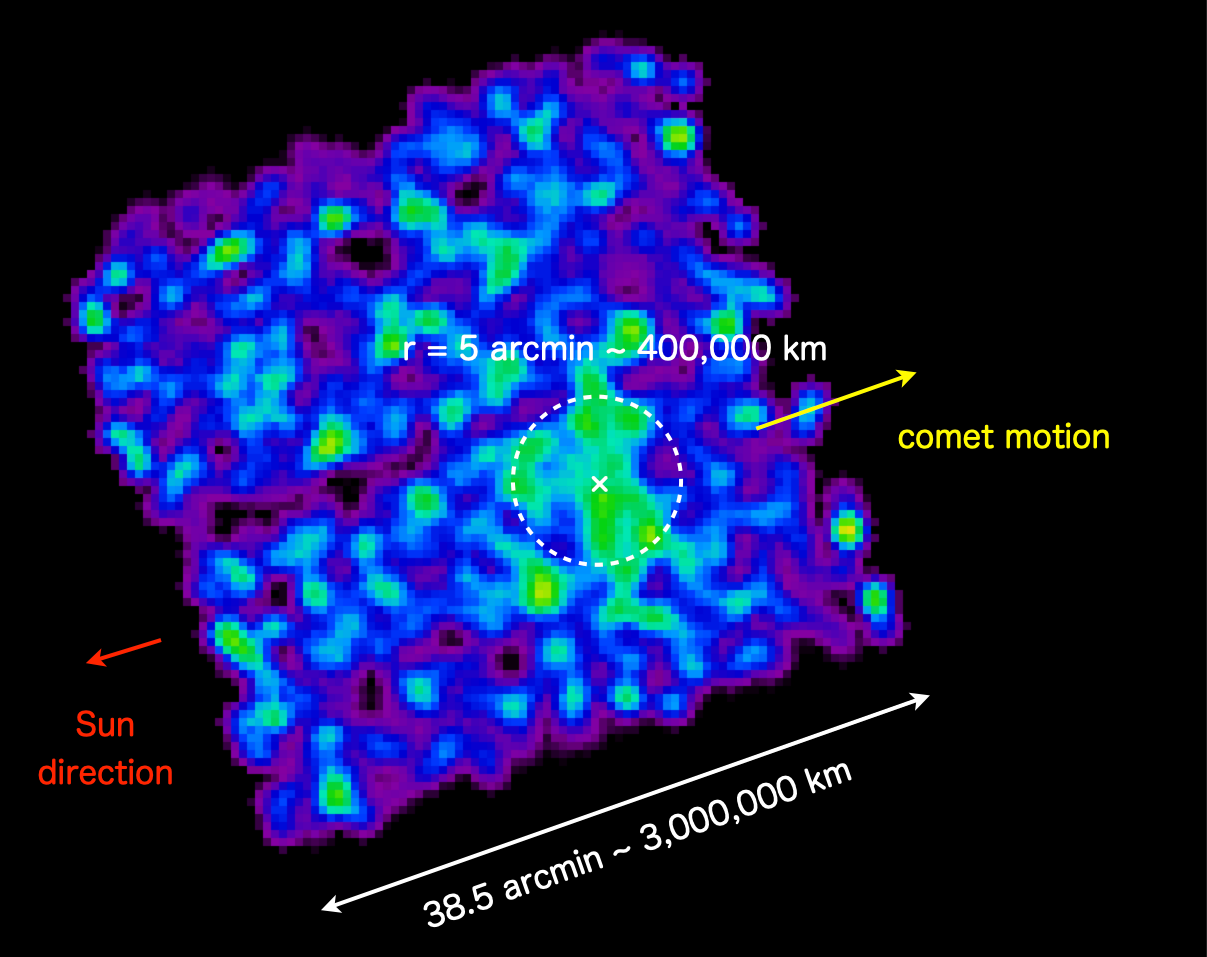
X-ray image of comet 3I/Atlas captured by the Xtend telescope, onboard JAXA’s Xrism mission. The instrument’s field of view covers an area around the comet of approximately three million kilometers across, revealing an X-ray emission structure (indicated by the white dashed circle) extending about 400,000 kilometers around the comet. Credits: JAXA
The observations, conducted between November 26 and November 28, involved a total exposure time of 17 hours. This was part of a “target of opportunity” program, allowing for the rapid scheduling of observations for scientifically significant events. The ability to quickly redirect powerful telescopes like Xrism demonstrates the agility of modern astronomical research.
Researchers aimed to determine whether interstellar comets emit X-rays in a similar manner to comets within our solar system, or if they exhibit distinct characteristics. Previously, no objects originating from outside our solar system had been detected in this part of the electromagnetic spectrum. The resulting image confirms that these objects are capable of emitting X-rays.
Analysis of the Xrism data revealed a diffuse X-ray glow (indicated by the white dashed circle in the image) extending approximately 400,000 kilometers around the comet – a distance comparable to that between the Earth and the Moon. Scientists hypothesize that this X-ray emission is generated by the interaction between the solar wind – the stream of charged particles emitted by our Sun – and gases released from the comet, including water vapor, carbon dioxide, and carbon monoxide.
Comets are surrounded by gas clouds created when sunlight heats and vaporizes their icy surfaces. When this gas interacts with the energetic flow of charged particles from the Sun – the solar wind – a process called charge-exchange ionization occurs, producing X-ray emission. Data from Xrism’s high-resolution X-ray spectrometer, Resolve, further supports this interpretation, revealing the presence of carbon, nitrogen, and oxygen around the comet’s nucleus – key components of these compounds.
The X-ray observation of 3I/Atlas, also supported by data from other missions such as ESA’s XMM-Newton (acquired on December 3), represents a significant step forward in understanding the physical and chemical properties of interstellar objects. These X-ray images, combined with observations across other wavelengths, suggest that despite originating from a distant star system, the comet behaves similarly to comets native to our solar system, following the same physical processes astronomers have long observed in our cosmic neighborhood.
