
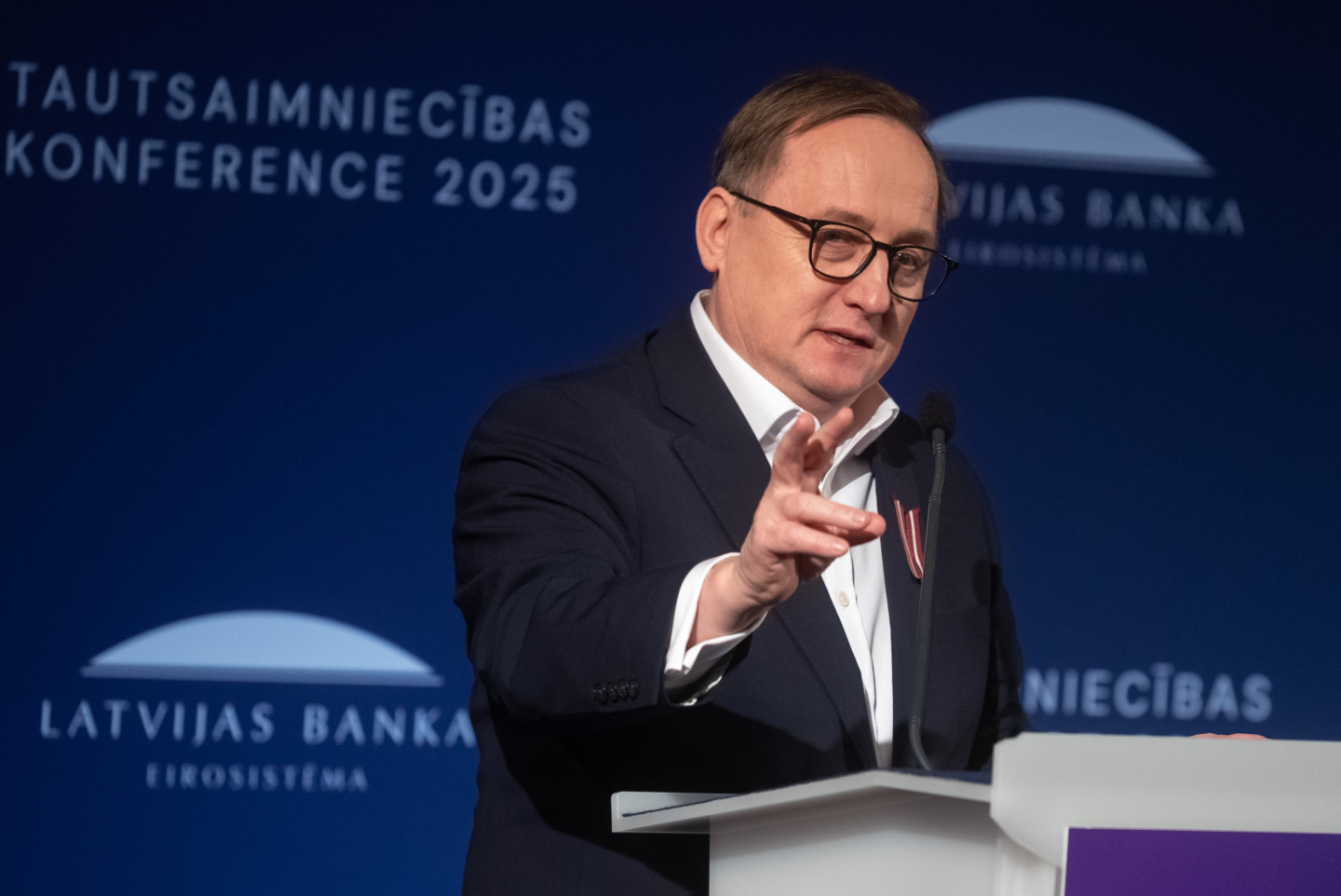
Latvia‘s central bank hosted a national economic conference this week aimed at addressing stalled lending growth, but key questions about restrictions on cash transactions and the true state of the country’s financial health went unanswered by top officials.
The event, which included Prime Minister Evika Siliņa and bank of latvia President Mārtiņš Kazāks, highlighted a discrepancy between optimistic growth figures and more moderate data revealed in the bank’s quarterly reports, raising concerns about the sustainability of recent lending increases. A complex new “Solidarity Tax Law” also factors into the equation, creating incentives – and potential complications – for banks’ lending practices.
Latvian officials, including Prime Minister Evika Siliņa and the head of the country’s central bank, did not address restrictions on large cash transactions during a recent conference on lending, raising questions about potential impacts on credit availability.
The Bank of Latvia hosted its annual national economy conference this year focusing on the question of “How to Increase Lending Capacity in Latvia?” Organizers noted in event materials that lending had stalled in 2023, but indicated a turning point has been reached.
Central Bank Head Expresses Frustration with Discussions
Table of Contents
Both mortgage and business lending have increased this year, not only compared to the previous year’s low levels but also relative to other Eurozone countries. While the Bank of Latvia highlighted these achievements, officials also voiced concerns about the sustainability of the lending growth.
During the conference’s opening remarks, Bank of Latvia President Mārtiņš Kazāks called for “daring to discuss things that are not always pleasant, to confront different points of view.” However, in his closing speech, he expressed frustration that a productive exchange hadn’t fully materialized. “In some cases, it seemed we were trying to be very friendly. Fine, okay. There’s no point in publicly bickering, but to achieve good results, we need those opposing… [a clear pause is audible in a recording of the conference], opposing viewpoints, which sometimes we are reluctant to… Well, again, that countercurrent… We know that. But we will achieve good results only if we can combine opposing views and understand how to move forward together.”
Further analysis suggests reasons to doubt the continued growth of lending, and why Kazāks has avoided directly addressing those concerns.
Statistics Can Be Interpreted in Multiple Ways
The way data is presented can influence perceptions, and the Bank of Latvia showcased figures suggesting a positive trend. Kazāks stated that “credit growth is close to 15% this year compared to the previous year, which means that lending has become a driver of the economy, pulling the economy forward, creating opportunities to improve the quality of life for residents and for businesses to grow.”
However, a different picture emerges from the Bank of Latvia’s quarterly reports on the supervision of commercial banks. These reports, which provide a snapshot of bank assets as of June 30, show a more moderate pace of lending growth than discussed at the conference. While lending growth does outpace the country’s gross domestic product (GDP) growth, the increase isn’t as substantial as initially presented.
In the first half of this year, the portion of bank credit portfolios allocated to non-bank borrowers increased by roughly the same amount as it did during all of last year. However, the quarterly reports also reveal that the nominal growth of credit portfolios hasn’t kept pace with inflation:
The table shows that the volume of loans issued by banks to non-banks increased by €4.14 billion between December 31, 2020, and June 30, 2025 – a rise of just over one-third. According to the Central Statistical Bureau, the cumulative inflation rate for the same period was 39.4%, an increase from 20,680 points to 28,821 points in the index.
This suggests that bank lending only partially offsets the loss of purchasing power caused by rising prices. While banks are helping the economy function, it’s difficult to characterize this as genuine development.
Law Passed to Incentivize Lending
The debate over whether economic growth drives lending or lending drives economic growth has long been a point of contention in Latvia. The government intervened with financial penalties for banks that didn’t issue enough loans.
In December of last year, the Saeima (Latvian parliament) passed and the President signed the Solidarity Tax Law, imposing a special levy on bank revenues in 2025, 2026, and 2027.
Article 2 of the law states that “the purpose of the law is to protect public safety in conditions of heightened national security risks, by generating additional financial resources to ensure the state’s national security fiscal needs.” However, Article 6 reveals that the state is willing to waive the levy for banks whose “credit growth rate during the payment period exceeds at least 1.75 times the projected annual growth rate of gross domestic product… used in the law on the state budget.”
The formula is complex, but the effect is that the state will receive approximately €90 million this year and €110 million next year, while borrowers will have access to a larger amount of money that banks are willing to distribute. Uldis Cērps, head of the Financial Industry Association (formerly the Commercial Bank Association), provided the bank payment forecasts at the conference. He argued that this money will simply be diverted from borrowers because the state is collecting it. This logic was questioned by Uldis Rutkaste, head of the Monetary Policy Department at the Bank of Latvia, who asked Cērps, “Isn’t the causality reversed – did these measures come about because lending was weak, not that lending was weak because of these measures?”
Cērps responded at length about why banks reduced lending after the 2008 economic crisis, avoiding a direct answer to Rutkaste’s question about “what prevented lending” when “household debt burdens were already low, bank credit quality was good, and interest rates were low or negative.” These characteristics clearly apply to the period after 2018, not after 2008, the effects of which had been overcome within 10 years. Cērps chose to portray himself as someone unfamiliar with the last decade of Latvian banking to avoid answering the question.
Latvia Confronts a Multi-Faceted Problem
The obstacles to lending remain a sensitive topic, one that officials are hesitant to discuss openly. The Bank of Latvia conference unfolded as if following a narrative similar to J.K. Rowling’s famous tale, or perhaps a satire, where characters are forbidden to utter Voldemort’s name.
The initial shock came on February 13, 2018, with allegations that ABLV Bank, registered in Latvia, was financing North Korea’s nuclear weapons program. The claim, reminiscent of a plot point from Rowling’s books, has never been substantiated, and the bank is no longer in operation. It was enough that the allegation was disseminated by the Financial Crimes Enforcement Network (FinCEN) of the U.S. Department of the Treasury.
The problem then resurfaced on August 23 of the same year, when the head of the Council of Europe’s Committee for the Prevention of Money Laundering and Financing of Terrorism arrived in Latvia, specifically in the cabinet of Prime Minister Māris Kučinskis, with threats of “economic consequences for Latvia.”
On October 3, Mārtiņš Kazāks paved his way from a member of the Bank of Latvia Council to the position of president with an announcement that “the main priority for the government next year must be to fulfill the requirements of ‘Moneyval.’” He has remained President of the Bank of Latvia since December 21, 2019.
The Latvian government has since acted in accordance with Kazāks’s recommendations. On January 23, 2019, the government of Krišjānis Kariņš, who replaced M. Kučinskis, began its work by removing the point regarding Latvia as a regional financial services center from the Financial Sector Development Plan on February 12. On February 20, K. Kariņš signed three orders regarding financial sector supervision, the essence of which was expressed in the famous phrase “capital repair.”
The “Muzzle” May Be Loosening, But Isn’t Removed
The words once enshrined in state planning documents about Latvia as a regional financial center did not authorize Latvian banks to engage in fraud or other crimes, but the deleted words were not replaced with a statement that the Latvian national economy should be simplified to a single dairy farm, two ice cream kiosks, and one bank – the latter being the most important, as it must ensure that ice cream buyers use only cashless payments and that reports on these transactions are delivered to FinCEN, “Moneyval,” and all others who have shouted loudest at Latvian officials at any time and in any volume. The move towards such a simplified Latvian economy and politics continues.
The conference took place in the Ziedonis Hall of the National Library of Latvia.
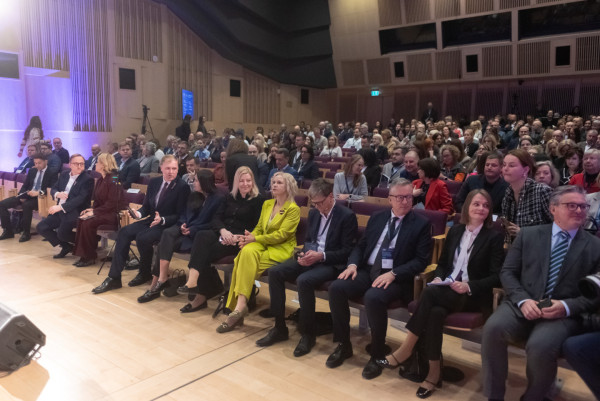
This location helped Andris Strazdums, Head of the LB General Secretariat, use the imagery of Imants Ziedonis’s “Uzpasakas.” Regarding Prime Minister Evika Siliņa’s introductory speech, he said that “in the context of ‘Uzpasakas,’ I would interpret it as the muzzle will become looser and sometimes it will be possible to remove it completely.”
Unfortunately, Siliņa’s kind words were not equivalent to the campaign with which the “muzzle” was placed on Latvia: there was the liquidation of a large bank, the demonstrative dragging of M. Kazāks’s predecessor, Ilmārs Rimšēvičs, to prison, and threats to disconnect Latvia from international payment systems. Until that campaign is erased with an equally powerful counter-campaign, the reduction of bank credit portfolios, if not in nominal terms, then in terms of the purchasing power of that portfolio, will continue.
