
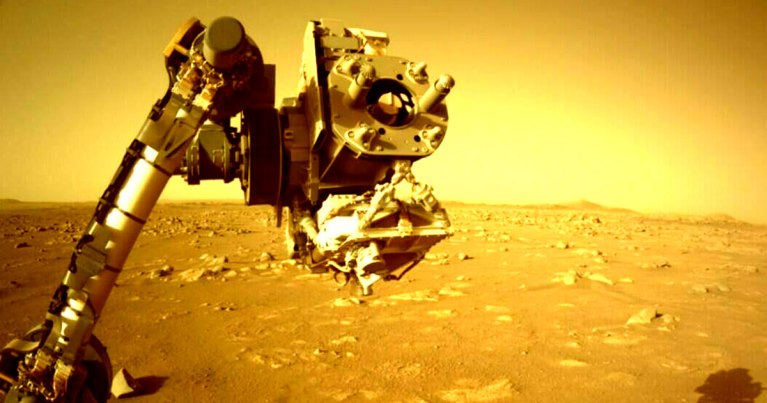
NASA’s Curiosity rover has uncovered the most diverse collection of organic molecules ever found on Mars, including seven compounds never before detected on the planet. The discovery comes from a rock sample nicknamed “Mary Anning 3,” drilled in 2020 from a clay-rich region of Mount Sharp in Gale crater, where ancient lakes and streams once flowed billions of years ago. After years of laboratory analysis, scientists confirmed the sample contains 21 carbon-containing molecules, with seven identified for the first time on Mars. These include diverse thermochemolysis products such as benzothiophene, methyl benzoate, and various aromatic compounds released during the Sample Analysis at Mars (SAM) instrument’s tetramethylammonium hydroxide wet chemistry experiment. The findings, published Tuesday in Nature Communications, indicate that complex organic matter can persist in Martian bedrock despite over 3.5 billion years of radiation exposure and geological alteration. Researchers emphasize that while the origin of these molecules—whether biological or geological—remains unknown, their presence confirms that ancient Mars possessed the necessary chemistry to support life. Curiosity’s Mastcam captured images of the surrounding clay-bearing terrain on February 3, 2019, providing context for the sampling site. The rover continues to explore the Glen Torridon region, where water-rich environments once existed, furthering the search for signs of past habitability on the Red Planet. The results contribute to a growing understanding that key organic compounds can survive on Mars over vast timescales, informing future missions aimed at uncovering the planet’s potential for life.
NASA Rover Discovers New Organic Molecules on Mars
1
