
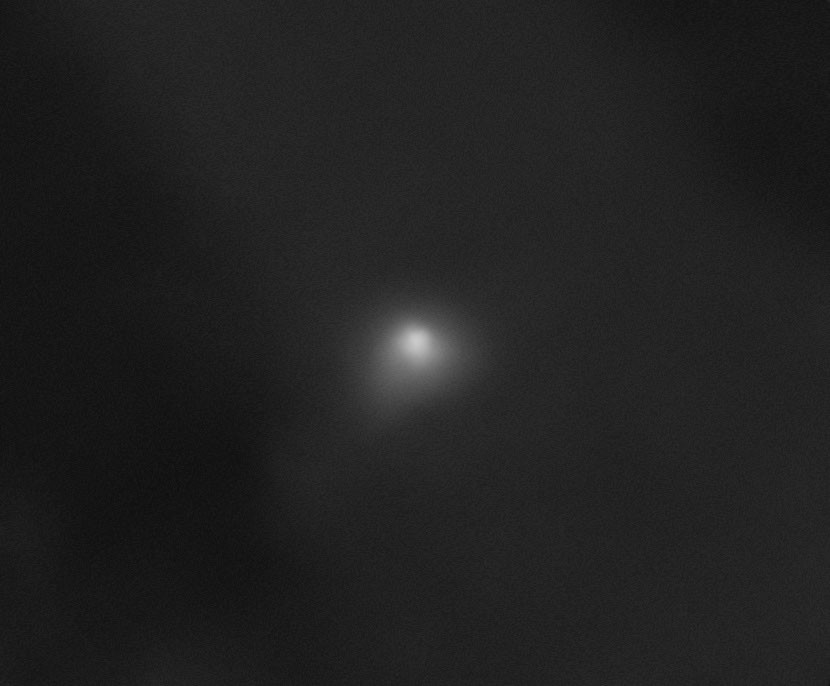
NASA is conducting an unprecedented, agency-wide observation campaign of interstellar comet 3I/ATLAS, one of only three confirmed to have passed through our solar system. Discovered July 1st by the ATLAS telescope in Chile, the comet is currently providing a unique opportunity for scientists to study an object originating beyond our sun. This coordinated effort, utilizing a dozen NASA assets and continuing through spring 2026, aims to better understand the composition of interstellar objects and the diversity of planetary systems across the galaxy.
Read this story in English here.
Nota de la editora: Este artículo se ha actualizado para incluir todas las fechas de la imagen adquirida por la misión SOHO.
Read this story in English here.
NASA is conducting an unprecedented, agency-wide observation campaign focused on 3I/ATLAS, only the third interstellar object confirmed to have passed through our solar system. Since its discovery on July 1, a dozen NASA assets have been capturing and processing images of the comet, with many more poised to gather data as it continues its journey. This coordinated effort offers a unique opportunity to study an object originating outside our solar system and compare its composition to those found within it.
The space agency’s observations are providing valuable insights into the differences between 3I/ATLAS and comets native to our solar system. The data collected will help scientists better understand the diversity of planetary systems beyond our own.
Some of the closest views of the comet have come from NASA spacecraft orbiting Mars. On October 3, 3I/ATLAS passed within 19 million miles (30.6 million kilometers) of the Red Planet, allowing three NASA missions to observe it. The Mars Reconnaissance Orbiter (MRO) captured some of the most detailed images, while the Mars Atmosphere and Volatile Evolution (MAVEN) orbiter obtained ultraviolet images that will aid in determining the comet’s composition. Even the Perseverance rover managed to catch a glimpse from the Martian surface.
Several of NASA’s heliophysics missions, designed to study the Sun and its influence on the solar system, have also been tracking 3I/ATLAS. These missions have a unique ability to observe areas of the sky close to the Sun, allowing them to monitor the comet even when it passed behind our star from Earth’s perspective. The Solar Terrestrial Relations Observatory (STEREO) captured images from September 11 to October 2, and the Solar and Heliospheric Observatory (SOHO)—a joint mission between NASA and the European Space Agency (ESA)—observed the comet on October 15 and 26. Images from NASA’s recently launched Polarimeter to Unify the Corona and Heliosphere (PUNCH) mission, which launched earlier this year, show the comet’s tail during observations between September 20 and October 3.
Notably, this marks the first time NASA’s heliophysics missions have intentionally observed an object originating from another solar system. The ability to study interstellar objects as they traverse our solar system is a relatively new field of astronomical research.
The Psyche and Lucy spacecraft, currently en route to study asteroids, also contributed to the observation campaign. On September 8 and 9, Psyche acquired four observations of the comet over eight hours from a distance of 33 million miles (53 million kilometers). These images will help refine the comet’s trajectory. Lucy captured a series of images on September 16 from 240 million miles (386 million kilometers) away, which, when combined, reveal details of the comet’s coma and tail.
3I/ATLAS was initially discovered on July 1 by the Asteroid Terrestrial-impact Last Alert System (ATLAS) telescope in Chile, which is funded by NASA. Later that month, the Hubble Space Telescope captured images of the comet. In August, both the James Webb Space Telescope and the Spectro-Photometer for the History of the Universe, Epoch of Reionization and Ices Explorer (SPHEREx) also obtained images.
The comet will make its closest approach to Earth around December 19, at a distance of 170 million miles (274 million kilometers)—nearly twice the distance between Earth and the Sun. NASA spacecraft will continue to observe 3I/ATLAS as it travels through the solar system, eventually passing the orbit of Jupiter in the spring of 2026.
More information about NASA’s observations of comet 3I/ATLAS is available on the agency’s website: https://go.nasa.gov/3I-ATLAS
Learn more about comet 3I/ATLAS in Spanish on the website: ciencia.nasa.gov/3iatlas
