
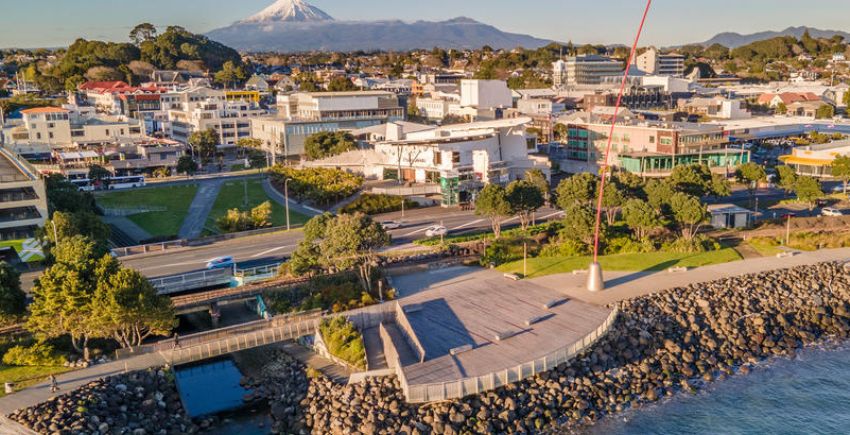
New Plymouth’s decades-old dispute over stolen land has reached a critical juncture, with the city’s iwi liaison committee formally declaring its support for returning a 33-hectare block to Puketapu hapū—setting a precedent that could reshape how local councils handle Māori land claims. The Mangati E block, seized under the Public Works Act in 1968 for a now-defunct sewerage project, sits idle as pasture and wetlands near the city’s coast, while Puketapu has fought for its return since 2010.
The Betrayal of Trust: How New Plymouth Council Seized and Abandoned Puketapu Hapū Land
The story begins with a betrayal of trust. In 1968, New Plymouth District Council (NPDC) took control of Mangati E—a 33-hectare parcel of land belonging to Puketapu hapū—under the Public Works Act, ostensibly to build a sewerage system for the Bell Block neighborhood. But by the mid-1980s, the city had constructed a new wastewater plant elsewhere, rendering the original project obsolete. The land, now part of Hickford Park, remains mostly unused, its two disused oxidation ponds serving as artificial wetlands while the rest lies as pasture and coastal vegetation.
Decades of Resistance: Puketapu Hapū’s Unsuccessful Fight for Restitution
What makes this case unique isn’t just the land’s abandonment—it’s the council’s refusal to return it. For over half a century, Puketapu has demanded restitution, only to be met with bureaucratic delays and legal technicalities. The latest push, however, comes with the full backing of Te Huinga Taumatua, the city’s iwi liaison committee, which has directed staff to explore how the land might be returned—including forming a joint working party with Puketapu to break through the impasse.
Legal Obligations vs. Public Access: The Council’s Stalling Tactics and Māori Counterarguments
The stakes couldn’t be higher. If successful, this could set a template for how other Māori land taken under the Public Works Act is handled—not just in New Plymouth, but across New Zealand. The council’s interim chief executive, Steve Ruru, acknowledged the legal obligations but framed the discussion in terms of public access: "Under the Public Works Act, the council must assess public use and access needs," he told reporters. Yet for Kaumātua Peter Moeahu, the framing misses the point entirely. "It’s our stolen land, not the council’s and not the public’s—ours," he said bluntly during a meeting of Te Huinga Taumatua. "We will accommodate the public where we can, but the principle should take priority here."
"We have determined that the land was taken unjustly, so the obligation should rest on us to return it."
Could Mangati E Become New Zealand’s Land Restitution Landmark Case?
The council’s argument hinges on two key points: first, that a small portion of the land (2.4 hectares) was legally authorized for recreation in 1978, and second, that the disused oxidation ponds require scientific assessment before any transfer. But these objections, critics argue, are little more than red herrings.

Te Huinga Taumatua’s push for a working party signals a shift in strategy—one that sidesteps the council’s usual delays by bringing Puketapu directly into the conversation. The committee’s representatives, including King, have made it clear: "The principle should take priority here." Their stance is rooted in a simple but powerful idea: if the land was taken unjustly, the burden of proof should fall on the council to justify keeping it.
Yet the council’s resistance isn’t without precedent. In 2010, Puketapu first petitioned for the land’s return, only to be met with the same bureaucratic hurdles. Moeahu’s frustration is palpable: "I understand there could be a huge public backlash, I get that. But the point remains: it’s our land, it was never paid for." The question now is whether the council will finally listen—or dig in its heels and risk a legal battle that could redefine land restitution in New Zealand.
If the working party succeeds, Mangati E could become a landmark case—not just for Puketapu, but for all iwi seeking restitution for land taken under colonial-era laws. The council’s own staff have framed this as a "model for dealing with other Māori land controlled by New Plymouth District Council," suggesting that if the process works here, it could be replicated elsewhere.
But the path forward isn’t guaranteed. Public backlash remains a wild card—especially given that parts of the land are used for recreation, including a coastal walkway and a softball field. The council’s insistence on assessing "public needs" before any transfer could stall progress indefinitely. Yet with Te Huinga Taumatua’s full support and the moral momentum behind them, Puketapu’s case is stronger than ever.
What’s certain is that this fight isn’t just about 33 hectares of land. It’s about justice, principle, and the future of how New Zealand treats its Māori heritage. And for the first time in decades, the balance of power may finally be shifting.
For now, the next steps hinge on whether the council and Puketapu can bridge their differences—or if this becomes another chapter in a half-century of broken promises.
