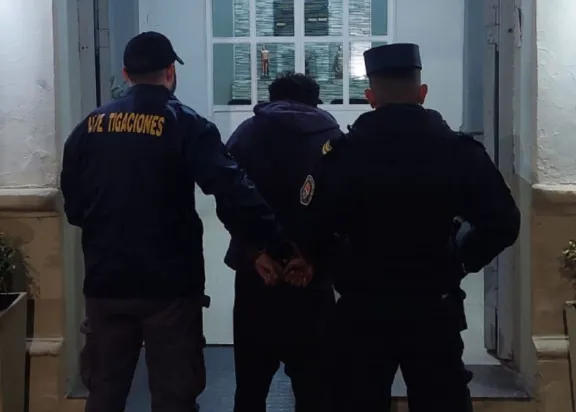
A 37-year-old man was arrested following an armed robbery of a student near the Azotea La Palma museum in Gualeguaychú, Argentina, this month. The suspect, who has prior criminal convictions, was apprehended after a police search operation in the city’s northern sector, sparking local debates regarding urban safety and socioeconomic pressures.
Police Response and Arrest Details
Police Response and Arrest Details
The incident, which occurred on a street typically regarded as safe by local residents, prompted an immediate mobilization of the Gualeguaychú police force. According to R2820, the victim was a student traveling to the Instituto Pio XII when she was threatened with a knife and robbed of her mobile phone. The arrest was executed by officers from the Fourth Police Station following a targeted search warrant on a residence linked to the investigation.
The suspect attempted to evade authorities by fleeing through the rear of the property, but a specialized perimeter operation led to his successful capture. During the subsequent search, authorities recovered items connected to the crime, including a Tramontina-style knife, a screwdriver, and a modified pair of scissors. The investigation involved multiple units, including the Departmental leadership, the DOSP, the Investigation Division, and the G.E.G.
Security Concerns in Historically Quiet Zones
cluster (priority): today.com
The brazen nature of the assault has caused significant alarm among residents and law enforcement alike, particularly because it occurred in a sector near educational facilities that had historically been viewed as low-risk. El Día de Gualeguaychú reported that the head of Operations for the Departmental Police, Osvaldo Adolf, emphasized the atypical nature of the crime for the local area.
“No es un episodio muy común ni muy frecuente. Automáticamente activó todas nuestras alertas y generó una ocupación inmediata del caso.” Osvaldo Adolf, Chief of Operations, Gualeguaychú Departmental Police
Beyond the immediate tactical response, the event has reignited public discourse regarding the intersection of economic instability and criminal behavior. While Adolf avoided drawing a direct causal line between the current economic climate and specific crimes, he acknowledged that the reality of the situation is multifaceted.
“Pueden aumentar los hechos contra la propiedad por la crisis económica, pero igualmente detrás de eso hay muchas situaciones. Hay cuestiones vinculadas a la contención familiar, a distintos contextos sociales y a realidades complejas.” Osvaldo Adolf, Chief of Operations, Gualeguaychú Departmental Police
The Impact on Victims and Urban Safety
Knife-wielding teenager accused of armed robbery, aggravated battery
A critical point raised by police leadership is the danger of minimizing crimes based on the value of stolen goods. Adolf argued that the psychological toll on victims often exceeds the material loss, a sentiment that resonates deeply following the attack on the student.
“Por ahí se habla de hechos menores y no se tiene en cuenta a las víctimas. Si a una persona le roban una bicicleta que estaba dentro de su casa, no solamente le sacan un bien material. También invaden su privacidad, ingresan a su espacio y eso tiene un impacto muy fuerte.” Osvaldo Adolf, Chief of Operations, Gualeguaychú Departmental Police
The community now faces a period of evaluation as officials consider whether to bolster security measures around school zones to prevent future incidents. The arrest of a repeat offender with a history of property crimes has underscored the challenges in monitoring individuals who have already served time but remain within the local criminal ecosystem.
Historical Context of Urban Transit and Infrastructure
cluster (priority): r2820.com
While modern urban security concerns dominate the current narrative in Gualeguaychú, the broader history of urban transit serves as a reminder of how infrastructure changes can redefine community safety. In the United States, the evolution of transit systems like the Third Avenue Elevated line in New York City—which operated from 1878 until its final phase closed in 1973—demonstrates the ongoing tension between aging urban infrastructure and the need for modernization, as detailed by UrbanAreas.net. The transition from elevated rail to bus routes, such as the Bx 55, highlights how cities must constantly adapt their transit to meet the safety and efficiency requirements of evolving populations.
Climate and Environmental Security Factors
As authorities monitor urban environments for criminal activity, they are also bracing for potential environmental stressors that can influence public life. Forecasters are currently tracking the development of a strong El Niño climate phenomenon. According to TODAY.com, experts note that the potential for record-setting temperatures and extreme weather through early 2027 could disrupt normal patterns and increase the frequency of environmental emergencies. Meteorologists warn that such climate shifts carry wide-reaching implications for hurricane seasons, heat waves, and flood patterns, factors that local governments must increasingly account for in their long-term urban management strategies.
Sophie Williams is the Tech Editor at Headlinez.News, covering innovation, artificial intelligence, cybersecurity, and emerging technology trends. Before joining the publication, she worked as a technology correspondent and product analyst for multiple tech-focused media outlets. With a background in computer science and digital media, Sophie bridges technical depth with accessible reporting, bringing readers closer to the technologies transforming everyday life.
Expertise: Artificial intelligence, consumer tech, cybersecurity, startups, digital transformation.
Location: San Francisco, California, USA