
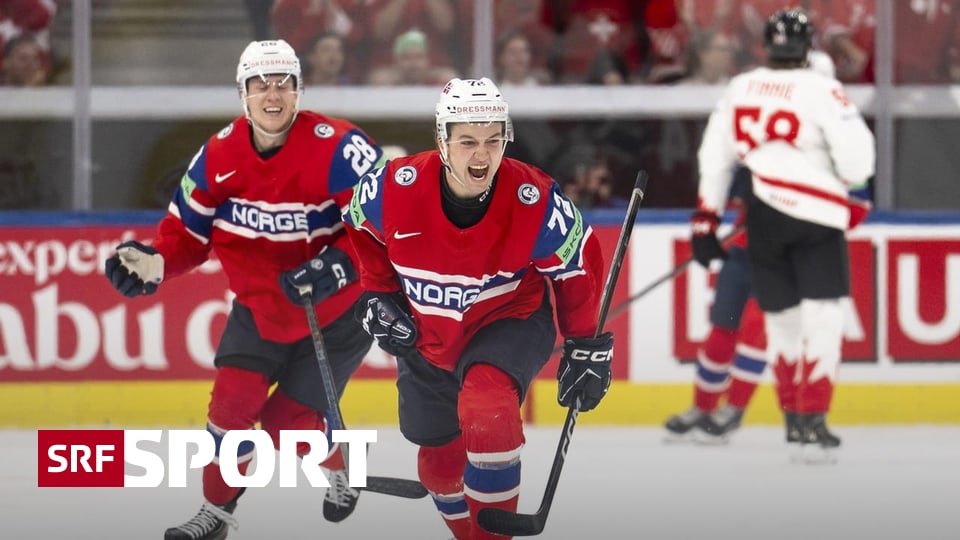
Norway’s ice hockey team made history on Sunday, May 31, 2026, by securing its first-ever World Championship medal with a dramatic 3-2 overtime victory over Canada in the bronze medal game at the 2026 IIHF World Championship in Zurich. The triumph capped a tournament where the underdog Norwegians defied expectations, while Canada—despite its star power—collapsed under the pressure of a late comeback attempt.
How Norway Defied the Odds
The Norwegians led 2-0 for much of the third period, only to watch Canada claw back to a 2-2 tie in the final 76 seconds of regulation. With time expiring, Canada’s Jet Greaves was pulled in favor of a sixth skater, sparking a furious late assault. Robert Thomas scored twice in the last minute to send the game into overtime—a gamble that paid off for Norway’s Petter Thoresen-coached squad.

In the 3-on-3 overtime, Noah Steen—just 21 years old—delivered the decisive goal at the 3:32 mark, firing a shot past Greaves from a 2-on-1 breakaway. It was a moment of pure clutch hockey, one that echoed Norway’s defiant spirit throughout the tournament. “The Jubel bei den Norwegern kennt keine Grenzen!” (The jubilation among the Norwegians knows no bounds!) read the SRF report, capturing the scene as Steen’s goal sent the crowd into euphoria.

The victory wasn’t just a statistical outlier—it was a cultural reset for Norwegian hockey. The country’s best finish before this tournament was a fourth-place showing in 1951, a result that now feels like a footnote. “So krönte Norwegen sein sensationelles Turnier tatsächlich mit der 1. WM-Medaille in der Geschichte des Landes,” (Thus Norway crowned its sensational tournament with its first-ever World Championship medal in history) SRF confirmed, marking a seismic shift in a nation where hockey has long been overshadowed by football and handball.
Canada’s Collapse: The Cost of Overconfidence
Canada’s path to the bronze medal game was littered with self-inflicted wounds. The team, featuring NHL stars like Sidney Crosby (38) and Macklin Celebrini (19), entered the tournament as heavy favorites. Yet by the time they faced Norway, they were a shell of their potential. Goalie Greaves—who had been stellar in earlier matches—was pulled in the final minute, a desperate move that backfired as Canada failed to capitalize on the ensuing power play.
The Norwegians, meanwhile, played with a fearlessness that belied their status as underdogs. Their defense was aggressive, their forecheck relentless, and their goaltender, Henrik Haukeland, was nearly untouchable. Haukeland, playing for the Straubing Tigers in Germany’s DEL, allowed just six goals in six games before the Canada match—a performance that Blick described as “überragend” (outstanding). The contrast with Greaves, who gave up two goals in the final minute, was stark.
Canada’s struggles extended beyond the ice. The team’s body language crumbled in the third period, a sign of mental fatigue. “Die Körpersprache versprüht zum Ende des Mitteldrittels wenig Hoffnung auf eine Wende,” (The body language conveyed little hope of a turnaround by the end of the middle third) Blick observed. The Norwegians, by contrast, exuded confidence, knowing they had a chance to rewrite history.
The Broader Implications: A Shift in Hockey’s Power Structure
Norway’s bronze medal isn’t just a feel-good story—it’s a statement about the evolving landscape of international hockey. For years, the sport has been dominated by the traditional powerhouses: Canada, the U.S., Russia, and Sweden. But as Norway’s performance shows, the margins are narrowing. The Norwegians, with an average age of 27, proved that heart, grit, and smart hockey can overcome star power.

Canada’s failure to medal at all—its third straight bronze-game loss—is a black eye for a program that has long prided itself on its depth. The team’s inability to close out games, combined with Greaves’ late blunder, underscores a broader issue: even elite teams can unravel when confidence wanes. “Wer sie vorne nicht macht, bekommt sie hinten,” (Who doesn’t win early won’t win late) Blick noted, a lesson Canada learned the hard way.
The tournament isn’t over yet—Finland and Switzerland will battle for gold later tonight—but Norway’s achievement has already sent ripples through the hockey world. For a country that has never won a medal, this is more than a victory; it’s a cultural moment. The players, many of whom are amateurs or play in lower-tier leagues, have given their nation a reason to believe in hockey’s future.
What’s Next for Norway—and Canada?
Norway’s success raises questions about its long-term trajectory. The team’s coach, Petter Thoresen, has built a system that thrives on aggression and quick transitions—qualities that served them well against Canada. If they can maintain this intensity, they could become a permanent fixture in the sport’s upper echelon. For Canada, the fallout is more immediate. The team’s poor performance in the medal game will fuel debates about its roster construction, goaltending reliability, and mental toughness.
One thing is certain: Norway’s bronze medal will be remembered as the moment the country stepped onto the world stage. As 20 Minuten put it, the victory was a “Lehrstunde in Sachen ‘nach vorne verteidigen’” (a masterclass in defensive positioning). For Norway, the lesson is clear: in hockey, as in life, sometimes the underdog’s story is the one that resonates most.
The gold medal game between Finland and Switzerland begins at 8:20 PM local time. But for Norway, the celebration has already begun—and it won’t end anytime soon.
