
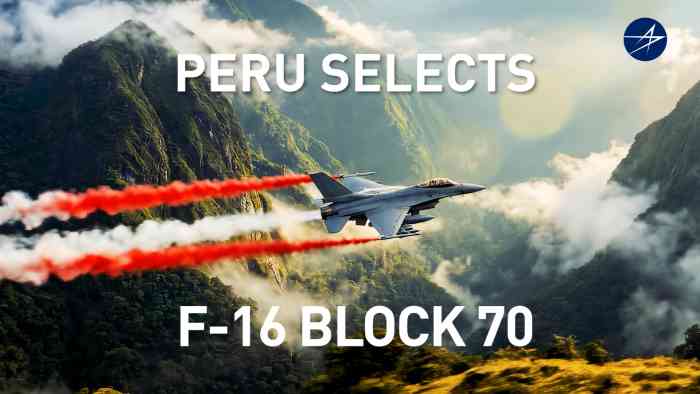
After Peru’s Months of Delays, U.S. F-16 Fighter Jet Deal Finally Moves Forward
Lima, Peru — After a turbulent political standoff that saw cabinet resignations and a temporary freeze on negotiations, Peru has officially finalized a long-awaited agreement to purchase F-16 Block 70 Viper fighter jets from the United States. The breakthrough comes as Lockheed Martin begins delivering demonstration aircraft to the South American nation, signaling the deal is now fully operational.
The contract, valued at approximately $3.9 billion (34 trillion Peruvian soles), was initially put on hold in early 2026 when President Dina Boluarte paused the acquisition amid mounting domestic pressure. The delay triggered the resignations of both the defense and foreign ministers, underscoring the high stakes of the procurement. However, after months of diplomatic maneuvering, the Peruvian government has confirmed the agreement is back on track, with the first U.S. Air Force demonstration team already deployed to Lima to showcase the aircraft’s capabilities.
The deal represents a significant shift in Peru’s military modernization efforts, positioning the F-16 as the country’s next-generation fighter jet. The Block 70 Viper model, equipped with advanced avionics and radar systems, outpaced competing bids from France’s Rafale and Sweden’s Gripen during the evaluation process. Officials cited the aircraft’s combat-proven performance and long-term sustainment advantages as key factors in the decision.
Yet the road to finalizing the contract was anything but smooth. In March 2026, Peru’s Ministry of Defense announced a temporary suspension of the purchase, citing the need for further review. The move prompted a sharp response from Washington, which had reportedly offered a 50% discount on the jets—a rare concession aimed at securing the sale. U.S. Officials later warned that any further delays could jeopardize the terms of the agreement, including the favorable pricing.
The political fallout was immediate. Defense Minister Walter Astudillo and Foreign Minister Javier González-Olaechea both resigned in protest, framing the pause as a necessary step to ensure transparency. Meanwhile, Peru faced financial consequences, with reports indicating the government had already paid a non-refundable deposit of $2.2 billion (7.9 trillion soles) under the original contract terms.
The resumption of the deal now appears to have quelled those tensions, at least for the moment. A U.S. Air Force F-16 demonstration team arrived in Peru this week to participate in the Festival Aéreo de Lima, a high-profile airshow that will give both military officials and the public a firsthand seem at the aircraft’s capabilities. The event is expected to serve as a symbolic reaffirmation of the partnership between the two nations.
For Peru, the acquisition of the F-16s marks a strategic pivot toward strengthening its air defense capabilities amid growing regional security concerns. Neighboring countries, including Chile and Brazil, have already modernized their fleets, leaving Peru’s aging Mirage 2000s and MiG-29s at a technological disadvantage. The new jets are expected to enhance Peru’s ability to monitor its vast Amazonian borders and respond to emerging threats.
The deal also reflects the broader geopolitical competition in Latin America, where the U.S. Has increasingly sought to counter Russian and Chinese influence by offering advanced military hardware at competitive prices. Peru’s decision to proceed with the F-16 purchase—despite initial hesitation—suggests a calculated effort to align more closely with Washington, even as the country navigates its own internal political divisions.
With the contract now active, attention will turn to the delivery timeline and the integration of the new aircraft into Peru’s air force. For now, however, the agreement stands as a rare moment of stability in a process that has been anything but.
