
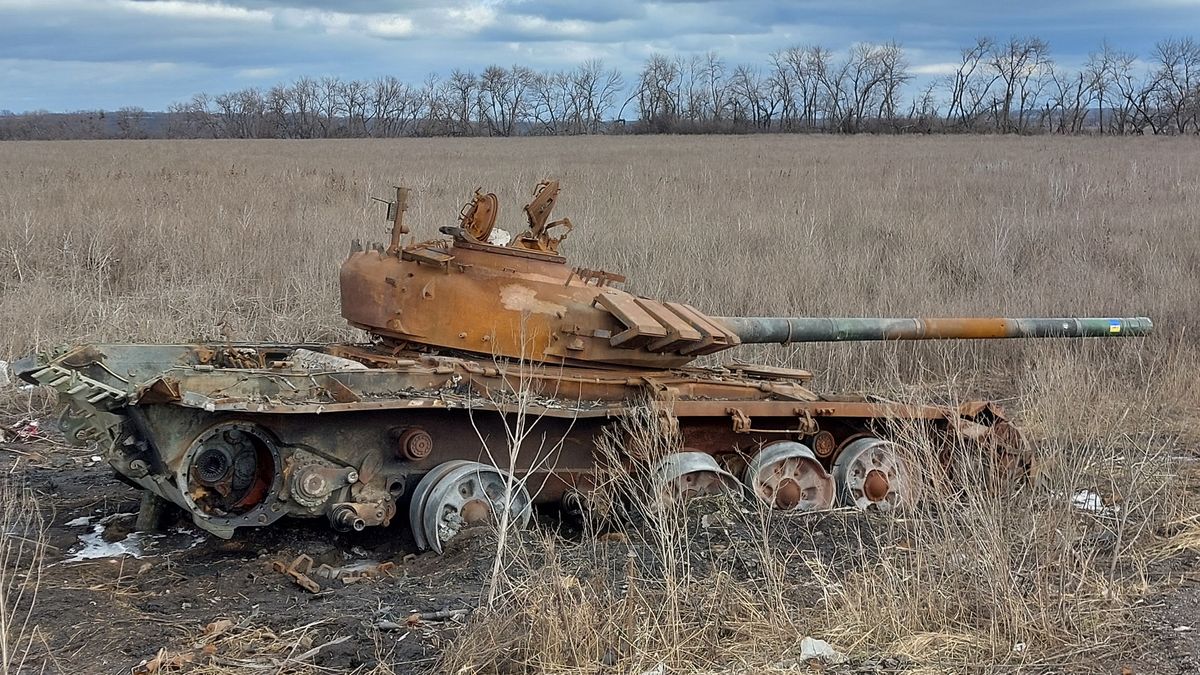
Four years of war have drained Russia’s seemingly endless Soviet-era tank reserves, leaving the country’s armored forces in a critical state. According to satellite imagery analyzed by long-time observer Jonpy99, movement of equipment in Russian storage facilities has nearly halted in recent months, with only occasional transfers of completely unusable wrecks meant for dismantling into spare parts.
This indicates that Russia has reached a point where further renovation of stored equipment no longer makes practical sense. What remains in storage is either too ancient or too damaged to justify the cost of revival — a milestone analysts and commentators had anticipated since 2022, when Russian forces began losing hundreds of pieces of heavy equipment monthly in Ukraine.
Despite the depletion, the situation is more complex than it first appears: Russia’s armored fleet is not in worse condition than at the war’s outset. In some categories, It’s actually larger. This apparent contradiction stems from how Russia has treated its Soviet inheritance — not as a continuously replenished reserve, but as a one-time transfer intended to offset wartime losses, possibly until broader new production could begin.
In February 2022, Russian forces had approximately 3,000 tanks in service and another 7,000 in storage, according to estimates and hard data from satellite images. By January 2026, total Russian tank losses exceeded 4,300, based on Ukrainian intelligence assessments. What remains in open-air storage are largely rusting hulks — either requiring expensive repairs or serving only as sources of spare parts.
Ukrainian battlefield reports confirm the trend: in 2023 and 2024, Ukrainian forces recorded daily destruction or damage of 14 to 17 Russian tanks. By summer 2025, that rate had fallen to just two to five per day. Similar declines were observed in the deployment of armored personnel carriers.
While Russia’s defense industry has increased output — producing an estimated 250 to 300 modern T-90M tanks and about 150 upgraded T-80BVM models in 2025 — this still falls short of demand. Moscow has increasingly turned to older models — including T-72s, T-62s, and even T-55s from the 1950s — reactivating and modernizing them, though their combat effectiveness remains significantly lower.
The shift means Russia can no longer rely on its vast Soviet stockpiles for sustained armored pressure on the front lines. Instead, it must depend on slower, more expensive new production — a reality that could shape the trajectory of its military capabilities in the prolonged conflict.
