
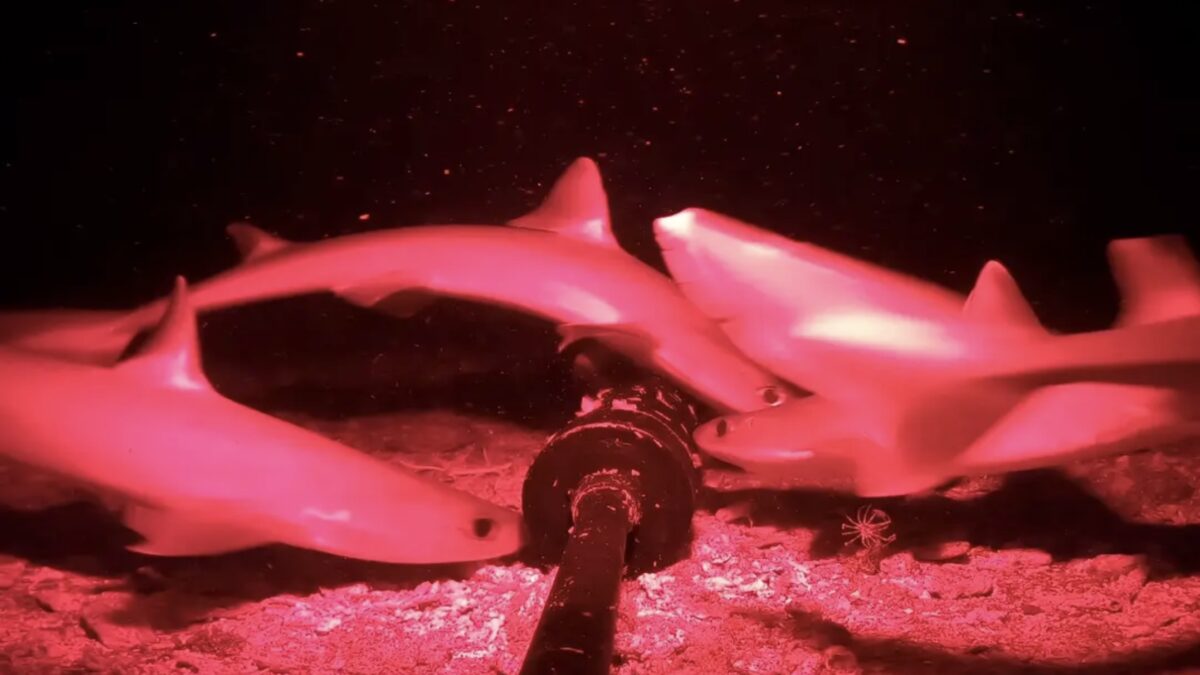
Marine researcher Dillarstone deployed an infrared camera in the deep sea for the first time, capturing unexpected behaviors and an unrecorded species, according to a Dutch news outlet. The expedition, conducted in uncharted waters, revealed marine life reacting unusually to the technology, including a rare shark species.
Deep-Sea Discovery with Infrared Technology
Dillarstone’s use of infrared light, invisible to most marine life, led to unexpected encounters. “Infrared light is invisible to the human eye and to most marine life,” he noted. The technology allowed the team to observe species typically wary of human presence, including an almaco jack that approached the camera repeatedly. “Might infrared make those that normally keep their distance become bolder?” Dillarstone pondered, highlighting the camera’s unique impact on marine behavior.

The expedition also captured footage of “Himevissen,” small creatures capable of enduring strong currents. Dillarstone observed their erratic behavior, stating, “Such currents would exhaust an Olympic swimmer within seconds.” Their interactions with other marine life remained enigmatic, raising questions about their ecological role.
Unusual Marine Behavior and Species Identification
A standout discovery was a bluntnose sixgill shark, described as “so ancient” due to its evolutionary lineage predating some dinosaurs. Dillarstone emphasized its significance, calling it a “living fossil.” However, the most startling find was an Indonesian houndshark, a species “never before recorded alive on camera,” according to Dillarstone. “As far as I’m aware, this is the first time this species has ever been recorded alive on camera,” he stated, noting the creature’s brief appearance near Indonesia’s coast.
The expedition’s findings underscore the vast unknowns of deep-sea ecosystems. With over 70% of the ocean floor unmapped, Dillarstone’s work represents a step toward uncovering hidden marine biodiversity. The use of infrared technology, previously untested in such depths, opens new avenues for research, potentially revealing species and behaviors unseen by traditional methods.
Implications for Ocean Research and Conservation
Experts in marine biology suggest Dillarstone’s results could influence future deep-sea exploration. The ability to observe species without direct human interference, via infrared, may reduce disturbance to fragile ecosystems. However, challenges remain, including the technical limitations of deep-sea equipment and the need for further study of the observed species.
The discovery of the Indonesian houndshark, in particular, highlights gaps in marine taxonomy. Dillarstone’s team collaborated with shark experts to confirm the identification, illustrating the collaborative nature of modern oceanographic research. As technology advances, such findings may become more frequent, reshaping understanding of marine life and conservation strategies.
For more on this story, see the original report here.
