
hear’s an introductory paragraph, designed to frame the provided article for readers, adhering to your specifications:
Suweida, Syria – As the anniversary of Bashar al-Assad‘s recapture of most of Syria approaches, the country remains a complex landscape of fragile stability and ongoing concerns. While the Assad regime asserts improved security, particularly for minority groups, recent outbreaks of violence – including deadly clashes in Suweida province – and continued geopolitical vulnerabilities raise questions about Syria’s long-term trajectory. This report examines the diverging perspectives on the nation’s future, from cautious optimism within the government to warnings from the UN and analysis of external pressures like israeli military presence.
DAMASCUS – A rebel coalition’s entry into Damascus on December 8, 2024, marked a stunning collapse of the Syrian regime under President Bashar al-Assad, ending 50 years of Assad family rule and 13 years of civil war. The shift has ignited hopes for reconstruction and justice, not only within Syria but also among the large Syrian diaspora, including communities in Canada.
The fall of the Assad regime represents a pivotal moment in the region, potentially reshaping the geopolitical landscape of the Middle East and prompting a reassessment of international involvement in the conflict.
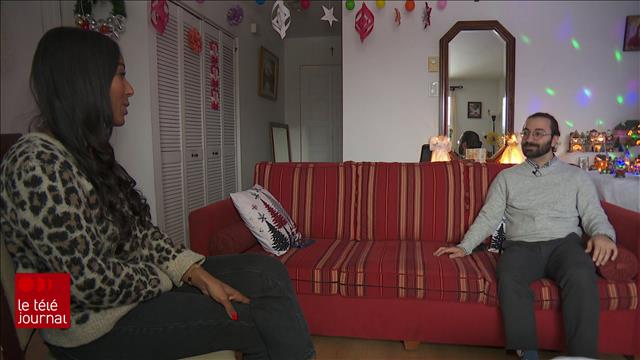
“It was a seismic event. I didn’t think I would see this day in my lifetime. I cried a lot, like millions of Syrians,” recounted Mohamad Rami Jiha, a Syrian who arrived in Montreal in 1994 at the age of 11.
Jiha, who recently returned to Syria for the first time this summer, expressed optimism about the future. “Syrians can now dream of a better future,” he said. “I found Damascus, my hometown, very tired, wounded. But the people were happy. There was hope, smiles. People told me, ‘Even if we don’t have progress like in developed countries, at least we don’t have torture prisons anymore.’”
Fadi Bertawi, president of the Association d’accueil des Syriens du Québec, echoed this sentiment. “It’s a nightmare we’ve gotten rid of. It’s really a new era emerging for the Syrian people after more than a decade of massacres, bombings, and chemical weapons,” Bertawi, who arrived in Quebec in 2012, stated.
Table of Contents
Despite the removal of Assad’s dictatorship, Syria’s path forward remains uncertain, according to Miloud Chennoufi, a professor of international relations at the Canadian Forces College in Toronto, also of Syrian origin. “We are still far from the promises made by those who supported the uprising in Syria – a stable, open, democratic, and prosperous regime,” Chennoufi said. “The political process is slow to establish the institutions of a modern state.”
“The chaos that was widely feared has not materialized, that is true, but politically, you have a regime that, for the moment, has seized power,” he added.
The chaos generalisé ne s’est pas produit, c’est vrai, mais, sur le plan politique, vous avez un régime, pour le moment, qui s’est emparé du pouvoir.
Currently, the Islamist group Hay’at Tahrir al-Cham forms the transitional government in Syria. Its leader, Ahmed Al-Charaa, the interim president of Syria, was formerly a member of Al-Qaeda but has since moderated his positions.
Al-Charaa has stated his intention to establish an inclusive democratic regime for women and ethnic minorities. He signed a constitutional declaration in May outlining plans for elections within four to five years.
However, Chennoufi fears this transition period could lead to “the consolidation of an authoritarian regime, the embryo of which is already present, [because] we have a president who is self-proclaimed and acts as if he were legitimately elected.”
Toward Reconstruction
Diplomatically, the new president, Ahmed Al-Charaa, is actively seeking the lifting of sanctions against Syria and securing aid for the rehabilitation of infrastructure devastated by 13 years of civil war.
The World Bank estimates that the cost of reconstruction could exceed $216 billion (approximately $302 billion CAD).
To that end, the Syrian transitional government is courting wealthy Gulf monarchies and has already signed investment agreements with several countries in the region, including Saudi Arabia, Qatar, and Turkey.
Signaling Syria’s attempts to open up diplomatically, U.S. President Donald Trump received Ahmed Al-Charaa at the White House in November, marking the first visit by a Syrian head of state to Washington since the country’s independence in 1946.
Meanwhile, Canada removed Hay’at Tahrir al-Cham, the group currently governing Syria, from its list of terrorist organizations on Friday.
Bertawi, of the Association d’accueil des Syriens du Québec, expressed hope that this gesture “will help to revive the country economically and humanely.”
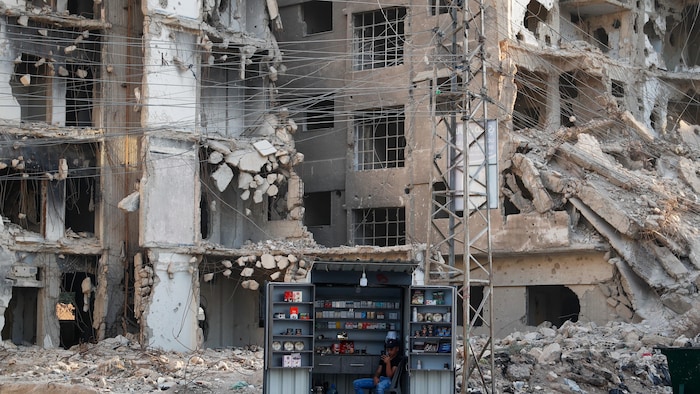
Buildings reduced to rubble by the war in the suburb of Damascus, in Daraya. (Archive photo)
Photo: Associated Press / Omar Sanadiki
Of the three million Syrians who have returned home since the fall of the regime, Bertawi says some are Canadians, particularly “business people who want to participate in the reconstruction of Syria.”
Reconstruction efforts are already bearing fruit, he noted. “For example, in Damascus, before the fall of the regime, we had 30 minutes of electricity during the day. And now, it’s between 14 and 16 hours a day. The efforts they’ve made in one year are a miracle.”
Mohamad Rami Jiha does not plan to return to live in Syria, but intends to invest financially in reconstruction efforts from Canada.
For the approximately 60,000 Syrians welcomed to Canada since 2015, “the choice to return [to their country of origin] is not easy. I know some who have already returned, others who are preparing to do so in a year or two, and others who are not sure if they want to return.”
Many Syrian refugees have put down roots in Canada, with young children still in school, he added.
Seeking Justice for Past Atrocities
Another significant challenge for Syria lies in the pursuit of justice. The civil war, which began in 2011, has left deep wounds with its catastrophic toll of over one million deaths and tens of thousands of missing persons.
Starting on March 15, 2011, as a pro-democracy uprising violently suppressed by the Assad regime, the civil war became complicated by the intervention of foreign actors and the influx of jihadists from around the world.
During the conflict, all parties were accused of atrocities, including the Islamic State armed group, which seized vast territories in Syria and committed abuses, including executions.
Fourteen years later, new evidence of torture and deaths in prison is emerging, alongside the discovery of mass graves, as families continue to hope to find missing relatives.
The Syrian Civil Defense, tasked with locating mass graves, estimates it will take between 10 and 20 years to identify all locations, exhume bodies, and conduct DNA testing.
Prosecuting those responsible for these abuses will also be challenging, as the justice system, under the Assad regime, was neither impartial nor independent and must be rebuilt, according to experts.
Bachar al-Assad, now exiled in Russia, remains beyond the reach of the Syrian justice system.
Fragile Transition, According to the UN
Alongside these efforts toward democracy, justice, and reconstruction, the country remains vulnerable to intercommunal violence.
Since Assad’s ouster, the Alawite minority, a branch of Shia Islam, has been targeted by attacks.
In March, massacres on the coast claimed over 1,700 lives, mostly Alawites, following clashes between security forces and supporters of Bashar al-Assad, according to the Syrian Observatory for Human Rights (OSDH), based in the UK.
And in July, the province of Suweida was the scene of clashes between Sunni Bedouin tribes and Druze fighters that killed more than 2,000 people, according to the OSDH.
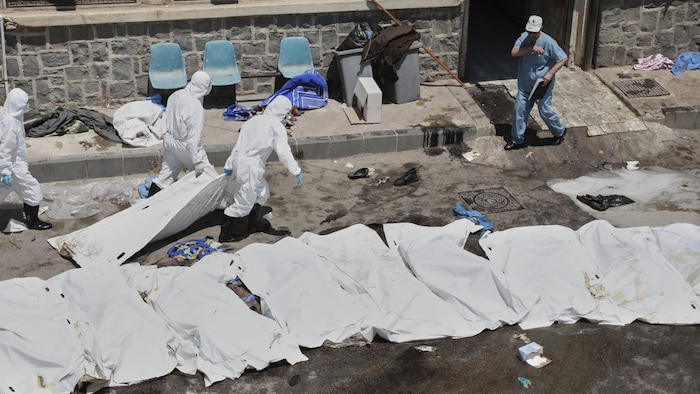
Workers at a morgue gather the bodies of unidentified people who were killed in clashes near the National Hospital in Suweida, on July 21, 2025. (Archive photo)
Photo: Associated Press / Fahd Kiwan
Despite these outbreaks of violence, Bertawi remains optimistic that his country will avoid sinking back into war.
“We see the president’s willingness… Coexistence and reconciliation are the priority above all else… Minorities have never been as protected as they are now,” he argued.
However, the UN’s independent commission of inquiry on Syria sees the situation differently. Its investigators lament that violence since the fall of Assad has caused new displacement and polarization in Syria, “raising concerns about the country’s future direction.”
“Syria’s transition is fragile. Many, across the country, will celebrate this anniversary, but others fear for their safety, and many others will still be sleeping in tents this winter,” they lamented in a statement released Sunday.
Professor Chennoufi further points to Syria’s geopolitical vulnerability due to Israeli incursions into its territory.
Indeed, Israel has virtually destroyed the entire infrastructure of the Syrian army since the fall of the Assad regime and militarily occupies large parts of Syrian territory.
Negotiations have been initiated by Syrian authorities with Israel to conclude a security agreement under which the Hebrew state would withdraw from the occupied areas in the south of the country, but nothing has been concluded to date.
With information from Agence France-Presse, Frédéric Zalac, David Kenner, Nicole Sadek, and Camille Kasisi-Monet
This news can be consulted in Chinese (new window) on the RCI (new window) website.
