Prehistoric 'murder scene' reveals 'unbelievable' triple-predator scenario
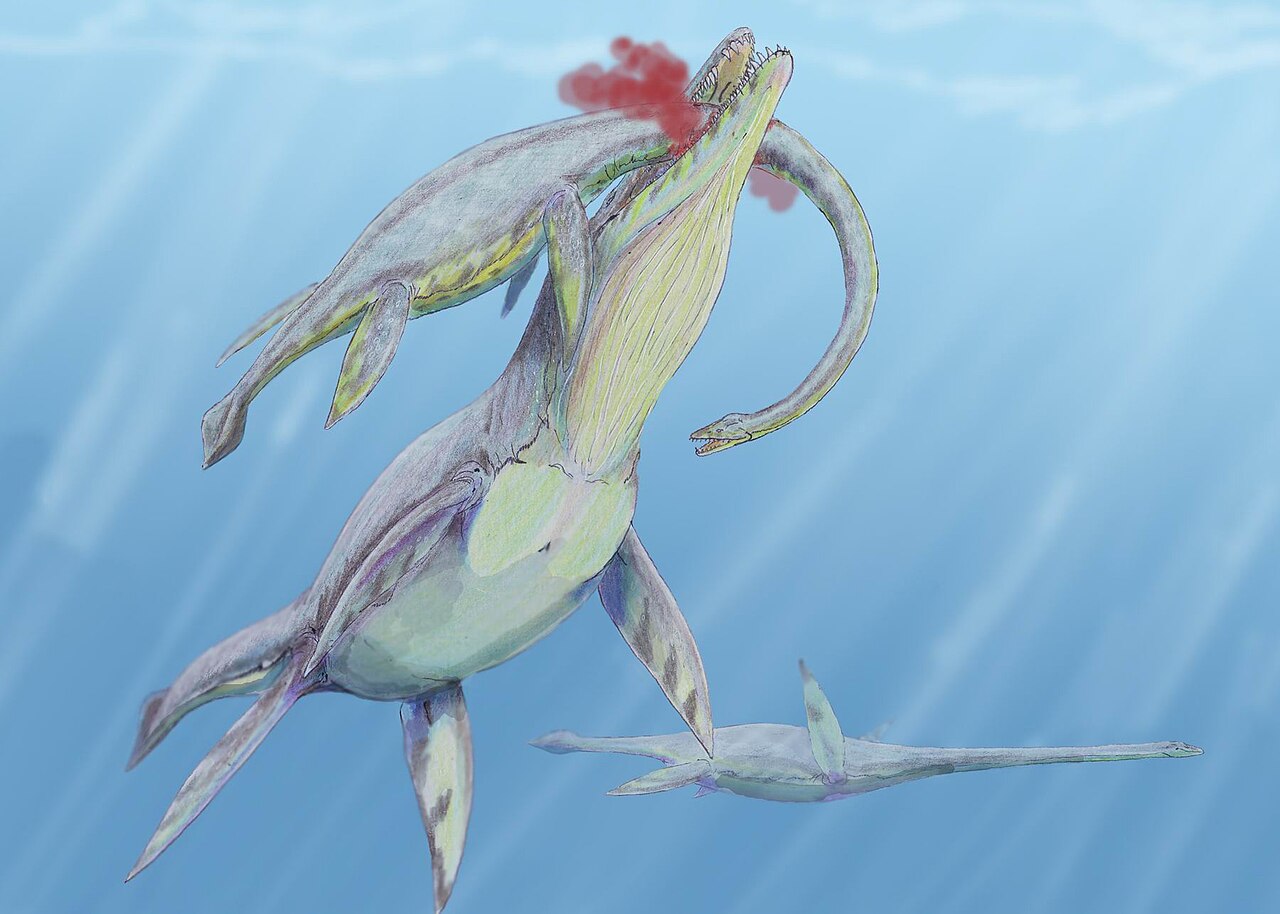
A rare prehistoric fossil discovered in Outback Queensland reveals a multi-tiered predatory sequence involving three ancient species.
📍 How it ended
{ "epilogue": "Coverage of the prehistoric fossil centered on a rare three-tier marine predator scenario, described as a 'turducken' or 'bag of bones' find in Outback Queensland. Headlines detailed a 40-foot-long Kronosaurus consuming a marine reptile, which had previously eaten a pterosaur. The story quieted without further updates in the provided coverage." }
Epilogue added 45d ago, after coverage quieted.
Quick answers
What animals were involved in this prehistoric fossil?
The fossil contains a 40-foot-long Kronosaurus, a 23-foot-long marine reptile, and a pterosaur.
Where was the fossil discovered?
The remains were discovered in Outback Queensland, Australia.
Why is this fossil considered significant?
It provides rare, direct evidence of a three-tier food chain in the Lower Cretaceous period.
The brief
A 40-foot-long Kronosaurus specimen has been identified containing the remains of a 23-foot-long marine reptile, which in turn contained a pterosaur. This fossilized "turducken" scenario provides evidence of an ancient food chain sequence from the Lower Cretaceous period. The remains were recovered from a site in Outback Queensland, with analysis conducted through the Australian Nuclear Science and Technology Organisation (ANSTO). The sequence of consumption is presented by New Scientist, ScienceAlert, and IFLScience as a primary example of marine behavior within the Gondwana region.
Media outlets including the New York Post and Yahoo characterize the finding as an "unbelievable" triple-predator event, focusing on the scale of the apex predator and the rarity of the preserved digestion chain. While the anatomical contents are documented, the specific temporal gap between each consumption event remains undefined. Coverage from ABC News and Phys.org notes that the "bag of bones" preservation is highly unusual, though the geological conditions responsible for such precise fossilization are not detailed across current sources. The scientific community has labeled this a world-first discovery regarding ancient marine interaction, yet technical reports have not specified the precise mechanism that halted the digestive process for all three animals simultaneously.
Future research is expected to clarify how the Kronosaurus interacted with its ecosystem beyond this single event. Detailed analysis of the stomach contents may provide further evidence regarding the hunting habits of marine reptiles during this era, though specific follow-up studies or publication schedules are not currently established in the available material.
Synthesized by headlinez.news from the headlines below under a strict no-invention contract. ✓ fact-checked: all claims supported by sources Updated 47d ago.
Coverage (9)
- 'Turducken' fossil shows flying dinosaur eaten by reptile, then devoured by 40-foot monster New York Post · 49d ago
- Extraordinary ichthyosaur fossil shows its last meal was a pterosaur New Scientist · 49d ago
- Epic 'Turducken' Fossil Reveals Ancient Sea Monsters Devouring Each Other ScienceAlert · 49d ago
- 40-foot-long Kronosaurus ate a 23-foot-long marine reptile who ate a pterosaur, fossil shows Yahoo · 49d ago
- Fossil provides world-first evidence of ancient marine behaviour in Gondwana ANSTO · 49d ago
- 'Bag of Bones' preserves rare three-tier prehistoric meal in Outback Queensland Phys.org · 49d ago
- 40-foot-long Kronosaurus ate a 23-foot-long marine reptile who ate a pterosaur, fossil shows Popular Science · 49d ago
- Three-Way Chomp-Fest Between Ancient Species Shows Who Was Eating Who in The Lower Cretaceous IFLScience · 49d ago
- Prehistoric 'murder scene' reveals 'unbelievable' triple-predator scenario ABC News & Headlines – Australian Broadcasting Corporation · 49d ago
The coverage curve
How fast coverage is spreading — measured hourly from article rate × source diversity. How this works →
Related visual coverage
Automatically selected only when the subject entities match this story. Embeds remain hosted by their original platforms.
Rare fossils reveal prehistoric 'crime scene' in outback Queensland | ABC NEWS
YouTube · ABC News (Australia)
Topics
Related trends
Ancient DNA Reveals Woolly Mammoth With A Sex Chromosome Combination Never Before Seen In An Extinct Species
Ancient DNA analysis suggests Ice Age humans disproportionately targeted female woolly mammoths, while revealing a unique genetic chromosomal mutation.
Ancient human relative cannibalized both adults and children in a cave in Spain 850,000 years ago, fossils reveal
Newly analyzed fossils from the Gran Dolina site in Spain reveal that Homo antecessor cannibalism was not restricted to the young, but included adults.
Saber-toothed cats' spinal tumors suggest inbred species struggled to survive
Ancient saber‑toothed cat spines reveal tumor‑laden evidence that inbreeding may have sealed their fate
China team unearths world’s oldest amber, hidden in ancient Xinjiang coal seam
A 385‑million‑year‑old amber unearthed in Xinjiang rewrites the timeline of Earth’s earliest forests.
Dinosaurs were roasted to death by asteroid dust cloud
A study suggests the Chicxulub asteroid strike triggered a global dust cloud that incinerated Cretaceous-era creatures within hours.
‘A moment in time’: Fossil footprints shed new light on the extinct ‘Nutcracker Man’
Million-year-old footprints found in Kenya are reshaping scientific understanding of the extinct human relative known as 'Nutcracker Man'.