
The United States is prepared for a prolonged conflict with Iran, with President Donald Trump not ruling out the deployment of troops as the conflict expands and the number of American service members killed rises. The escalating tensions reach amid a complex series of events with global implications, raising concerns about wider regional instability.
Speaking Monday during a medal ceremony, Trump stated the U.S. Will continue to strike Iran “as long as it takes” to prevent it from posing a threat. “We will easily triumph. We had planned for four to five weeks from the beginning, but we have the ability to go well beyond that. We will do it,” he said, despite previously advocating for a non-interventionist foreign policy.
“We are already well ahead of our schedule, but no matter how long it takes, that’s OK. We will do whatever it takes,” Trump added, before shifting the conversation to the future White House ballroom and declining to capture questions from reporters.
The comments came on the third day of the U.S.-Israeli military operation against Iran, hours after the U.S. Central Command (CENTCOM) revised the death toll to six American service members.
In recent days, Trump has been communicating through statements and pre-recorded videos on his Truth Social platform, as well as through phone calls with journalists. This marked his first public discussion of the conflict on camera since the start of “Epic Fury.”
In an interview with the Fresh York Post, Trump, who initiated military action without congressional approval, declined to dismiss the possibility of deploying ground troops.
I have no trepidation about troops on the ground, like all presidents [American presidents] who say, “There will be no troops on the ground.” I don’t say that. I say, “We probably won’t need them, [or there will be] if necessary.”
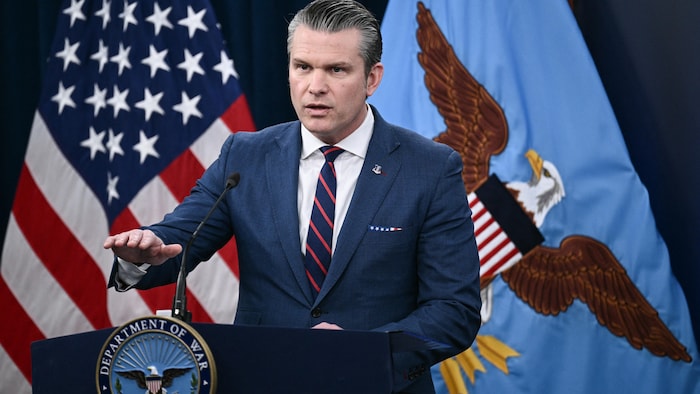
Defense Secretary Pete Hegseth told reporters during a press conference that there were no current plans for deploying troops, but did not rule out a change in position.
U.S. Defense Secretary Pete Hegseth speaks to reporters.
Photo : Getty Images / AFP / Brendan Smialowski
“We’re not going to get into what we will or won’t do,” Hegseth said, adding that doing so would be “stupid.” He affirmed that the U.S. Would go “as far as necessary.”
During a CNN interview, Trump hinted at a possible escalation. “We’re giving them a really bad beating,” he told the journalist. “I think it’s going very well. It’s very powerful. We have the best army in the world and we’re using it.”
“We haven’t even started hitting them hard. The big wave hasn’t even come yet. The big [wave] is coming soon,” he warned.
Secretary of State Marco Rubio echoed those sentiments later in the afternoon, following a meeting with the “Group of Eight,” comprised of senior congressional leaders from both parties.
“The hardest strikes are yet to come,” he told reporters from Capitol Hill.
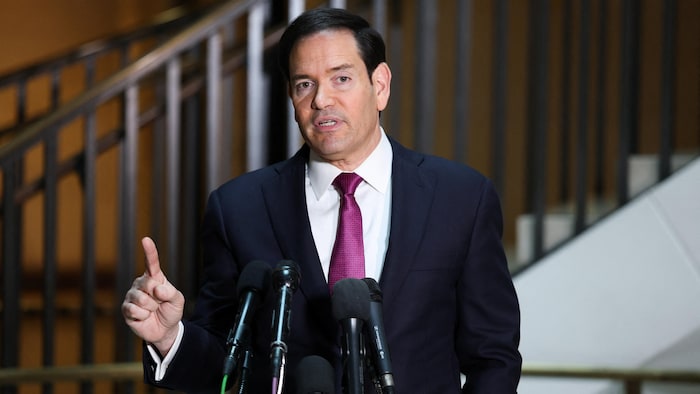
U.S. Secretary of State Marco Rubio addresses the media before a briefing on the conflict in Iran for top congressional leaders at the Capitol, Washington, March 2, 2026.
Photo : Reuters / Kylie Cooper
Alongside Hegseth, Chairman of the Joint Chiefs of Staff General Dan Caine indicated the U.S. Would be reinforcing its military presence in the Middle East.
Trump Outlines Objectives
During his address at the White House, Trump framed the U.S.-Israeli operation as the best opportunity to eliminate threats posed by the Iranian regime.
This was our last best chance to deliver strikes – which we are doing now – and to eliminate the intolerable threats posed by this sick and sinister regime. And they are indeed sick and sinister.
The goals of the offensive are “clear,” he said, after days of fluctuating explanations.
He listed four objectives: “destroying Iran’s ballistic capabilities,” “annihilating” its navy, preventing Iran from acquiring nuclear weapons, and ensuring the Iranian regime can no longer “finance and direct terrorist armies,” a reference to groups like Hamas, Hezbollah, and the Houthis.
This weekend, Trump stated that Tehran was on the verge of being able to reach the U.S. With long-range ballistic missiles, a claim contradicted by U.S. Intelligence sources.
The White House occupant had not formally laid out his rationale for war, even during his State of the Union address last Tuesday, during which the Iranian issue was addressed only briefly.
Trump, who has repeatedly called on Iranians to overthrow the regime since Saturday, did not mention this during his remarks.
During a Pentagon press conference, Hegseth assured reporters that the U.S. Was not becoming embroiled in a new “quagmire” and that the goal was not regime change.
To the media and the left who are screaming “endless wars!” stop. This is not Iraq. This is not an endless war.
“We don’t need to send 200,000 people and stay for 20 years. We’ve proven we can accomplish objectives that advance American interests without being foolish about it,” he continued.
Trump has long railed against U.S. Wars aimed at toppling regimes.
U.S. Acted Preventively
, Rubio Argues
U.S. Secretary of State Marco Rubio speaks to the media before a briefing on the conflict in Iran for top congressional leaders at the Capitol, Washington, March 2, 2026.
Photo : Reuters / Kylie Cooper
Before reporters, the Secretary of State suggested the U.S. Acted in response to decisions made by Israel. He stated the U.S. Launched a “preventive” strike in response to the “imminent threat” of Iranian retaliation for a potential Israeli attack.
We proactively acted defensively to prevent them from doing more damage.
“It was perfectly clear that if Iran was attacked – by the United States, Israel, or anyone – they would retaliate, retaliate against the United States. We would suffer more losses, and there might be even more deaths,” he argued.
“The President made the very wise decision to strike first. We knew an Israeli action was imminent, that it would provoke an attack against our forces, and that if we didn’t get ahead of them before they launched their strikes, the consequences would be far worse,” he said.
The Iranian response is evidence of that, he added.
Following their briefing with the top diplomat, congressional leaders from both parties reacted in predictably opposing ways.
House Speaker Mike Johnson, a Republican, reiterated arguments made by the Trump administration, while Senate Democratic Leader Chuck Schumer expressed dissatisfaction with a meeting that “raised more questions than it answered.”
Representative Joaquin Castro criticized Israel for “putting American forces in danger by insisting on attacking Iran.” “That’s unacceptable from the President and it’s unacceptable from a country that claims to be our ally,” he wrote on social media X.
Both chambers of Congress, which has the constitutional power to declare war, are set to consider bipartisan resolutions this week that would limit President Trump’s military action against Iran.
Although, the vast majority of Republicans continue to support the military offensive launched by their leader.
Six Americans Killed
The CENTCOM has revised its casualty count from the “Epic Fury” operation.
“U.S. Forces recently recovered the remains of two service members who were missing after an attack on an installation that was struck during the initial Iranian attacks in the region,” CENTCOM said in a statement. This brings the total number of American service members killed since the operation began Saturday to six.
Earlier in the day, it had reported a fourth fatality, stating the service member had died from injuries sustained in the attacks.
The CENTCOM similarly specified that the first three American service members whose deaths were announced Sunday were “likely victims of friendly fire” from Kuwaiti air defenses.
The President warned over the weekend that the death toll was likely to rise. “Unfortunately, there will probably be more,” he said Sunday after praising the three initial American victims.
The strikes have also killed Supreme Leader Ali Khamenei, who was almost 87 years ancient, as well as several family members and other regime figures.
During an interview with the New York Times Sunday, Trump stated he had “three very good choices” to lead Iran.
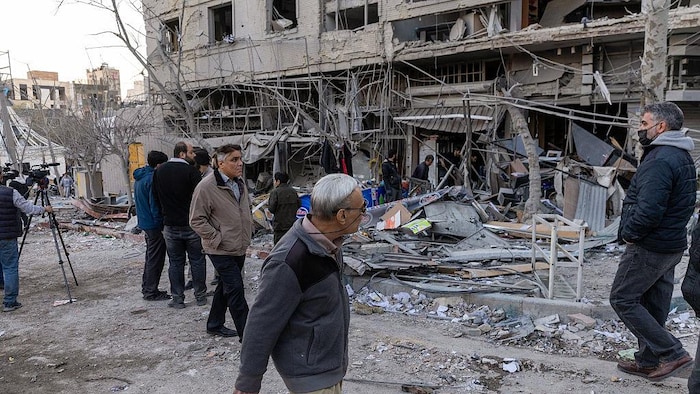
People seem at the damage caused to shops and homes by an airstrike on March 2, 2026, in Tehran, Iran.
Photo : Getty Images / Majid Saeedi
In an interview with ABC News, he indicated that the potential leaders identified by the U.S. Had been killed in the initial attack. “The strike was so effective that it eliminated most of the candidates,” he said, according to the network. “The second and third candidates are dead.”
The Iranian Red Crescent has reported 555 deaths since Saturday. Tehran claims a bombing killed 168 people in a school in the south of the country on Saturday, a figure that has not been independently verified.
Citing “significant security risks,” the State Department has urged Americans in the Middle East to leave a dozen countries and territories: Iran, Israel, Gaza, the West Bank, Bahrain, Egypt, Iraq, Jordan, Kuwait, Lebanon, Oman, Qatar, Saudi Arabia, Syria, and the United Arab Emirates and Yemen.
