
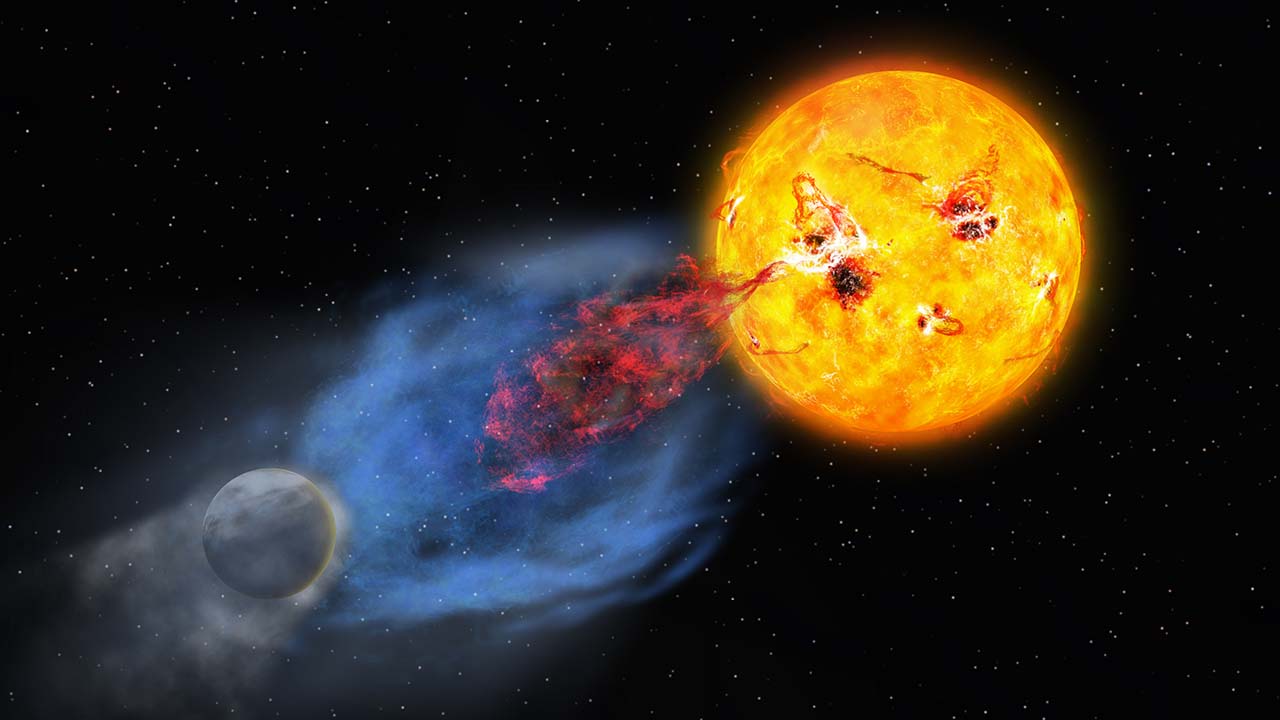
New research is shedding light on the energetic behavior of young stars, providing crucial data in the search for habitable planets beyond our solar system. Astronomers studying the star EK Draconics,located 110 light-years from Earth,have observed powerful outbursts of plasma – similar to solar flares – exhibiting distinct temperature variations and speeds. These findings, detailed in recent observations [[1]] and [[3]], could help scientists better understand the conditions necessary for life to emerge on planets orbiting young stars.
Astronomers have discovered that young stars similar to our Sun can experience powerful outbursts, releasing energy in two distinct components.
Like our Sun, young stars can experience periods of intense magnetic activity, resulting in the release of superfast gas known as plasma. These events, often called coronal mass ejections (CMEs), are a common occurrence for our Sun, and understanding them in other stars could provide valuable insights into the conditions necessary for life to develop.
Researchers have long wondered if other young stars exhibit similar energetic behavior, and if so, how their outbursts compare to those of our Sun. A recent study focused on the star EK Draconics, a young star located 110 light-years away in the Draco constellation, to investigate these questions.
Using telescopes both on Earth and in space, the team observed EK Draconics in ultraviolet (UV) and optical light – essentially using advanced imaging to see details invisible to the naked eye. Their observations revealed that the star ejected plasma at an astonishing 550 kilometers per second (approximately 1.2 million miles per hour) with a temperature of 100,000 Kelvin. Following this initial burst, a slower-moving stream of cooler gas, around 10,000 Kelvin and traveling at 70 kilometers per second, was also detected.
This suggests that EK Draconics exhibits both a “hot” and “cold” aura during these outbursts. Understanding the characteristics of these stellar tantrums is crucial because they can offer clues about the early solar system and the environments where planets form.
Specifically, fast CMEs may have played a key role in creating conditions suitable for life on young planets. The findings could help refine our understanding of planetary habitability and the origins of life itself.
The research team plans to continue observing similar young stars and their CMEs using X-ray, radio, and UV observations, hoping to unlock further secrets about how planets become habitable and how life on Earth may have begun.
Cool Fact
Our Sun is currently 4.6 billion years old. The material ejected by the Sun can reach temperatures of 1,000,000 Kelvin – about 2,500 times hotter than a freshly made pumpkin soup!
