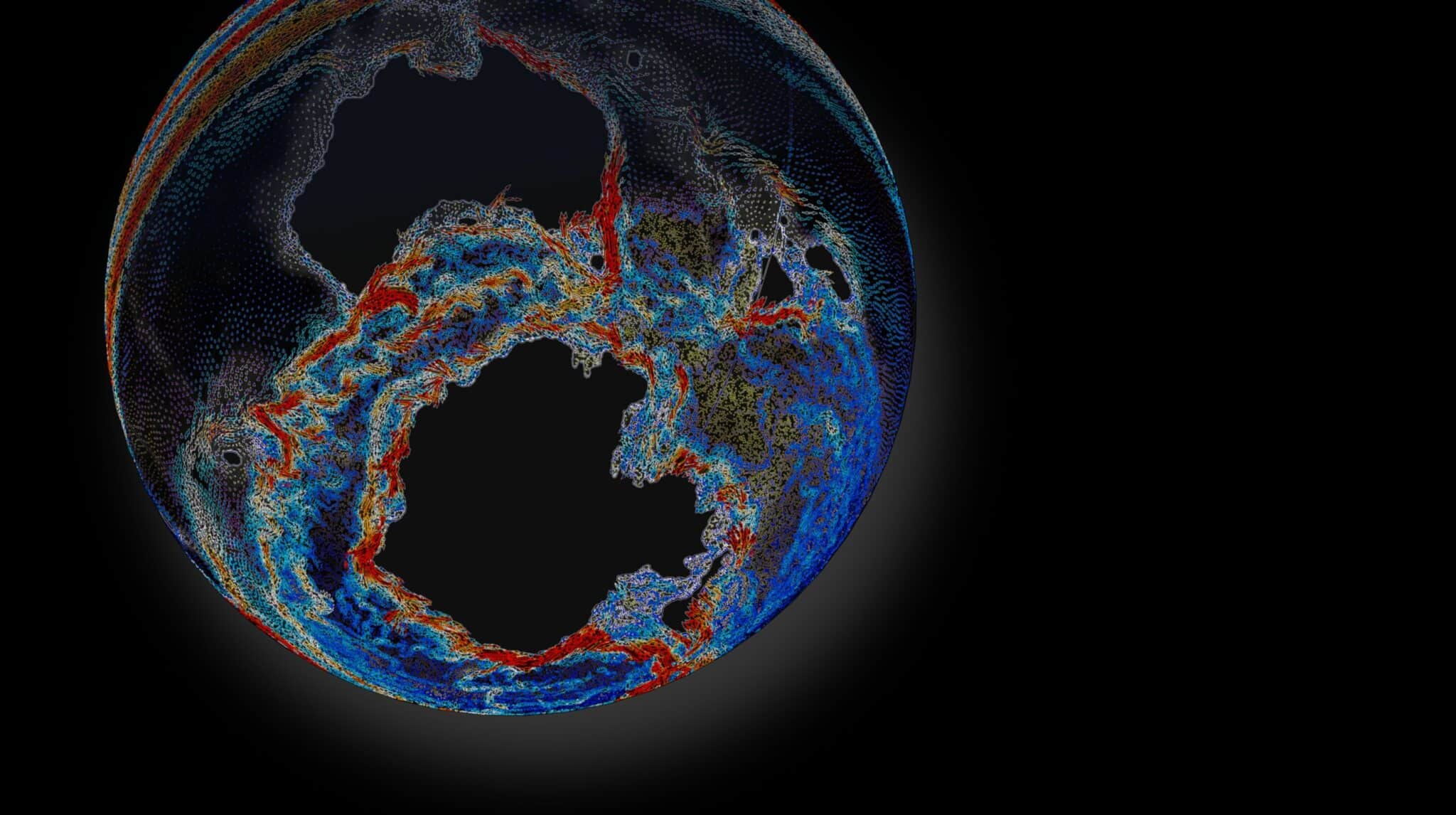
The Antarctic Circumpolar Current (ACC), the most powerful ocean current on Earth, was born 34 million years ago when shifting continents and relentless winds created a global climate shift that locked Antarctica into an endless winter. New research reveals how this “titan of the seas” — 100 times stronger than the Amazon River — reshaped Earth’s climate by isolating the southern continent, and why its modern-day weakening could trigger irreversible consequences by 2050.
How a 34-Million-Year-Old Ocean Current Froze the Planet
The Antarctic Circumpolar Current (ACC) isn’t just a river of water — it’s the planet’s climate regulator, a 20,000-kilometer loop that moves more water than all the world’s rivers combined. Its origins, detailed in simulations by researchers at the Alfred Wegener Institute, explain why Earth’s climate flipped from greenhouse warmth to ice-age chill. The key? A perfect storm of continental drift, wind patterns, and underwater geography that created a barrier so powerful it still dictates global weather today.
According to the SciencePost analysis, the current’s birth began when Australia and South America drifted away from Antarctica, opening a deep ocean passage. But the real engine? Violent westerly winds that swept unimpeded across the Southern Ocean, driving the current into existence. Without these winds, the ACC might never have formed — and Earth’s climate would remain far warmer than it is today.
cluster (priority): amphisciences.ouest-france.fr
The current’s formation wasn’t instantaneous. Early simulations suggest the ACC initially split into two distinct systems: a vigorous flow in the Atlantic and Indian Oceans, while the Pacific side remained sluggish. This asymmetry, noted in AmphiSciences’ deep-dive, shows how the current’s early structure differed dramatically from its modern, unified loop. The Pacific’s slower circulation meant heat distribution was uneven — a clue to how climate systems can shift unpredictably under pressure.
The Underwater Mountains That Shape the Current
What makes the ACC so powerful isn’t just wind — it’s the ocean floor. Beneath the waves, underwater mountain ranges and plateaus act like invisible dams, forcing the current to surge upward or plunge downward in massive whirlpools. These collisions, described in AmphiSciences’ geological breakdown, create vortexes hundreds of kilometers wide, pulling nutrient-rich deep water to the surface and fueling Antarctic ecosystems. Without these submerged obstacles, the current would accelerate uncontrollably — a scenario climate models now warn could happen if human activity disrupts ocean salinity.
cluster (priority): losangeles.com
Today, the ACC acts as a moat around Antarctica, blocking warm ocean currents from melting its ice sheets. But this protective barrier is under threat. Freshwater from melting glaciers is diluting the salty ocean water, weakening the current’s ability to circulate heat. According to the BBC’s climate report, the ACC could slow by 20% by 2050 — a shift with catastrophic implications. Warmer waters would erode glaciers from below, accelerating sea-level rise. Meanwhile, the current’s collapse could disrupt global weather patterns, from European winters to monsoons in Asia.
Why the Current’s Weakening Could Reshape the Planet
The ACC’s influence extends far beyond Antarctica. It’s a critical cog in the global ocean conveyor belt, redistributing heat, carbon, and nutrients worldwide. When the current weakens, as projected by BBC researchers, the consequences ripple outward:
95% Risk: Atlantic Ocean Current Failure May Freeze the Planet
Climate chaos: The current’s slowdown could alter rainfall patterns, intensifying droughts in Australia and floods in South America.
Ecosystem collapse: Antarctic krill, the backbone of marine food chains, rely on the current’s nutrient upwelling. A weaker flow means less food for whales, seals, and penguins.
Sea-level surge: Warmer ocean waters would accelerate glacial melt, threatening coastal cities from Miami to Mumbai.
Weather whiplash: The Gulf Stream and other currents could destabilize, leading to more extreme winters in Europe and unpredictable storms globally.
The stakes are higher than most realize. The ACC’s modern-day behavior is already showing signs of stress. Satellite data from Copernicus Marine Service reveals that Antarctic sea ice — which acts as a natural thermostat — has fluctuated wildly in recent years. Between 2014 and 2017, the region lost two million square kilometers of ice, an area four times the size of Spain. While some recovery occurred in 2018, the long-term trend is alarming: the most recent low in February 2023 saw ice coverage shrink to just 2.06 million square kilometers, a record low.
The ACC’s future hinges on two competing forces: the relentless push of westerly winds and the growing freshwater input from melting ice. While winds may accelerate the current in the short term, the dilution effect from glacial melt is a long-term threat. Researchers warn that if the current weakens beyond a certain point, it could trigger a cascade of feedback loops — less ice means more heat absorption, which in turn melts more ice, creating a runaway cycle.
cluster (priority): news.google.com
There’s no silver bullet to reverse this trend. Geoengineering schemes like artificial currents or massive desalination projects remain speculative at best. The most effective solution? Slashing greenhouse gas emissions to slow Antarctic ice loss. But even with aggressive action, the ACC’s decline may already be locked in. As BBC’s climate scientists put it: “We’re not just watching the current weaken — we’re witnessing the unraveling of a system that has shaped Earth’s climate for millions of years.”
For now, the ACC remains a silent sentinel, its power both a shield against climate chaos and a warning of what’s to come. Its story — from the ancient winds that birthed it to the modern crisis threatening its survival — is a microcosm of Earth’s delicate balance. And as the current’s pulse weakens, so too does our window to act.
Sophie Williams is the Tech Editor at Headlinez.News, covering innovation, artificial intelligence, cybersecurity, and emerging technology trends. Before joining the publication, she worked as a technology correspondent and product analyst for multiple tech-focused media outlets. With a background in computer science and digital media, Sophie bridges technical depth with accessible reporting, bringing readers closer to the technologies transforming everyday life.
Expertise: Artificial intelligence, consumer tech, cybersecurity, startups, digital transformation.
Location: San Francisco, California, USA