
French authorities are expected to conclude an examination by year’s end into allegations that Czech Prime Minister-designate Andrej Babiš engaged in money laundering and tax evasion related to teh 2009-2010 purchase of a considerable estate in southern France.the probe, stemming from information revealed in the Pandora Papers, centers on the acquisition of the “Château Bigaud” property through a series of offshore companies. A decision could have significant political implications as Babiš is positioned to potentially lead the country again following recent elections.
French authorities are nearing the conclusion of an investigation into whether Czech Prime Minister-designate Andrej Babiš potentially engaged in money laundering and tax evasion related to the purchase of a substantial estate in southern France.
The investigation, spanning more than three years, centers on the circumstances surrounding Babiš’s 2009 and 2010 acquisition of a six-hectare property near Cannes, known as “Château Bigaud,” through a series of offshore companies. The estate includes several homes and a main residence.
According to a response to Seznam Zprávy from Bérénice Dinh, a deputy prosecutor with the National Financial Prosecutor’s Office, a decision on the case is expected by the end of the year. “We will be able to decide on this file by the end of the year,” Dinh stated.
Investigators have identified Babiš as the sole suspect in a potential money laundering scheme, though no charges have been filed against him. “No charges have been brought against him,” Dinh confirmed. “At this stage, it is not possible to say whether it will be necessary to question Mr. Andrej Babiš. There are no other suspects at this stage.”
Babiš has not commented on the impending conclusion of the investigation and did not respond to a request for comment from Seznam Zprávy on Thursday. He has previously maintained that all of his property purchases were conducted legally.
Michael Bartončík, Babiš’s lawyer in the Czech Republic, dismissed the case, stating he “has nothing to do with it.”
Babiš’s French Case:
The investigation began after French police specializing in combating corruption and tax evasion began examining transactions made by Babiš in September 2009 and 2010.
The scrutiny arose from the release of the Pandora Papers, a leak of nearly 12 million documents from legal firms, by the International Consortium of Investigative Journalists (ICIJ). The documents revealed how wealthy and influential individuals utilize offshore companies and opaque jurisdictions for tax optimization.
The Pandora Papers detailed how Babiš acquired land and homes, including the Château Bigaud residence, on the French Riviera through companies established in tax havens. He purchased the property for 14 million euros in 2009 and added further properties the following year.
French authorities are investigating whether the complex structure of offshore companies was used to facilitate potential tax evasion.
According to the Pandora Papers, Babiš transferred 15 million euros through a company in the British Virgin Islands to an American company, which then loaned the funds to a Monaco-based firm, SCP Bigaud. SCP Bigaud subsequently purchased the properties in France. The arrangement effectively functioned as a “loan to himself” between his own companies. A sales agreement obtained by Le Monde indicated the price was paid “in cash.”
This complicated structure could have been used to conceal the true owner and to engage in illegal tax optimization. At the time, buyers could reduce their wealth tax by using loans. However, in Babiš’s case, the transfer and lending of funds between related companies may have constituted unlawful tax reduction.
Babiš’s French Case:
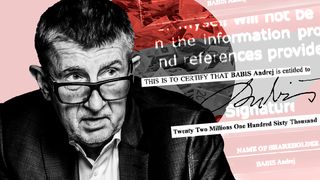
French authorities requested assistance from authorities in four countries, including the Czech Republic, during the investigation.
“The investigation concerns a complex arrangement and flow of funds and required the use of international mutual legal assistance,” Dinh stated.
Czech detectives from the National Center Against Organized Crime also investigated the matter. However, in early 2022, they concluded they could not pursue the case as the alleged crime did not occur within the Czech Republic. They forwarded their findings to foreign counterparts.
Photo: David Neff, Seznam Zprávy
Other potential tax irregularities related to Babiš’s companies have been addressed by Czech authorities.
These involved allegations that companies under the Agrofert holding paid inflated amounts for advertising to Farma Čapí hnízdo, intentionally reducing their tax base. The case was eventually closed, but tax authorities assessed additional taxes on five of Babiš’s companies. According to the findings of the tax authorities, which were also confirmed by the courts, the companies claimed advertising that did not actually take place at the Čapí hnízdo site.
Czech authorities received a tip-off from Germany in 2014, when Babiš was Minister of Finance, regarding these alleged irregularities. However, the Prague Financial Office did not pursue the case further, and an investigation did not begin until several years later. Some parts of the case were statute-barred due to the delay.

Babiš is currently on trial in a separate case related to Čapí hnízdo, alleging fraud related to a subsidy. In this case, the Prague High Court overturned a previous acquittal in June of this year, finding that Babiš and co-defendant Jana Nagyová, a member of the European Parliament, were wrongly cleared of charges.
The appeals court ordered the Municipal Court to convict both Babiš and Nagyová. According to the appellate court, both committed subsidy fraud and damaged the financial interests of the European Union. Babiš has since regained parliamentary immunity with a new mandate as a member of parliament. The court sent a request for his re-issuance for criminal prosecution to the Chamber of Deputies in November. Newly elected members of parliament will soon decide on his release.
Nine Years of Investigation and Trials in the Čapí hnízdo Case
- In March 2016 Andrej Babiš, who was then Minister of Finance, stated that the owners of the shares of Farma Čapí hnízdo were his two children and his wife Monika’s brother, Martin Herodes.
- In August 2017 the Chamber of Deputies received the first request for the release of Andrej Babiš and then-MP Jaroslav Faltýnek. On September 6, 2017, they voted to release them, and at the beginning of October 2017 they received a notice of the initiation of criminal proceedings. A total of 11 people were originally accused.
- In January 2018 the Chamber of Deputies released Andrej Babiš and Jaroslav Faltýnek for criminal prosecution for the second time. In the autumn of 2017, both MPs obtained a new mandate in the parliamentary elections and thus also immunity, and criminal prosecution had to be suspended.
- In May 2018 prosecutor Jaroslav Šaroch granted the appeal of four defendants, including Jaroslav Faltýnek, and terminated their prosecution.
- In April 2019 police officer Pavel Nevtípil proposed to prosecutor Šaroch to file an indictment in this case.
- In September 2019 prosecutor Šaroch terminated the prosecution of six people, including Andrej Babiš. Several months later, he also terminated the prosecution of Babiš’s son.
- In December 2019 then-Chief Prosecutor Pavel Zeman overturned Šaroch’s decision in the case of Babiš and other defendant Jana Nagyová (Mayerová). Further investigation has been underway since then.
- In March 2022 prosecutor Jaroslav Šaroch announced that he had filed an indictment against Babiš and Nagyová with the Municipal Court in Prague. The case was assigned to Judge Jan Šott. The main hearing was scheduled for September 12.
- In September 2022 the trial began.
- In January 2023 Andrej Babiš was acquitted in the first instance.
- In September 2023 the Prague High Court ordered a hearing in the Čapí hnízdo case. It set it for Thursday, September 14, when it overturned the original verdict and returned the case to Judge Šott at the Prague Municipal Court.
- In February 2025 a new hearing took place at the Prague Municipal Court. Judge Šott again acquitted both defendants. The prosecutor appealed again.
- In April 2025 the European Parliament stripped Czech MEP Jana Nagyová of her immunity. The Prague High Court subsequently ordered a hearing in this case.
- In May and June 2025 the second appellate hearing took place at the High Court in Prague.
- On June 23, 2025 the appellate High Court overturned the acquittal of Babiš and Nagyová and returned the case to the Municipal Court in Prague.
- On August 19, 2025 the Senate of the High Court in Prague completed its decision and sent the file back to the Municipal Court in Prague.
- On October 9, 2025 Judge Jan Šott again requested the release of Andrej Babiš for criminal prosecution.
- On November 20, 2025 the Prague Municipal Court sent the file in the Čapí hnízdo case to the Chamber of Deputies.
The French National Financial Prosecutor’s Office did not indicate whether it would charge Babiš following the conclusion of the investigation. A decision is expected by the end of the year, a timeframe that coincides with the possibility of Babiš becoming the new Czech Prime Minister as the leader of the winning ANO movement.
Babiš has previously stated that all transactions were conducted in accordance with the law and that the funds used to purchase the property in France were properly taxed. However, he has not yet explained the circumstances surrounding the complex purchase through offshore companies.
