
While renowned for creating family-friendly franchises like Mario and The Legend of Zelda, Nintendo’s Shigeru Miyamoto has a lesser-known early work with a surprisingly complex history. Released in Japan and Europe in 1985, Devil World-Miyamoto’s first original game for the Nintendo Entertainment System-remained unavailable in North America for nearly four decades. The game’s unusual content, featuring religious iconography, ran afoul of stricter content standards and Nintendo of America’s guidelines at the time, offering a unique look at the evolving relationship between video game content and cultural sensitivities.
Shigeru Miyamoto is synonymous with Nintendo, having designed, directed, and produced some of the company’s most beloved games. Miyamoto consistently blended childlike wonder with accessible and engaging gameplay, resulting in creations that have proven remarkably memorable and enduring. This is perhaps best exemplified by Link from “The Legend of Zelda,” a character inspired by the literary figure of Peter Pan. However, the first game Miyamoto designed specifically for a home console – rather than arcades – drew inspiration from a far more unusual source.
Released in 1985, “Devil World” occupies a curious space in Nintendo’s history and within Miyamoto’s body of work. He served as the game’s director and co-designer. Despite this, “Devil World” remained without an official North American release for nearly four decades due to its content. While Miyamoto’s legacy is hardly defined by the game’s absence in North America, it represents a peculiar chapter in his early career. Here’s the story behind “Devil World,” from its development to the reasons for its rejection in the U.S. and its lasting impact today.
The Story of Devil World
Despite not being designed for arcades – unlike “Donkey Kong” or the original “Mario Bros.” from 1983 – “Devil World” certainly feels like it could have been. The game tasks players with navigating a maze-like environment from a top-down perspective, collecting points in a manner similar to “Pac-Man,” while controlling dragons inhabiting the titular Devil World. A demon at the top of the screen periodically points to indicate the stage’s direction, and players must follow these cues to avoid being crushed. Players can collect crosses scattered throughout the stage to temporarily activate a fiery breath attack to eliminate monsters.
Behind the scenes, “Devil World” brought together Miyamoto with several collaborators he’d worked with previously, and introduced him to partners who would help shape his career. The game was one of the first projects for Takashi Tezuka, who would later co-direct and co-design “The Legend of Zelda” with Miyamoto. Koji Kondo composed the game’s soundtrack, and would go on to create the iconic “Super Mario” theme, later collaborating with Miyamoto and Tezuka on “The Legend of Zelda.” However, despite the all-star creative team behind “Devil World,” plans for a release outside of Japan and Europe were quietly shelved.
Why Was Devil World Never Released in the U.S.?
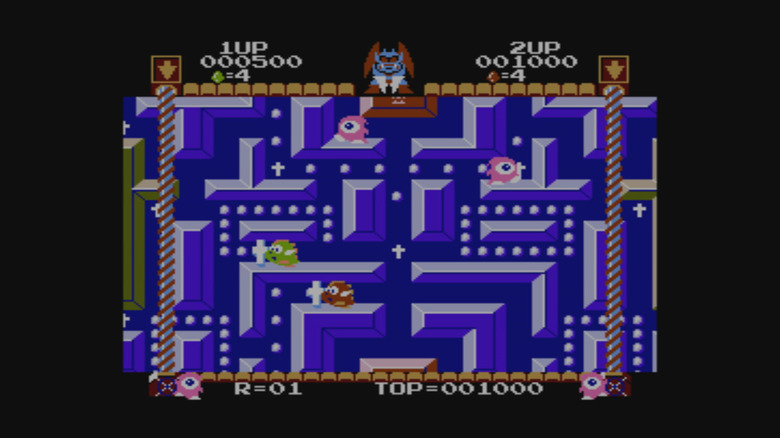
During the introduction of the Nintendo Entertainment System, the industry was still recovering from the video game crash of 1983, and stricter content standards were in place in North America. This included guidelines from Nintendo of America prohibiting overt religious imagery in games intended for the market. Even innocuous tombstones featuring crosses, common in games like “Castlevania,” required modification. When it came to a game explicitly dealing with religious iconography and a Christian depiction of hell, “Devil World” went too far for a simple edit.
With frequent depictions of Bibles and crosses within “Devil World,” and the prominent inclusion of a Judeo-Christian demon, Nintendo of America decided against releasing the game in the United States. Given the industry’s ongoing recovery and Nintendo’s initial steps into the American console market, the company likely wanted to avoid any potential controversy the game might generate. By 1986, Nintendo of America’s stance on religious imagery in the games it distributed had softened somewhat, with both “Ghosts ‘n Goblins” and “Castlevania” featuring cross-themed weaponry. Even with this shift, “Devil World” remained unreleased in North America until its digital Nintendo Switch release in October 2023.
The Legacy of Devil World
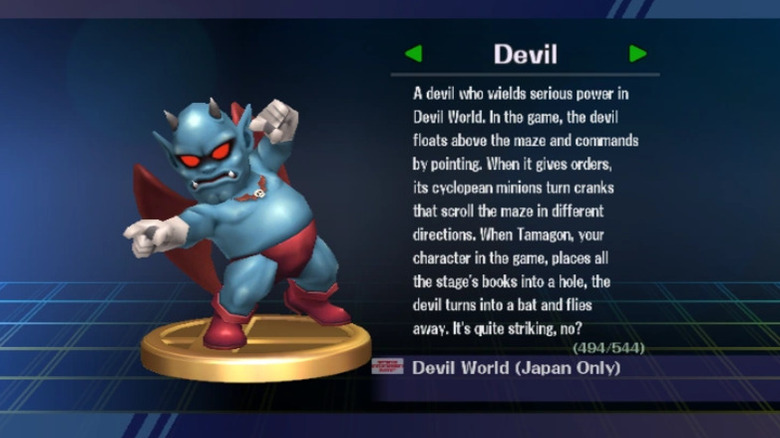
Despite its limited distribution, “Devil World” doesn’t rank among Shigeru Miyamoto’s biggest missteps. Miyamoto and his team would soon deliver far greater successes, including “Super Mario Bros.” the following year. The title wasn’t entirely forgotten within Nintendo’s history either, as the demon from “Devil World” appeared as an assist trophy in “Super Smash Bros. Brawl,” and its subsequent iterations on the Wii U and 3DS. The assist trophy would reappear in the Nintendo Switch continuation of the series, “Super Smash Bros. Ultimate,” five years before a global re-release on the Switch’s digital library.
Beyond Easter eggs and its modest re-release on the Switch, 39 years after its debut, “Devil World” holds a unique place in the Nintendo catalog. The game predates the unvarnished truth of “Super Mario Bros.: The Lost Levels,” which also featured the same creative team and faced a delayed American release for years. But while the 1986 “Super Mario” sequel was shelved due to its incredible difficulty, “Devil World” is the only Miyamoto game halted due to content concerns. For the master of good cheer and unrestrained joy that is Nintendo, this distinction is strangely unique.
