
READ ALSO
Former Venezuelan intelligence chief Hugo Carvajal, currently imprisoned in New York, is now a key figure in revealing alleged crimes committed under the Chavismo government. He has recently provided testimony to the International Criminal Court, according to reports. This development comes as Nicolás Maduro, also now detained in New York after being captured by U.S. Authorities in Caracas on January 3, faces increasing scrutiny over alleged human rights abuses.
Carvajal reportedly told the ICC that Maduro is directly responsible for the repression of Venezuelan opposition members between 2014 and 2017, alongside other high-ranking officials. The information was revealed through audio recordings shared by Venezuelan journalist David Placer.
Carvajal made these statements while detained in Spain before his extradition to the United States, where he is currently on trial facing charges including drug trafficking and financing terrorist groups on the Colombian border.
Police use tear gas against protesters during a demonstration in Caracas. Photo: AFP
La Patilla reported that while in Spain, the ICC sent Carvajal a questionnaire as part of its investigation into “Caso Venezuela I,” which is evaluating potential crimes against humanity committed during the Chávez administration.
According to Carvajal’s testimony, Venezuela’s response to protests operates on two levels. “First, there is formal control, using the agencies responsible for handling public order situations according to the law. and second, there is informal control, operated outside the law and executed by para-state or paramilitary criminal organizations,” he stated.
READ ALSO
The ICC reportedly requested Carvajal identify those responsible for the repression – which resulted in over 100 deaths – and he named Maduro, Tareck El Aissami, Néstor Reverol, Justo Noguera Pietri, Antonio Benavides Torres, Sergio Rivero Marcano, Gustavo González López and Iván Hernández Dala. He also implicated Diosdado Cabello, Pedro Carreño, and Freddy Bernal as members of the “anti-coup command.”
“In addition to the commanders of the National Bolivarian Police (PNB) in 2014 and 2017, whose names I do not have at hand,” Carvajal added.
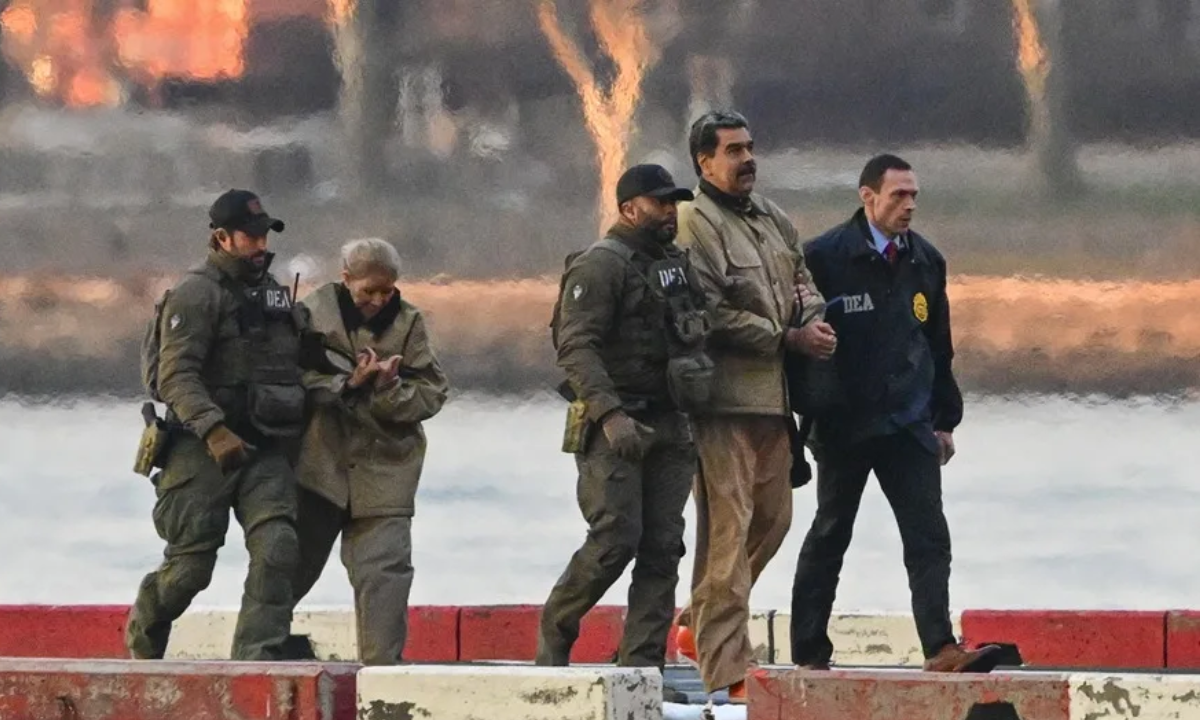
Nicolás Maduro surrounded by DEA agents. Photo: Archivo particular
Carvajal further alleged that Maduro personally directed the response to protests, maintaining direct communication with both the PNB and the National Guard. “In theory, all public order actions are the responsibility of the Ministry of the Interior, but in practice, Nicolás Maduro decides everything, and even has direct communication with the Police and the National Guard,” he said.
He also claimed that Maduro ordered the repression of any protests, regardless of the risk to human life. “He needed to demonstrate that his power and strength were above any political or civil attempt to resolve the demands of society,” Carvajal stated. This testimony could significantly impact the ICC’s investigation into alleged crimes against humanity in Venezuela.
READ ALSO
Carvajal also asserted that Néstor Reverol, a former Minister of Interior and Justice, instructed the director of the Scientific, Criminal and Forensic Investigation Corps to manipulate forensic evidence to incriminate protesters and exonerate state security forces.
“The Maduro regime has created many illegal ways to neutralize protests, but it can be summarized in two main modalities. First, with the irregular use of security forces; and second, with the use of armed groups,” he said.
In closing his statement, Carvajal distanced himself from the Chavismo government and framed his actions as a matter of political responsibility to the Venezuelan people. “I would like to make it clear that, as a general citizen of the Republic and a deputy of the legitimate National Assembly (2015), I owe myself to the people and, in honor of that population, I withdrew my support from the government, fundamentally due to all the atrocities committed and the violation of human rights, as I have already mentioned,” Carvajal concluded.
Despite cooperating with the ICC, Carvajal stated he faces personal obstacles limiting his full cooperation.
“Unfortunately, I find myself in a personal situation of political persecution that does not allow me to provide the collaboration that commission deserves,” he added.
Nicolás Maduro on the day of his first hearing. Photo: EFE
Carvajal also sent a letter, dated December 2, to Donald Trump, denouncing the dynamics of gangs such as the Tren de Aragua and the Cartel de los Soles, and how these groups allegedly use drug trafficking as a strategy against the United States. He also revealed that, for two decades, the regime had allegedly sent undercover spies posing as opposition members to the U.S.
‘El Pollo’ is currently detained in New York awaiting trial.
Unexpected Visit to Nicolás Maduro
On the same day the audio recordings were released, Nicolás Maduro and his wife, Cilia Flores, received a consular visit from a Venezuelan official at the federal detention center where they are being held in New York, while awaiting their next judicial hearing, scheduled for March 26.
READ ALSO
According to a notification from the Prosecutor’s Office and the defense to the judge, available this Wednesday in the case’s digital file, Maduro and Flores received the official “representing the Republic of Venezuela to help facilitate any services the accused may need.”
The document, delivered Tuesday, notes that Judge Alvin Hellerstein ordered the Prosecutor’s Office, in the initial appearance of the accused on January 5, to facilitate access to consular services and inform the court when it does so.
The next hearing for Maduro and Flores is scheduled for March 26 at 11 a.m., after the Prosecutor’s Office, with the consent of the defense, requested a postponement from the original date of March 17.
