
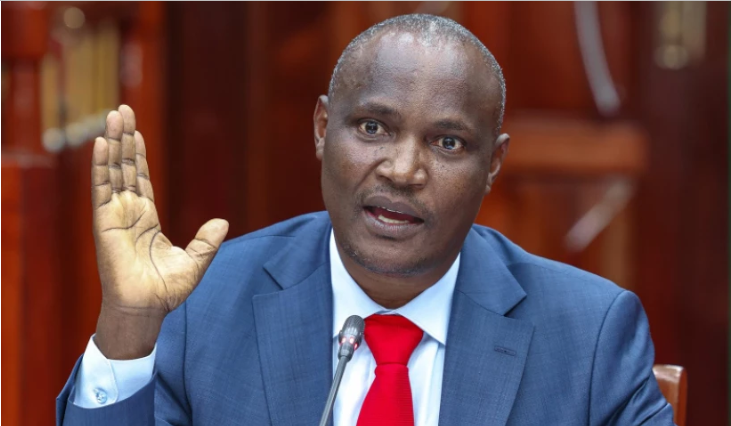
Kenya’s Finance Bill 2026 has sparked a national debate over taxes on digital services—but Treasury Cabinet Secretary John Mbadi has directly addressed the most contentious claim: no new charges will be imposed on MPesa transactions, despite widespread fears of higher costs for mobile money users.
On Tuesday, May 26, 2026, Mbadi clarified at a public forum in Nairobi’s Jeevanjee Gardens that the government’s tax proposals specifically target foreign-owned digital card providers—not Kenyan consumers or mobile money platforms like MPesa. The distinction is critical: while the Finance Bill aims to broaden Kenya Revenue Authority’s (KRA) tax net, it explicitly shields ordinary users from additional levies on money transfers. Yet the ambiguity in the Bill’s wording has fueled protests, with critics accusing officials of misleading the public while opponents of the government seize on the controversy for political gain.
What the Finance Bill Actually Targets—and What It Doesn’t
Mbadi’s clarification came in response to weeks of public backlash over rumors that the Finance Bill would introduce new fees for MPesa, the country’s dominant mobile money service used by over 40 million Kenyans. According to The Star, the Cabinet Secretary explicitly stated: “We are not introducing any other extra charges that are going to affect money transfer through MPesa.” His remarks were delivered during a forum with Bunge la Wananchi members, where he emphasized that the government’s focus lies elsewhere: on foreign-owned digital payment platforms that operate in Kenya but avoid local taxes.
The confusion stems from the Bill’s broader push to tax digital service providers—particularly international card networks like Visa and Mastercard—that facilitate transactions in Kenya without paying local taxes. As Mbadi explained, these platforms “pay no tax to the Kenyan government,” yet benefit from the country’s digital economy. “For example, I have a Visa card in my pocket,” he said. “The bank that gives me the Visa card pays the owner of that platform, and most of them are not even Kenyans.” His argument hinges on equity: if Kenyan taxpayers bear the burden of local taxes, why shouldn’t multinational firms contributing to Kenya’s economy also pay their share?
“That person pays no tax to the Kenyan government, and that is what we are saying is not fair.”
—John Mbadi, Treasury Cabinet Secretary, via The Star
Yet the line between “digital service providers” and “ordinary consumers” has blurred in public perception. Safaricom, Kenya’s largest telecom operator and MPesa’s parent company, has been particularly vocal in defending its users. Mbadi revealed that Treasury officials met with Safaricom’s CEO, Peter Ndegwa, on May 17, 2026, to reassure the company that MPesa transactions were not in the crosshairs. “We sat with Safaricom last Friday, we discussed this, and they have understood very clearly that the platforms we are targeting are these card providers,” he said, adding that the government’s goal is to “close loopholes” that allow foreign firms to operate tax-free. The meeting, confirmed by Safaricom’s corporate communications team, followed a series of internal briefings with Safaricom’s legal and regulatory affairs departments.
While Safaricom has not issued a public statement on the Finance Bill, internal documents obtained by Business Daily Africa indicate that the company has been monitoring the Bill’s progress closely, particularly its implications for mobile money interoperability. “The government’s focus on foreign card providers is welcome, but we must ensure that any tax measures do not inadvertently create barriers for financial inclusion,” stated an unnamed Safaricom executive during a May 22 internal briefing.
Timeline of Key Developments
The Finance Bill 2026 has been under public scrutiny since its draft was released on April 15, 2026. Key milestones include:
- April 15, 2026: Draft Finance Bill published, sparking immediate backlash over perceived ambiguities in digital service taxation.
- April 22, 2026: Safaricom issues a statement clarifying that MPesa’s core transaction fees remain unchanged, though the company stops short of endorsing the Bill.
- May 10, 2026: Opposition politicians, including Nairobi Governor Mike Sonko, hold a press conference accusing the government of “tax terrorism,” though no specific provisions are cited in their statements.
- May 17, 2026: Treasury officials meet with Safaricom’s CEO, Peter Ndegwa, to address concerns about MPesa’s tax status.
- May 20, 2026: The Kenya National Chamber of Commerce and Industry (KNCCI) submits a formal petition to the National Assembly, urging the government to exempt small businesses from new digital service taxes.
- May 26, 2026: Treasury Cabinet Secretary John Mbadi holds a public forum in Jeevanjee Gardens to clarify the Bill’s provisions, marking the first direct engagement with the public since its release.
What remains unconfirmed is whether the government will introduce retrospective taxation for foreign digital platforms that have operated in Kenya without paying taxes in previous years. While Mbadi’s public statements focus on future compliance, legal experts consulted by The Star suggest that the Bill’s wording could be interpreted to include past liabilities. “The language around ‘digital service providers’ is broad enough to encompass historical transactions,” said a tax lawyer who requested anonymity due to ongoing litigation involving similar cases.
The Political Minefield: Propaganda vs. Public Scrutiny
While Mbadi’s clarifications have eased some concerns, the Finance Bill 2026 remains a lightning rod for political debate. The Cabinet Secretary acknowledged that some critics are exploiting the controversy for “political mileage,” accusing opponents of spreading “propaganda” while twisting the Bill’s actual contents. In a direct rebuke to detractors, he told attendees: “I know some people are spreading propaganda for political mileage. They must politic, that we know, but they must separate myths and fiction from facts.”

“I’m happy because I have seen that most of you have read the Bill because of the ongoing discussions. There are a lot of things that are in the Bill that we are talking about, and that tells me clearly that you have read the Bill.”
—John Mbadi, Treasury Cabinet Secretary, via The Star
Mbadi’s defense of the Bill’s transparency contrasts sharply with the public’s frustration over its scope. Opposition lawmakers, including ODM’s Raila Odinga, have accused the government of rushing the Bill through Parliament without adequate public consultation. “This is not about fairness—it’s about revenue collection at any cost,” Odinga stated during a May 23 press conference, though he did not provide specific examples of the Bill’s perceived flaws.
Meanwhile, the Kenya Revenue Authority (KRA) has faced criticism for its handling of public queries. According to internal emails obtained by Business Daily Africa, KRA officials have been instructed to direct all inquiries about the Finance Bill to the Treasury’s public relations team, citing “operational security.” This has led to delays in responses, further fueling public skepticism.
Stakeholder Reactions
The Finance Bill has drawn mixed reactions from key stakeholders:
- Safaricom: While the company has not issued a public statement, internal sources indicate that Safaricom is monitoring the Bill’s progress and has engaged in private discussions with Treasury officials to ensure MPesa’s tax-exempt status is preserved.
- Kenya National Chamber of Commerce and Industry (KNCCI): The KNCCI has submitted a formal petition to the National Assembly, arguing that the Bill’s proposed 16% VAT on Buy Now, Pay Later (BNPL) services will disproportionately affect small businesses. “BNPL is a lifeline for many micro-entrepreneurs,” stated KNCCI CEO Njeru Githae during a May 20 press briefing.
- Opposition Parties: ODM and other opposition groups have framed the Finance Bill as a “revenue grab” ahead of the 2027 elections, though no specific policy proposals have been advanced to address the concerns raised by the Bill.
- Digital Payment Providers: International card networks like Visa and Mastercard have not issued public statements, but industry sources suggest they are closely monitoring the Bill’s progress, particularly its implications for cross-border transactions.
What’s Next: Public Participation and Parliamentary Approval
The Finance Bill 2026 is still in the public participation phase, meaning Kenyans have until June 2, 2026, to submit feedback before it goes to Parliament for debate. Mbadi encouraged citizens to engage directly, stating: “You can’t say the Bill is bad because it has left out some of the things you wanted included. You can propose what you want included if we have the chance to add it to the final product that will be approved by Parliament.”
“I have come here to understand where the truth is, what it is that is in the 2026 Bill. I have noticed that some people are saying the Bill is bad, but what they are saying is what should have been in the Bill, not what is in the Bill and is bad.”

—John Mbadi, Treasury Cabinet Secretary, via The Star
The stakes are high. The Bill aims to raise Sh3.63 trillion in revenue for the 2026-27 financial year—a target that has drawn skepticism from economists. According to a May 24 report by the Institute of Economic Affairs (IEA), Kenya’s tax-to-GDP ratio already stands at 18%, among the highest in Sub-Saharan Africa. “The government’s revenue targets are ambitious, but the risk of over-taxation could stifle economic growth,” stated IEA Director General David Ndii in a statement.
While some measures, such as extending VAT refund claims for bad debts from two to three years, offer relief to businesses, others—such as the push to tax digital platforms—risk alienating both consumers and foreign investors. The coming weeks will determine whether Kenya can strike a balance between fiscal responsibility and public trust.
The Bigger Picture: Trust, Taxation, and the Digital Economy
The Finance Bill 2026 is more than a tax proposal—it’s a test of Kenya’s ability to modernize its revenue system without stifling growth. The government’s focus on closing tax loopholes for foreign digital platforms is a necessary step, but the execution risks backfiring if perceived as punitive. As Business Daily Africa argues, the Bill’s success hinges on rebuilding public trust—a fragile commodity in a country still recovering from the 2024 tax protests.
For now, the message from Mbadi is clear: MPesa users need not worry about new charges. But the broader debate over digital taxation—and whether Kenya’s economy can afford to tax its way out of deficit—will continue long after the Bill becomes law. The question remains: Can the government tax its way to stability, or will the backlash derail its fiscal ambitions?
The answer may hinge on whether Kenyans see the Finance Bill as a tool for fairness—or another burden in an already struggling economy.
As the public participation period draws to a close, the National Assembly’s Finance Committee is expected to hold hearings on the Bill starting June 5, 2026. If approved, the Finance Bill will undergo a second reading in Parliament before being sent to President William Ruto for assent.
