
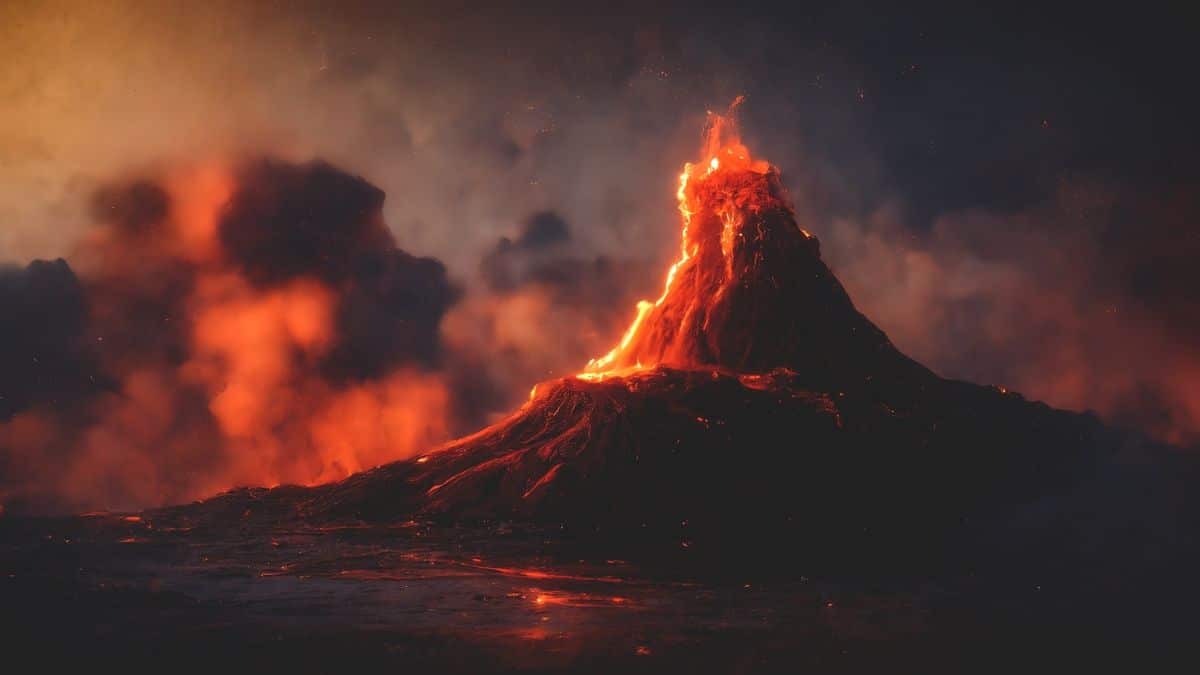
A new study published in Nature Communications reveals that magma superheating plays a decisive role in volcanic eruption styles. Researchers from the University of Manchester found that when magma temperature exceeds crystal stability thresholds, it remains fluid longer, leading to explosive lava fountains rather than slow, steady lava flows.
The Mechanism of Magma Superheating
The distinction between a tranquil lava flow and a violent volcanic eruption often comes down to the thermal history of the magma before it reaches the surface. According to reporting by Vosveteit.sk, the research team analyzed samples from the 2021 eruption of the Tajogaite volcano on La Palma. Their findings suggest that when magma is “superheated”—pushed above the temperature where mineral crystals remain stable—the internal structure of the molten rock changes significantly.

Under normal cooling conditions, magma develops mineral crystals that increase its viscosity, or thickness. This thicker consistency allows gases to escape more gradually. However, superheating dissolves these early crystal seeds, keeping the magma in a more fluid, homogeneous state for a longer duration. This delay in crystallization changes the physics of the eruption entirely.
In volcanology, the transition from a liquid to a solid state is governed by the nucleation and growth of crystals. As magma rises through the Earth’s crust, it experiences a drop in pressure and temperature. Traditionally, models of volcanic behavior assumed that this process was relatively predictable based on the chemical composition of the melt. However, the study highlights that the thermal “memory” of the magma—how much heat it retained during its ascent—can override these chemical expectations. By dissolving the nuclei that would otherwise facilitate crystal formation, superheating prevents the magma from thickening as it nears the surface, allowing it to maintain a lower viscosity until the final moments before an eruption.
Laboratory Validation of Volcanic Behavior
To confirm these findings, the international team recreated subterranean conditions in a laboratory setting. By utilizing synchrotron X-ray microtomography at the Diamond Light Source facility in the United Kingdom, they observed crystallization processes in real time. Supplementary experiments conducted in Prague provided a longer-term view of these thermal changes.
The data revealed a striking temporal gap:
- Standard Magma: Began forming mineral crystals approximately 20 minutes after cooling began.
- Superheated Magma: The onset of crystallization was delayed by more than eight hours.
“Doteraz sme úplne nerozumeli tomu, ako rastú kryštály v magme, ktorá získala dodatočné teplo tesne pred výstupom k povrchu,” explained lead author Barbara Bonechi, as cited by Vosveteit.sk. This research effectively shifts the scientific focus from purely chemical composition toward the importance of the magma’s thermal journey during its ascent. The use of synchrotron radiation is critical here because it allows researchers to peer through opaque, molten rock samples at a microscopic level, capturing the exact moment a crystal lattice begins to form—a feat impossible with standard optical microscopy.
Mapping the Subsurface at Mount Erebus
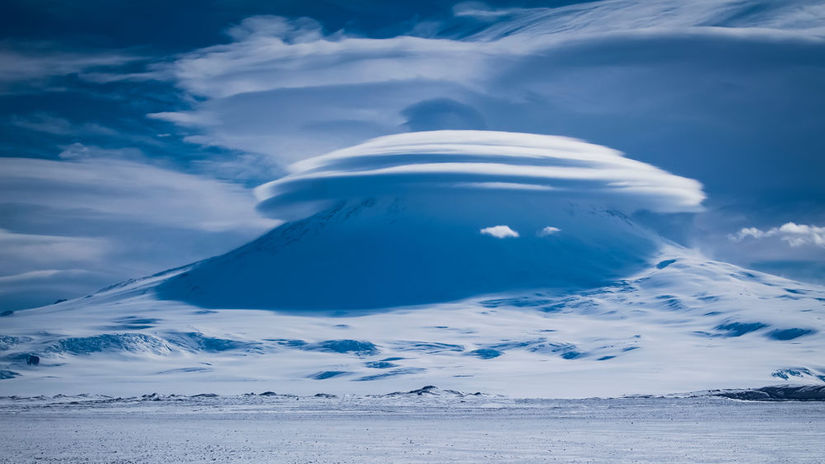
While the La Palma study focuses on thermal state, other research has mapped the physical architecture of volcanic plumbing. Scientists from the Geophysical Institute of the Czech Academy of Sciences and the University of Utah have utilized the magnetotelluric method to visualize the interior of Mount Erebus in Antarctica. As reported by VAT.Pravda.sk, this technique measures the electrical resistance of rocks to create a 3D map of magma pathways down to 100 kilometers.
The model shows that the conduit feeding the Mount Erebus lava lake is not a straight pipe. It begins at the crust-mantle boundary roughly 40 kilometers deep, narrows within the crust, and bends sharply eastward at a depth of 10 kilometers. Researchers attribute this “duck-bill” shape to tectonic fault zones that act like pressure valves, regulating the flow of magma and carbon dioxide. Magnetotellurics relies on natural variations in Earth’s magnetic field, which induce tiny electrical currents in the ground; because magma is significantly more conductive than solid rock, these currents reveal the geometry of the plumbing system with high resolution.
The Role of Gas and Composition in Eruptions
Beyond thermal states and conduit geometry, the fundamental behavior of a volcano is dictated by gas content and silica, or quartz, composition. According to Aktuality.sk, eruptions are essentially gas-driven processes similar to a shaken soda bottle. Magma rich in gas undergoes rapid expansion upon reaching the atmosphere, shattering the rock into ash and pyroclastic material.

The silica content further determines the “flow” characteristics:
| Lava Type | Characteristics |
|---|---|
| Low-silica | Liquid, fast-moving, glowing red flows. |
| High-silica | Viscous, sticky, asphalt-like movement. |
Volcanoes with high silica content, such as stratovolcanoes, are often the most hazardous because their sticky lava traps volcanic gases. As the magma rises, the pressure decreases and these gases attempt to escape, but the high viscosity prevents them from doing so easily. The resulting pressure buildup eventually exceeds the strength of the surrounding rock, leading to explosive, catastrophic eruptions. Conversely, low-silica volcanoes, like those found in Hawaii or Iceland, typically allow gas to escape relatively easily, resulting in the more predictable, fountain-like eruptions that characterize those regions.
These varying factors—superheating, conduit architecture, and chemical composition—collectively determine the hazard profile of a volcano. Understanding these variables allows researchers to better predict whether a volcanic event will result in a manageable lava flow or a dangerous explosive eruption. As these studies demonstrate, the most critical “decisions” a volcano makes occur deep within the Earth, long before the magma reaches the crater. By integrating thermal history data with structural maps of the subsurface, the scientific community is moving closer to an era where the precursors to explosive events can be identified with greater lead time, potentially enhancing early warning systems for populations living in the shadow of active volcanoes.
Find more reporting in our Tech section.
