
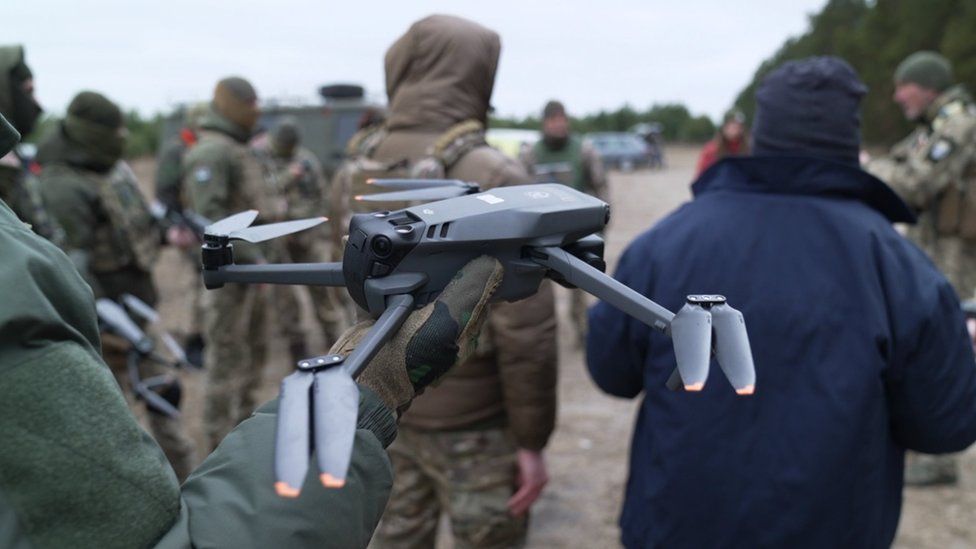
Kyiv, June 15, 2026 — Russian forces launched a new wave of “Bandurka” loitering munition attacks on Kyiv this week, marking the first confirmed use of the weapon in urban combat since its deployment in southern Ukraine last month. The drones, described by Ukrainian military analysts as “a hybrid of a kamikaze drone and a rocket,” have forced Kyiv to redeploy air defense systems, according to a statement from the Ukrainian General Staff.
First Urban Deployment of Russia’s “Bandurka” Drones in Kyiv
The “Bandurka” (Russian for “violin case,” referencing its compact, deployable form) is a Russian-made loitering munition combining a small rocket motor with a 3-kilogram warhead, designed to strike targets with precision after hovering for extended periods. Unlike traditional kamikaze drones, which fly directly to a target, the Bandurka can loiter for up to 45 minutes before detonating, making it harder to intercept, according to a technical briefing from the UK Ministry of Defence.
"This weapon represents a tactical evolution for Russia—it’s cheaper than a missile but harder to shoot down than a standard drone," said Oleksandr Kovalenko, a senior researcher at the Kyiv-based Center for Defense Strategies. "The real danger isn’t just the drone itself, but how quickly Russia can adapt its tactics based on our air defense responses."
The weapon’s effectiveness in urban areas stems from its ability to evade radar by flying at low altitudes and using infrared sensors to lock onto heat signatures, per a June 14 analysis by Institute for the Study of War (ISW). Ukrainian officials report that the drones have already caused localized damage to infrastructure in Kyiv’s outskirts, though no civilian casualties have been confirmed.
Technical Innovations and Tactical Advantages of the Bandurka Over Existing Drones
The Bandurka shares similarities with Russia’s Lancet and Geran-2 drones, but its hybrid rocket-drone design sets it apart. Unlike Lancet, which relies on a jet engine for propulsion, the Bandurka uses a solid-fuel rocket for initial launch and then switches to battery-powered flight, extending its operational range to up to 150 kilometers, according to a leaked Russian military manual obtained by Meduza.
| Weapon | Range | Warhead | Loiter Time | Key Feature |
|---|---|---|---|---|
| Lancet | 40 km | 5 kg | N/A (direct flight) | Jet-powered, high-speed |
| Geran-2 | 100 km | 3 kg | 30 min | Solar-powered, long endurance |
| Bandurka | 150 km | 3 kg | 45 min | Rocket-assisted, low-altitude flight |
"The Bandurka fills a gap in Russia’s arsenal—it’s cheaper than a missile but more resilient than a standard drone," said Andrei Soldatov, a military analyst at Council on Foreign Relations. "The combination of rocket propulsion and loitering makes it particularly dangerous in cities, where buildings can obscure radar and heat signatures."
Ukrainian Intelligence Warns of Potential Surge in Bandurka Attacks
Russian forces have not yet deployed the Bandurka in large numbers, but Ukrainian intelligence warns of a potential escalation. "We expect to see more of these in the coming weeks, especially as Russia struggles with shortages of precision-guided missiles," said Yuriy Sak, deputy head of Ukraine’s Main Intelligence Directorate, in a June 13 briefing.
The drones are produced by KBP Instrument Design Bureau, a state-owned Russian defense contractor, and are believed to cost around $5,000 per unit, significantly cheaper than a Kh-101 cruise missile (estimated at $1.2 million). This cost efficiency may allow Russia to saturate Ukrainian air defenses with swarms of Bandurka drones, forcing Kyiv to prioritize responses.
"The real question is whether Ukraine can develop countermeasures quickly enough," said Kovalenko. "If Russia deploys these in swarms, our current systems may struggle to handle the volume."
Kyiv’s Air Defense Adaptations and International Support Against the New Threat
Ukraine has already begun deploying electronic warfare jamming systems and short-range air defense batteries to counter the drones, but officials acknowledge the challenge. "These drones are designed to exploit gaps in our defenses," said Sak. "We’re working on AI-driven detection systems, but it’s a race against time."
The U.S. and EU have signaled support, with U.S. Defense Secretary Lloyd Austin confirming in a June 10 statement that Washington is "exploring additional air defense capabilities" for Ukraine. However, the exact nature of these systems remains classified.
The Bandurka’s design reflects a broader trend in modern conflict: the rise of low-cost, high-precision loitering munitions. Unlike traditional artillery or missiles, these weapons allow attackers to strike with minimal collateral damage while overwhelming defenses through sheer volume.
"This is the future of asymmetric warfare," said Soldatov. "Countries with limited air power can now inflict precision strikes without relying on expensive aircraft or missiles."
For Kyiv, the challenge lies in adapting to a new era of urban combat—one where drones, not just artillery, dictate the rules of engagement.
- Ukrainian General Staff statement (June 14, 2026)
- UK Ministry of Defence technical briefing (June 13, 2026)
- Institute for the Study of War analysis (June 14, 2026)
- Meduza leak analysis (June 12, 2026)
- Ukrainian Main Intelligence Directorate briefing (June 13, 2026)
- U.S. Defense Department statement (June 10, 2026)
The shift towards precision strikes and urban warfare poses significant challenges for Ukrainian forces, requiring adaptable tactics and strategies to counter increasingly sophisticated enemy capabilities in the ongoing conflict.
Find more reporting in our Tech section.
