
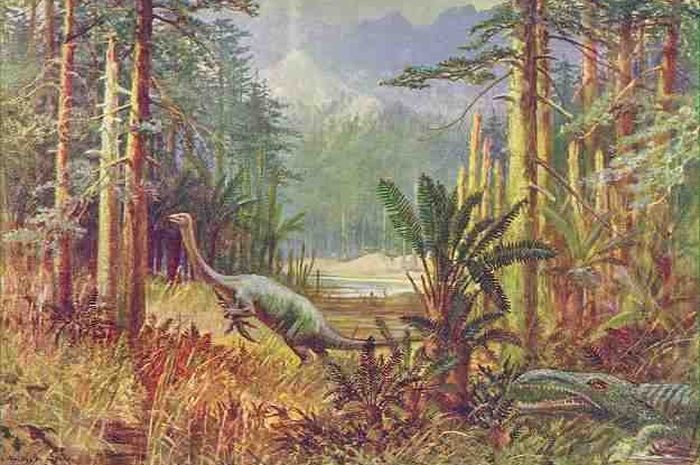
the story of Anchisaurus, an early Jurassic dinosaur, reveals how paleontological understanding can evolve through serendipitous discoveries and decades of revised analysis. first identified in the mid-19th century during construction work in Connecticut and Massachusetts,the fragmented fossils of this “near lizard” initially baffled scientists,leading to multiple naming changes before settling on Anchisaurus in 1865. This account details the complex history of this sauropodomorph-a crucial link in understanding the evolution of long-necked giants-and how ongoing research continues to refine our knowledge of its place in prehistoric life.
The scientific story of Anchisaurus, a long-necked dinosaur from the early Jurassic period, is a testament to how discoveries can emerge from unexpected places. Understanding the evolution of these early dinosaurs provides valuable insight into the lineage of some of the largest creatures to ever walk the Earth.
The first fossils of Anchisaurus weren’t unearthed during a dedicated paleontological expedition, but rather during construction work in the United States. While many of the bones were fragmented and scattered by the blast, the recovered pieces proved crucial for understanding the early evolution of sauropodomorphs – the group that includes iconic long-necked dinosaurs like Brachiosaurus and Diplodocus.
The dinosaur’s journey to scientific recognition began in 1865 when geologist Edward Hitchcock initially named the fossil Megadactylus. However, that name was already in use for another animal, prompting a change to Amphisaurus. That name, too, had already been assigned.
It wasn’t until the third attempt that the name Anchisaurus – meaning “near lizard” – stuck, reflecting its evolutionary relationship to the sauropoda. Researchers believe Anchisaurus was capable of walking on four legs, but could also stand on two, potentially using its hind legs to run quickly when threatened.
Each of its hands was equipped with sharp, strong claws, a feature that sparked considerable debate about its lifestyle. Until the 1950s, some paleontologists, including Richard Swan Lull of Yale University, believed Anchisaurus was an active carnivore that hunted smaller vertebrates.
However, modern research now strongly suggests it was likely a herbivore, with the claws used for stripping bark from trees, grasping vegetation, or defending itself against predators. This shift in understanding highlights how scientific knowledge evolves with new evidence and analytical techniques.
The first Anchisaurus fossils appeared in 1855 at the Springfield Armory National Historic Site, when workers blasting during construction uncovered the mysterious bones. Unfortunately, many were destroyed or taken home by workers before experts could be notified.
Inspector William Smith eventually contacted Hitchcock, sending him as much of the damaged material as he could recover. For years, Anchisaurus was considered to be 190 million years old.
However, rock dating in 2013 revealed that the layer where the fossils were found is actually between 201.6 and 200.9 million years old, making it older than previously thought. Footprints from the same period, discovered in Nova Scotia, bear a striking resemblance to those of Anchisaurus, though a definitive identification remains elusive.
In the 1880s, the most complete Anchisaurus skeleton was found in Manchester, Connecticut, encased within a stone block sold for construction purposes. Renowned paleontologist Othniel Charles Marsh of Yale initially attributed the fossil to Anchisaurus, but then renamed it Ammosaurus.
Some modern experts believe Marsh’s initial assessment may have been correct, suggesting that Ammosaurus could be an invalid name. The saga continued when other skeletal remains were discovered incorporated into the structure of a local bridge.
