
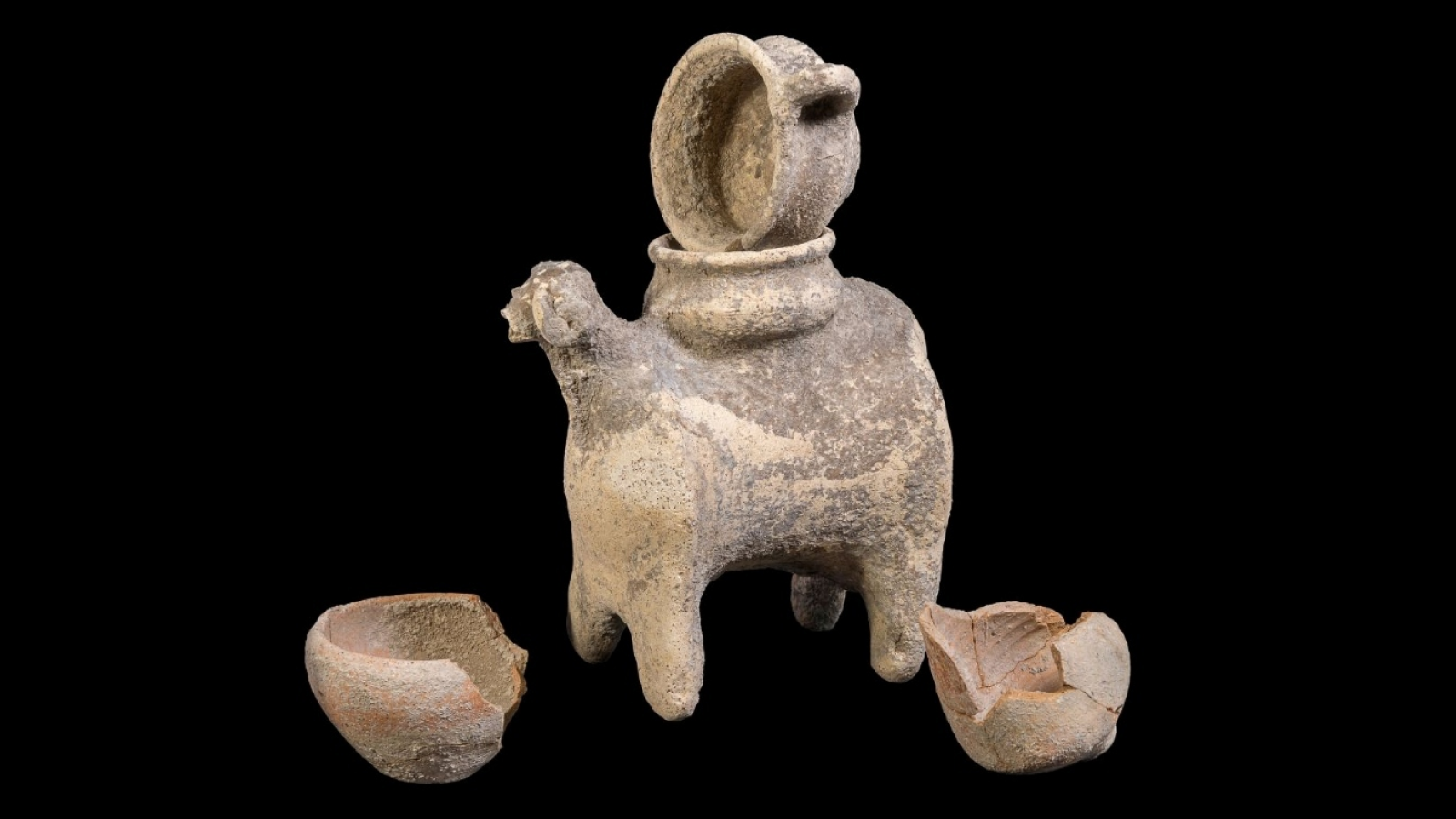
3,300-Year-Old ‘Tea Set,’ Ancient Winepress Unearthed Near Armageddon
Archaeologists excavating near the ancient city of Armageddon in Israel have discovered a remarkably preserved Canaanite “tea set” dating back 3,300 years, along with a miniature temple and one of the world’s oldest known winepresses.
The “tea set” consists of a ram-shaped teapot and several small bowls, believed to have been ritual offerings buried during the Late Bronze Age. Researchers from the Israel Antiquities Authority (IAA) explained that the ram’s head was molded to function as a spout, allowing liquid to pour from its mouth. “The vessel seems intended for pouring a valuable liquid such as milk, oil, wine or another beverage,” the IAA stated, “which could either be drunk directly from the spout, or poured into a smaller vessel for consumption, or as a votive gift.” The discovery provides insight into the religious practices and daily life of the Canaanite people.
Alongside the tea set, archaeologists uncovered a 3,300-year-old ceramic model temple, offering a potential glimpse into the architecture of larger Canaanite temples. “This is what the real temples in the Canaanite Late Bronze Age may have looked like,” said Amir Golani, an IAA excavation director, in a translated video. Further excavation revealed a 5,000-year-old winepress carved into the rock, a significant find as it represents one of the earliest examples of winemaking in the region – a practice that continues to be culturally important in Israel today. You can learn more about the history of Megiddo on Encyclopedia Britannica.
The artifacts were found ahead of road construction in the Jezreel Valley, near Megiddo, a site historically known as Armageddon and mentioned in the Book of Revelation. The area has been continuously inhabited since approximately 7000 B.C. and has seen numerous battles throughout history. IAA directors Golani and Barak Tzin noted in a joint statement that the winepress is “unique, one of very few known from such an ancient period when urbanization first took place in our region,” and provides “conclusive proof” of early winemaking. Further research into the site is planned to understand the full extent of Canaanite life in the area, as detailed on the Israel Antiquities Authority website.
The IAA plans to continue analyzing the artifacts and expanding the excavation site to uncover more details about the ancient civilizations that once thrived there.
