
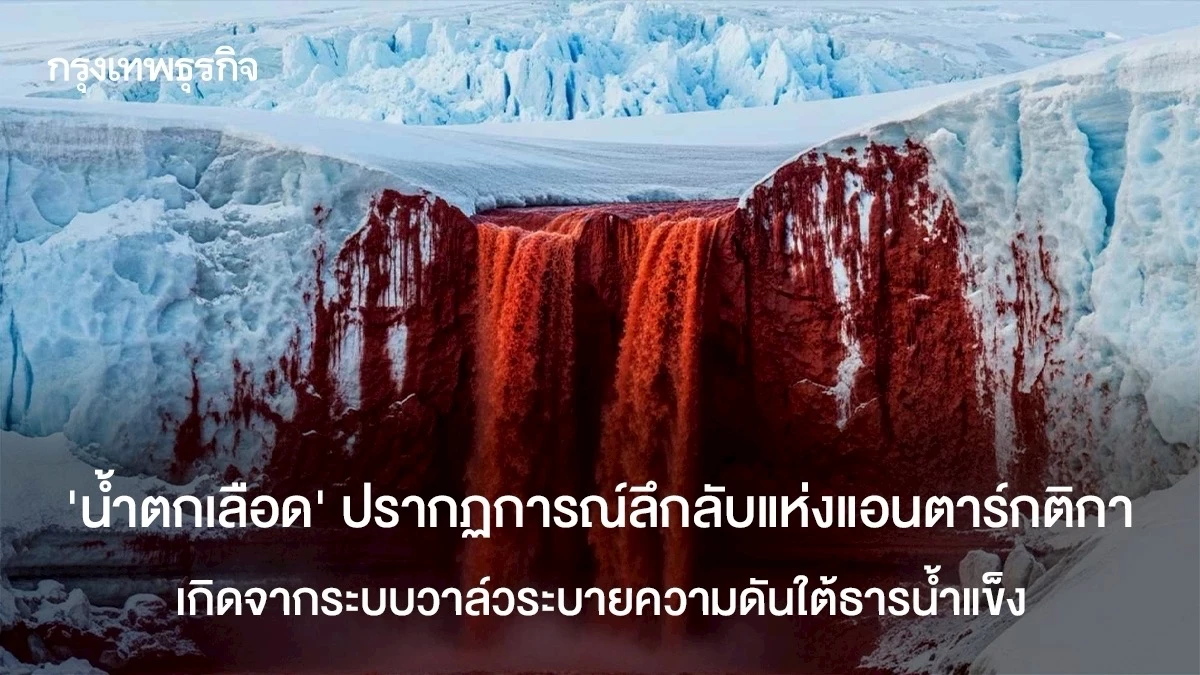
For more than a century, the Blood Falls at East Antarctica’s Taylor Glacier have confounded researchers, appearing as a crimson stream flowing against a backdrop of white ice. Scientists have now confirmed the source of this phenomenon, concluding that the signature red color results from hypersaline water rich in iron-bearing nanospheres.
A Century of Mystery at Taylor Glacier
The stark visual of red liquid pouring from the pristine white ice of the Taylor Glacier in the McMurdo Dry Valleys has long invited speculation. First discovered in 1911 by Australian geologist Thomas Griffith Taylor during the Terra Nova Expedition, the site earned its name, Blood Falls, for its unsettling resemblance to a biological wound, as reported by Bangkok Biz News.

For decades, the prevailing hypothesis was that the coloration was caused by red algae or other organic matter present in the glacial melt. However, this theory failed to account for the chemical composition of the water and the extreme environmental conditions that allow a liquid to flow continuously in a region where temperatures consistently drop far below the freezing point of water. The persistence of the flow, despite the surrounding sub-zero climate, necessitated a deeper investigation into the sub-glacial hydrology of the McMurdo Dry Valleys.
The site remains a focal point for researchers studying extreme environments, as the Taylor Glacier serves as a natural laboratory for understanding how life and chemistry persist in isolated, high-salinity conditions. The isolation of the sub-glacial reservoir suggests that the water has been cut off from the atmosphere for an extended period, creating a unique environment that preserves ancient chemical signatures.
The Chemistry Behind the Crimson Flow
Modern scientific analysis has finally moved beyond the initial algae theories, identifying the true culprit behind the red hue: iron. According to research cited by Sanook, the liquid is not blood, nor is it the result of any biological harm to the ecosystem. Instead, the water is a highly concentrated brine that has been trapped beneath the glacier for millions of years.

The key to the color lies in the presence of microscopic iron-bearing particles known as nanospheres. These particles, which are derived from the bedrock beneath the glacier, are suspended within the brine. When this iron-rich brine is finally forced out from beneath the ice and exposed to the atmosphere, it undergoes a rapid oxidation process. Upon contact with oxygen, the iron reacts and turns into a rust-like color, effectively painting the water the vibrant red that characterizes the falls. This oxidation is a surface-level reaction; the brine itself remains clear while beneath the glacier, only revealing its striking coloration upon reaching the exterior environment.
The discovery of these nanospheres provides a clear explanation for the visual appearance that has puzzled generations of explorers. By utilizing advanced imaging and spectroscopic analysis, researchers have been able to isolate these particles and confirm their role in the coloration, moving the conversation from speculative theories regarding biological pigments to a concrete understanding of iron geochemistry in glacial systems.
Why the Water Remains Liquid
A primary question that occupied researchers for over 100 years was how this water could exist in a liquid state despite the extreme sub-zero temperatures of the Antarctic environment. The answer lies in the extreme salinity of the trapped water. The brine contains a massive concentration of salt, which acts as a powerful antifreeze.
This high salt content prevents the water from turning to ice, allowing it to remain fluid while stored in a subterranean reservoir beneath the Taylor Glacier for millions of years. The process is further aided by the release of latent heat; as the brine freezes slightly at the edges of the reservoir, the heat released by the phase change helps to keep the remaining core of the liquid unfrozen. This discovery highlights the unique geological and chemical conditions that allow such a rare phenomenon to persist, turning a mystery that baffled early 20th-century explorers into a documented case study of cryospheric chemistry.

The sub-glacial reservoir is not merely a static pool; it acts as a complex chemical system. The interaction between the brine and the underlying bedrock continues to modify the chemical profile of the water, ensuring that the necessary concentrations of minerals—specifically iron—are maintained. This chemical stability is essential for the continued flow of the falls, as any significant change in the salinity or mineral content would likely disrupt the fluid dynamics that drive the brine to the surface.
Administrative Clarification: Distinguishing Scientific Fact from Immigration Procedures
It is important for readers to distinguish between the natural phenomena of the Antarctic and unrelated administrative processes that may appear in search queries. While researchers continue to study the unique environment of the McMurdo Dry Valleys, individuals seeking information regarding the Form I-90 are dealing with an entirely different set of requirements.
Form I-90 is the official documentation used by permanent residents in the United States to apply for a replacement of their Permanent Resident Card, commonly known as a green card. The requirements for this form—such as providing proof of identity, detailing the reason for replacement (such as loss, theft, or expiration), and ensuring all non-English documents are accompanied by certified translations—are strictly legal and administrative in nature. These processes are entirely distinct from the geological studies conducted at the Taylor Glacier, though both topics often appear in digital information repositories. Misidentifying these disparate fields can lead to confusion; the scientific inquiry into Blood Falls remains firmly rooted in the physical sciences, while Form I-90 is a matter of administrative law and immigration policy.
