

Colombia’s right-wing shift: How a U.S.
A right-wing outsider backed by former U.S. President Donald Trump has won Colombia’s presidential election, ending a decade of left-leaning governance and signaling a sharp turn toward security-focused policies. The victory of Álvaro de la Espriella—nicknamed “the Tiger” for his hardline stance—over his leftist rival Iván Spada by a margin of roughly 245,000 votes marks the first time in Colombia’s modern history that a conservative candidate has defeated a progressive one in a runoff, according to Ynet News. His win comes amid escalating violence, soaring cocaine production, and protests that turned violent in cities like Cali, where demonstrators clashed with police over the election results.
Who won—and why the margin matters
De la Espriella secured 49.66% of the vote, narrowly edging out Spada’s 48.70%, according to Makor Rishon. The razor-thin gap—just 0.96 percentage points—reflects deep polarization in Colombia, where the leftist FARC peace process and the right’s crackdown on drug trafficking have become defining political fault lines. Spada, who refused to concede immediately, claimed irregularities in 33,000 voting booths, though no evidence of widespread fraud has been substantiated. His refusal to acknowledge defeat risks prolonging political instability in a country still grappling with post-conflict reconciliation.
The election’s outcome hinged on two factors: security and U.S. backing. De la Espriella’s campaign positioned him as a law-and-order candidate, promising a 90-day military offensive against dissident FARC factions and drug cartels, with explicit support from Washington. His dual citizenship—Colombian and American—gave him access to Trump-era networks, including a public endorsement from the former president, who called his victory a “win for freedom.” Meanwhile, Spada’s leftist platform, which emphasized social programs and continued peace talks, struggled to resonate in a country where cocaine exports hit record highs in 2025 and homicides rose by 20% in the first quarter of 2026.
Israel’s quick embrace—and what it signals
Israel’s Foreign Minister Gideon Sa’ar was among the first world leaders to congratulate de la Espriella, tweeting in Hebrew: “The Tiger won, I invited him to Israel”. The move underscores Colombia’s growing strategic value as a regional partner against Iran-backed militias, particularly Hezbollah’s expanding influence in Latin America. De la Espriella has openly criticized Iran’s support for Venezuela’s Nicolás Maduro and has signaled interest in deepening ties with Jerusalem, including relocating Colombia’s embassy from Tel Aviv to Jerusalem—a move that would align with Trump’s 2017 recognition of Jerusalem as Israel’s capital.
Sa’ar’s invitation reflects a broader regional realignment. While leftist governments in Mexico and Argentina have distanced themselves from Israel, Colombia’s shift could counterbalance that trend. For de la Espriella, the invitation is a diplomatic coup: it positions him as a leader capable of navigating complex international alliances, particularly with the U.S. and Israel, at a time when Colombia’s leftist neighbors are leaning toward China and Russia.
The drug war’s next chapter: Will 90 days change anything?
De la Espriella’s election campaign centered on crushing Colombia’s cocaine trade, which funds both cartels and dissident FARC groups. His promise of a 90-day military campaign, including aerial strikes with U.S. backing, echoes past failed attempts to eradicate coca production. In 2024, Colombia produced 1,700 metric tons of cocaine—a record, according to the United Nations Office on Drugs and Crime. The question now is whether his approach will differ from past strategies.
Historically, Colombia’s drug war has oscillated between military suppression and negotiated demobilization. De la Espriella’s hardline stance risks reviving the violence that plagued the country in the 2000s, when President Álvaro Uribe’s “democratic security” policy led to extrajudicial killings and human rights abuses. Yet his election also reflects widespread public frustration with the left’s inability to curb crime or reduce poverty. In Barranquilla, a city where de la Espriella won by a landslide, supporters like Daniela Olivares, 30, told Makor Rishon that his victory offers “security, jobs, and dignity”—priorities that have been sidelined under leftist rule.
Protests, polarization—and the peace process at risk
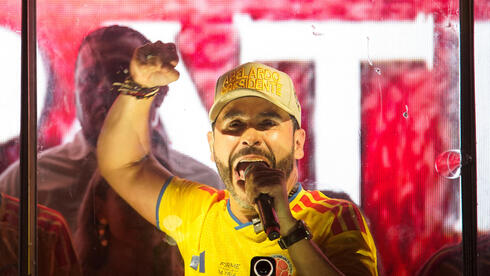
The election’s aftermath has been marked by dueling narratives. In Cali, thousands of protesters—many wearing white, a symbol of the leftist movement—clashed with police, burning U.S. flags and chanting “Out with Petro!” (a reference to outgoing President Gustavo Petro, Colombia’s first leftist leader). Meanwhile, in Medellín, de la Espriella’s supporters celebrated with yellow shirts (a nod to Colombia’s national soccer team) and chanted “The Tiger is coming!”
The most immediate casualty of de la Espriella’s victory may be Colombia’s 2016 peace accord with the FARC. The deal, brokered under former President Juan Manuel Santos, remains incomplete: while most FARC fighters laid down arms, dissident factions continue to wage war, and landmine clearance remains stalled. De la Espriella has vowed to abandon the accord entirely, calling it a “failure” that emboldened cartels. His refusal to engage with remaining FARC groups could plunge rural areas back into conflict, particularly in Caquetá and Putumayo, where coca cultivation and guerrilla activity remain high.
What happens next: Three scenarios for Colombia’s future
- Security crackdown: Expect a militarized response to drug trafficking and guerrilla activity, with potential U.S. military aid under a future Trump administration. However, past efforts to eradicate coca have failed to reduce production long-term, and de la Espriella’s approach may displace violence rather than eliminate it.
- Diplomatic realignment: Colombia will pivot toward Israel and the U.S., potentially breaking with leftist allies in Latin America. De la Espriella’s visit to Jerusalem—if it materializes—could normalize embassy moves in the region, emboldening other nations to follow suit.
- Economic and social tensions: His promises of “security and dignity” may worsen inequality if economic policies favor military and corporate interests over social programs. With 42% of Colombians living in poverty, his ability to deliver on jobs and infrastructure will determine his long-term legitimacy.
The biggest wild card remains Spada’s refusal to concede. If he challenges the results in court, Colombia could face months of political paralysis, delaying de la Espriella’s inauguration—scheduled for August 7, 2026. For now, the streets are divided: in Bogotá, leftist activists plan daily protests, while in Cartagena, business leaders welcome the shift as a “return to stability”. What’s clear is that Colombia’s experiment with leftist governance is over—and the country is entering uncharted territory.
“We’re starting a new era!” de la Espriella declared to supporters in Barranquilla, standing behind bulletproof glass. Whether that era brings peace or renewed conflict depends on whether his hardline approach can deliver what Colombians desperately want: security without sacrificing their fragile democracy.
Álvaro de la Espriella, Colombia’s newly elected president, waves to supporters in Barranquilla.
Find more reporting in our News section.
