
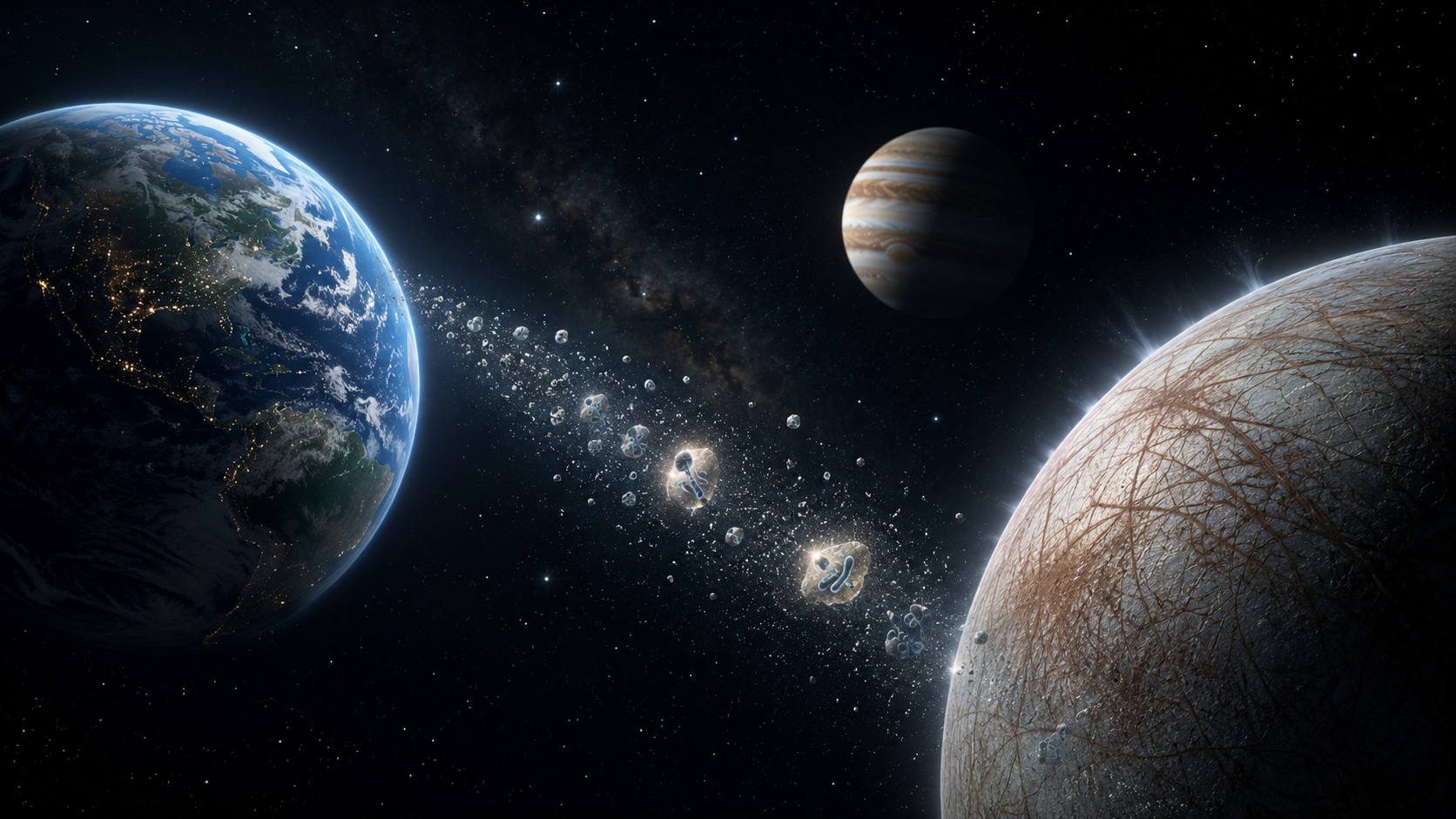
A 2026 study published in the International Journal of Astrobiology suggests Earth’s microbial dust could have traveled to Jupiter’s moon Europa, according to ZME Science. The research, led by Zaza Osmanov, posits that over millions of years, microbes might have been transported via dust particles, raising questions about potential life on Europa.
A Theoretical Route for Panspermia
Zaza Osmanov, a physicist at the Free University of Tbilisi, argues that Earth’s microbial life could have been carried to Europa through tiny dust grains, a process he describes as “reverse panspermia.” His model, detailed in a 2026 paper, calculates that particles as small as one micron—similar in size to bacteria—could escape Earth’s gravity at up to 14 kilometers per second, propelled by cosmic dust collisions. Once free, these grains would be influenced by solar radiation and gravitational forces, potentially reaching Europa over millions of years. “Life on Earth originated at least 3.55 billion years ago, which implies that for approximately that long, Earth has been shedding life-bearing particles into surrounding space,” Osmanov wrote, citing his study.

Europa’s subsurface ocean, estimated to be 50 to 100 miles deep beneath an ice shell, has long been a focal point for astrobiologists. NASA and the European Space Agency (ESA) plan missions in the next five years to investigate whether the moon could host life. “If favorable conditions exist elsewhere in the Solar System and can be accessed by dust particles, the transport of life from Earth appears plausible,” Osmanov concluded.
Revisiting Europa’s Plumes
While Osmanov’s study focuses on theoretical transport mechanisms, recent re-analyses of Europa’s features challenge some assumptions. A 2026 study published in *Astronomy & Astrophysics* found that water vapor plumes previously detected by the Hubble Space Telescope may have been a statistical anomaly. Researchers led by L. Roth noted that initial 2013 observations were affected by a misalignment in Hubble’s detector and the moon’s hydrogen exosphere, which scatters ultraviolet light. “The resulting UV glow could be mistaken for emissions from the moon’s surface,” the study states.
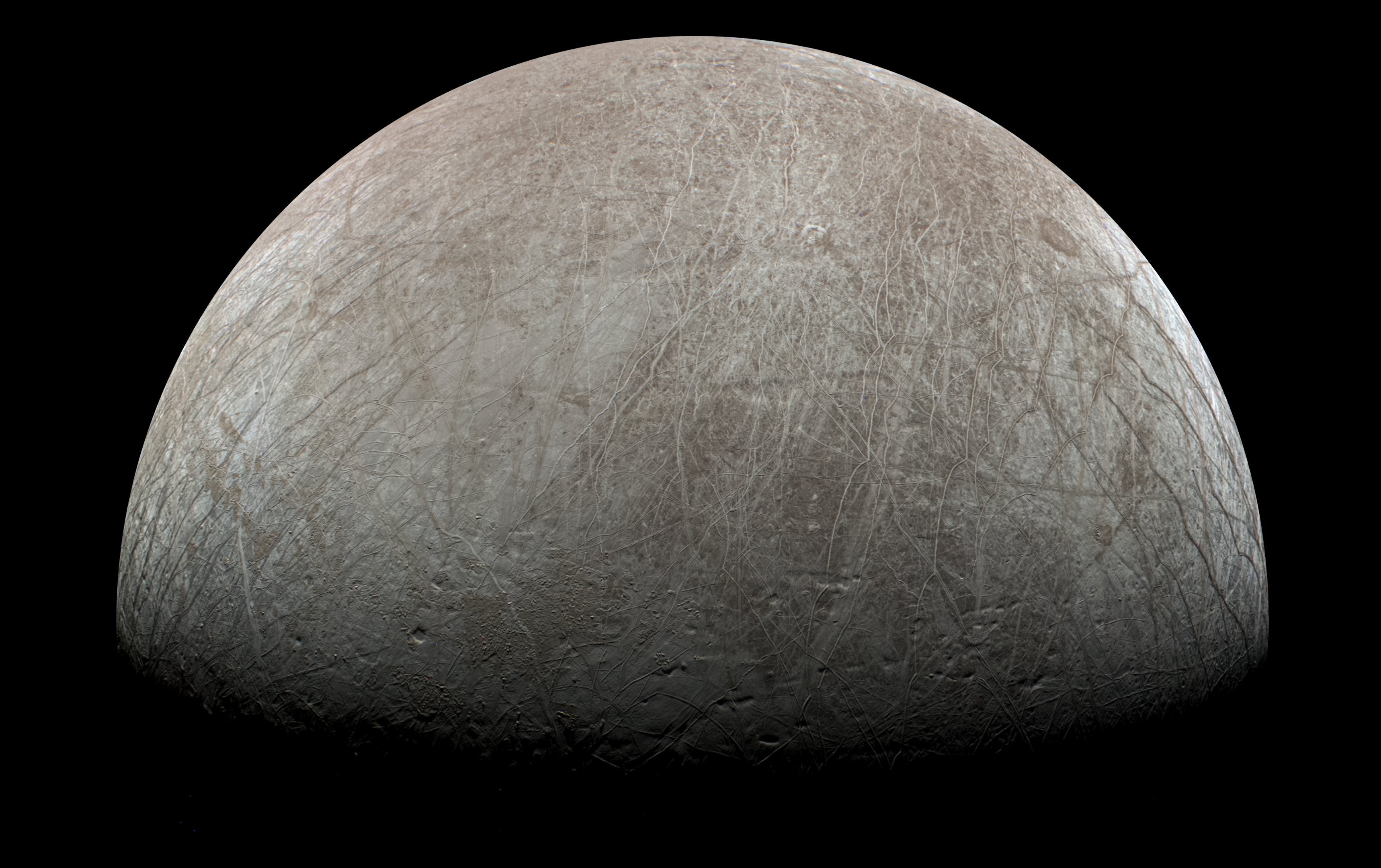
This re-analysis does not dismiss Europa’s potential for life but underscores the challenges of detecting surface features from Earth. “Even if the plumes were a mirage, Europa’s subsurface ocean remains a compelling target,” said Dr. Mike Reed, host of KSMU’s *Astro Brief*. “The moon’s icy crust, tidal heating, and chemical complexity make it a prime candidate for astrobiological exploration.”
Europa’s Unique Environment
Europa’s structure, as explained in KSMU’s podcast, highlights its distinctiveness. Unlike Jupiter’s volcanic moon Io, Europa’s ice shell—up to 20 miles thick—protects a global ocean, twice the volume of Earth’s oceans. Tidal forces from Jupiter generate heat, maintaining liquid water and potentially fueling hydrothermal activity. “Life on Earth thrives around deep-sea vents, where chemical energy replaces sunlight,” Reed noted. “Europa’s ocean could host similar ecosystems, though we’ve yet to confirm this.”
Historical data from NASA’s Galileo spacecraft (1995–2003) revealed Europa’s cracked ice surface, suggesting tectonic activity. These findings, combined with the moon’s magnetic field, support the presence of a subsurface ocean. However, direct evidence of life remains elusive, with upcoming missions like NASA’s Europa Clipper (planned for 2025) aiming to address this gap.
Implications for Astrobiology
The possibility of Earth-originating microbes on Europa challenges traditional views of life’s origins. If confirmed, it would imply that life’s “seeds” could spread across the Solar System, a concept known as panspermia. “This isn’t about Earth being the sole cradle of life,” said Osmanov. “It’s about the interconnectedness of planetary systems.”

However, the study’s authors caution that survival of microbes during interplanetary travel remains unproven. “Dust grains would face extreme conditions—radiation, temperature fluctuations, and vacuum—before reaching Europa,” noted a 2026 analysis in *ZME Science*. “While the mechanism is theoretically sound, empirical evidence is lacking.”
For now, Europa remains a scientific enigma. Its potential to host life—whether native or Earth-derived—continues to drive exploration. As KSMU’s *Astro Brief* emphasizes, “The next decade will determine whether we find life beyond Earth, or at least the conditions that could support it.”
https://www.zmescience.
https://www.ksmu.
<!Find more reporting in our Tech section.
