
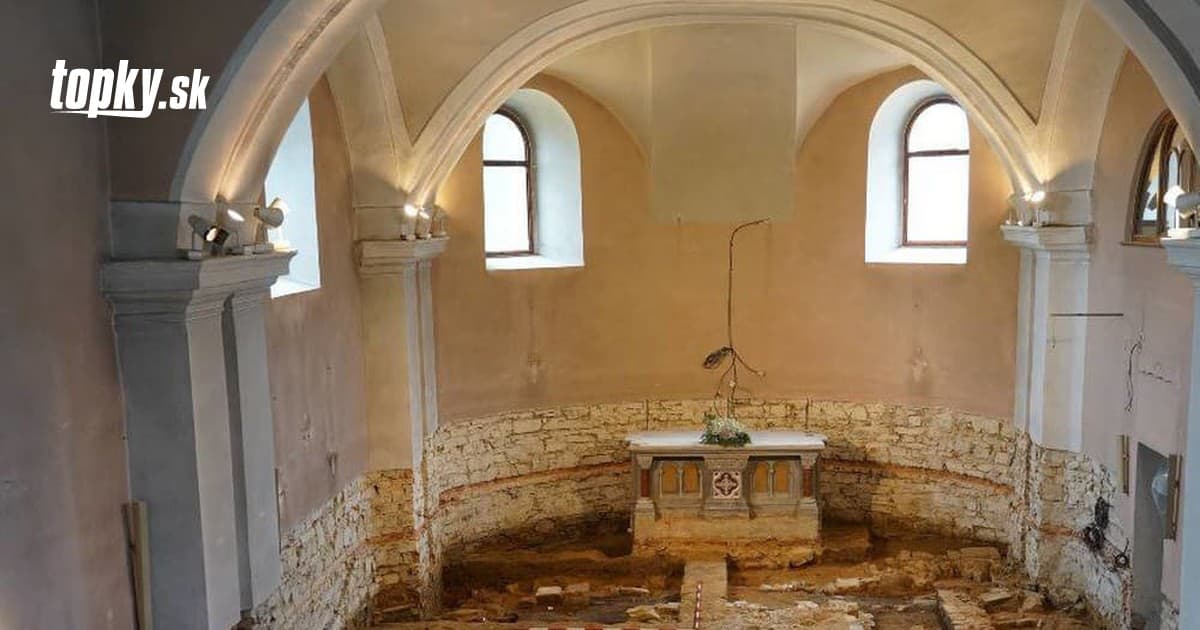
Archaeologists in Stěbořice, Czech Republic, have uncovered a well-preserved Romanesque presbytery beneath the Church of the Nativity of the Virgin Mary, offering new insights into the region’s medieval heritage. The discovery, made during excavations, reveals a 13th-century altar area that had been obscured by later renovations, according to the National Heritage Institute (NPÚ). The find, described as rare in the Moravian-Silesian region, could reshape understanding of early medieval religious architecture and the role of local institutions in shaping the area’s historical landscape.
Unearthing a Lost Chapter of Medieval Architecture
The excavations, led by researchers from the NPÚ, focused on the 13th-century church structure, which had long been thought to lack significant Romanesque elements. “Based on new findings, it will be possible to reliably reconstruct the Romanesque form of the building,” said Petra Batková, a spokesperson for the NPÚ’s Ostrava branch. The team identified remnants of the original presbytery, including a portal carved from white sandstone, which had previously been the sole evidence of the church’s Romanesque origins.
The discovery also sheds light on the architectural evolution of the site. While the current structure reflects Gothic influences, the medieval team found evidence of earlier construction phases, suggesting a layered history of renovations and reconstructions. “This find is not just about architecture,” said Michal Zezula, director of the institute. “It highlights the role of significant Moravian religious institutions supported by the Přemyslid rulers in integrating the Opava region into the Czech state during the 13th century.”

The presbytery’s preservation offers a rare glimpse into the religious and administrative networks of the time. Stěbořice, mentioned in records from 1220, served as a key center for monastic estates, including a stonecutting and construction workshop that contributed to the region’s religious buildings. “The site was part of a broader network of monastic properties that underpinned the economic and social systems of the era,” Zezula explained.
Local municipal officials in Stěbořice have coordinated with the NPÚ to ensure the site remains protected under the Czech Republic’s Act on the Protection of Monuments (Act No. 20/1987 Coll.). According to the Moravian-Silesian Regional Authority, the discovery has necessitated a pause in scheduled interior floor renovations to allow for a comprehensive stratigraphic survey. The regional government is currently reviewing whether to grant the site “national cultural monument” status, a designation that would unlock additional state funding for specialized restoration work. Archaeological teams from the Silesian Museum in Opava are assisting the NPÚ in documenting the masonry, noting that the mortar composition matches samples found at the nearby Hradec nad Moravicí fortification, suggesting a centralized supply chain for high-status building projects during the reign of Ottokar I.
Future Plans and Historical Implications
The NPÚ plans to use the findings to create a 3D model of the Romanesque church, which will be incorporated into the site’s future interior design. The institute emphasized that the discovery could provide a new framework for understanding the region’s medieval history, particularly the transition from the early medieval Holasice province to the later, more centralized Opava area.
The findings also raise questions about the broader significance of Romanesque architecture in the Moravian-Silesian region. “This is one of the few surviving examples of Romanesque architecture in the area, making it a crucial piece of the historical puzzle,” said Batková. The team is now analyzing additional structural data to map the church’s development over centuries.
Discussions between the Roman Catholic Archdiocese of Olomouc and the NPÚ are currently underway regarding the long-term presentation of the site to the public. While the Church of the Nativity of the Virgin Mary remains an active place of worship, the parish council has expressed support for integrating the exposed Romanesque foundations into the church’s visitor circuit. The Archdiocese stated in a recent press release that any permanent exhibition must respect the liturgical functions of the space, while the NPÚ argues that the structural integrity of the sandstone portal requires a controlled environment with specific humidity and temperature regulation. These conflicting logistical priorities are being mediated by the Ministry of Culture, which oversees the preservation protocols for ecclesiastical buildings under the state-church cooperation agreement.
A Mathematical Oddity: Proving (-1) × (-1) = 1
While the archaeological discovery captures the spotlight, a separate but equally intriguing debate unfolds in the realm of mathematics. On math.stackexchange.com, users have long debated the formal proof for why (-1) × (-1) equals 1. One explanation, rooted in algebraic structures, uses the distributive property to demonstrate the result. By setting $x = -1$ in the equation $(x + 1)(x – 1) = x^2 – 1$, the left-hand side becomes zero, forcing the right-hand side to also equal zero, which leads to $x^2 = 1$. This, in turn, confirms that $(-1)^2 = 1$.

The discussion highlights the foundational role of axioms in mathematics. “The integers can be defined as pairs of natural numbers $(a, b)$, where $(a, b)$ represents the solution to $a + x = b$,” explained a contributor. This approach, which avoids relying on subtraction, ensures consistency in operations like multiplication. Through this framework, the product of two negative numbers is logically derived as positive, reinforcing the rules of arithmetic.
The debate on these platforms often draws input from academic mathematicians who distinguish between pedagogical explanations—which rely on intuitive patterns—and formal axiomatic proofs. For instance, in the field of abstract algebra, the proof is often grounded in the ring axioms of the integers, specifically the distributive law $a(b + c) = ab + ac$ and the additive inverse property. Some contributors argue that the pedagogical reliance on “negative times negative equals positive” as a rule is insufficient for advanced theoretical work, leading to intensive discussions on the necessity of proving the property from the Peano axioms. These discussions often involve rigorous peer-review-like scrutiny of submitted proofs, where participants challenge the circular logic of assuming $0 times (-1) = 0$ before it has been formally derived from the definition of the additive identity. These threads are frequently cited in pedagogical research regarding how students transition from rote arithmetic to formal proof-based mathematics, highlighting a divide between those who view the rule as a self-evident truth and those who demand a rigorous derivation from base principles.
While the archaeological and mathematical discoveries seem unrelated, both underscore the human drive to uncover and explain patterns—whether in ancient stone or abstract equations. The Stěbořice find offers a tangible connection to the past, while the mathematical proof exemplifies the enduring quest to define and verify fundamental truths.
