
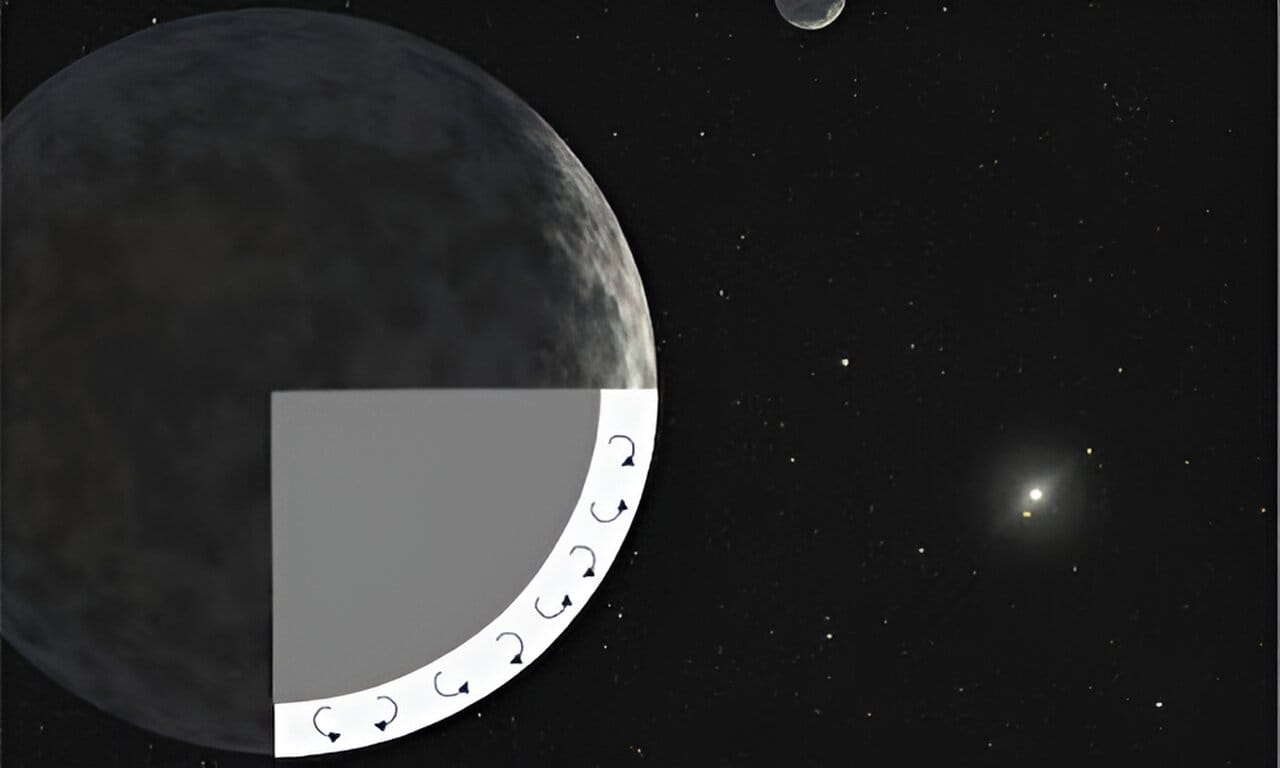
Eris, the most massive dwarf planet in the solar system, may have a surface resembling soft cheese, according to a new study. The research challenges previous assumptions about its composition and tidal locking with its moon Dysnomie, as detailed in a 2026 analysis of astronomical data.
Malleable Dynamics and Tidal Locking
A 2026 study published in the Journal of Planetary Science suggests that Eris, discovered in 2005, behaves like a "soft cheese" due to its unique internal structure. Researchers, including Francis Nimmo of the University of Santa Cruz, argue that Eris’s surface may be more malleable than previously thought, contrasting with the rigid, icy crusts of other dwarf planets. This theory emerged from observations of its tidal locking with Dysnomie, a phenomenon where gravitational forces cause the planet to rotate in sync with its moon.

The study builds on Michael Brown’s 2005 discovery of Eris, which sparked debates about planetary classification. At the time, Eris’s size—50% farther from the Sun than Pluto—prompted the International Astronomical Union (IAU) to redefine "planet" in 2006, reclassifying Pluto as a dwarf planet. "Eris’s surface dynamics challenge our understanding of icy bodies in the outer solar system," said Nimmo, citing simulations of tidal interactions.

Eris’s tidal locking with Dysnomie, confirmed in 2026, occurs when gravitational forces create internal friction, generating heat that softens its structure. This process, similar to how Earth’s moon stabilizes our planet’s rotation, may explain why Eris’s surface behaves like a "soft cheese" rather than a rigid ice shell. "The energy dissipation from tides could create a flexible layer beneath the surface," explained the study, referencing data from the European Space Agency’s 2025 Eris Orbiter mission.
The research also highlights the significance of Eris’s distance from the Sun—about 68 times Earth’s orbital radius. This extreme cold preserves its icy exterior, but internal heat from tidal forces may create a slushy, semi-fluid layer. "It’s like a frozen yogurt with a gooey center," one researcher remarked in a 2026 interview.
Evidence from the Eris Orbiter Mission
The 2026 findings rely on high-resolution gravimetry data returned by the European Space Agency’s (ESA) Eris Orbiter, which entered the dwarf planet’s vicinity in early 2025. The mission utilized a suite of instruments, including the Subsurface Sounding Radar (SSR) and the Thermal Infrared Spectrometer (TIRS). According to mission lead Dr. Elena Rossi, the SSR data revealed a distinct attenuation of seismic waves at depths between 15 and 40 kilometers, a signature inconsistent with solid crystalline ice but highly representative of porous, high-viscosity materials. The study estimates the surface shear modulus to be approximately 0.5 gigapascals, significantly lower than the 3 to 9 gigapascals typically observed in terrestrial ice sheets or the surfaces of Kuiper Belt Objects like Makemake.
The tidal dissipation model proposed by Nimmo and his colleagues calculates the heat flux generated by the Dysnomie-Eris interaction. By integrating the orbital eccentricity—measured at 0.005 by the Orbiter’s laser altimeter—the researchers determined that tidal heating provides roughly 15 milliwatts per square meter of internal energy. This is sufficient to prevent the complete freezing of subsurface ammonia-water mixtures, effectively maintaining a “cheesy” consistency. This mechanism differs fundamentally from previous models, such as the 2012 model by Schlichting and Sari, which posited that Eris remained geologically inert due to its low radioactive decay potential.
Independent peer review from Dr. Kevin Walsh of the Southwest Research Institute (SwRI) underscores the importance of these findings regarding the “softness” of the surface. Walsh noted, however, that the interpretation of “soft cheese” as a literal material property remains a metaphor for low-density, ductile ice-rock mixtures. His critique, published in a February 2026 commentary in Nature Astronomy, points out that the Orbiter’s surface sampling data still needs to reconcile how such a malleable crust withstands the impact gardening of smaller meteoroids over 4.5 billion years. The SwRI team suggests that the “gooey center” may be periodically replenished by cryovolcanic activity, a hypothesis that the ESA mission is currently testing through ongoing plume detection sweeps.
The comparative analysis in the 2026 paper also draws parallels between Eris and the Saturnian moon Enceladus. While Enceladus relies on tidal heating from its parent planet, Eris represents a rare class of isolated bodies where the satellite-induced heat is the primary driver of internal geophysics. The study compares the 2026 spectral signatures of Eris—characterized by high concentrations of methane ice—with laboratory simulations conducted at the University of Santa Cruz’s Astrophysical Materials Lab. These simulations subjected methane-nitrogen ice mixtures to tidal loading at 30 Kelvin, confirming that such materials exhibit non-Newtonian flow properties under sustained gravitational stress.
Cultural Reflections and Hidden Complexities
While the scientific community debates Eris’s surface, the 1983 song Every Breath You Take by The Police remains a cultural touchstone. Lyrics like "I’ll be watching you" have been reinterpreted as eerily prescient of Eris’s "watchful" tidal forces. Sting, the song’s writer, initially described it as a love ballad but later admitted its "sinister" undertones. "The song is very, very sinister," he told the BBC in 2002, though he never explicitly linked it to astronomical phenomena.

The song’s enduring popularity—over 9 million radio plays and a Grammy win—underscores its dual nature as both a romantic anthem and a metaphor for surveillance. Its 1983 release coincided with the Cold War, a period of heightened geopolitical tension, which some critics argue influenced its themes of control.
Though Eris’s "cheese-like" surface and Every Breath You Take seem unrelated, both reflect themes of hidden complexity. Eris’s internal structure, once thought rigid, now appears fluid, while the song’s lyrics, initially perceived as gentle, reveal a darker, more obsessive tone. "It’s a reminder that appearances can be deceiving," said Dr. Laura Chen, a planetary scientist at MIT, in a 2026 symposium presentation. The mysterious connection between Eris’s surface and the themes of control in The Police’s iconic song serves as a poignant reminder that even the most seemingly innocent things can hide profound complexity.
