
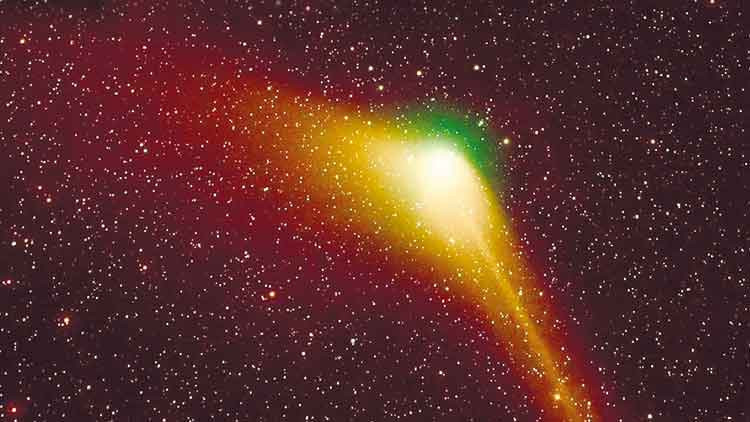
A newly discovered interstellar comet,designated 3I/Atlas,is currently captivating the attention of astronomers as it journeys through our solar system. First spotted in July 2025, the ancient comet – estimated to be over 7 billion years old – offers a unique opportunity to analyze material originating from beyond our own star system, perhaps revealing clues about the formation of other planetary systems. While the vast majority of scientists attribute observed anomalies to natural processes, the comet’s trajectory and behavior have also fueled speculation about its origins, as detailed below. NASA and the European Space Agency are prioritizing observations of 3I/Atlas before its departure in the coming months.
Created Date: November 22, 2025 07:00
Interstellar Comet 3I/ATLAS Captures Attention of Astronomers
NASA has released the first close-up images of interstellar comet 3I/Atlas, discovered in July 2025. The comet, currently passing near Mars, was observed by NASA and ESA spacecraft orbiting the planet from a distance of approximately 17.5 million miles (28 million kilometers). As the comet continues its journey, it’s expected to approach Earth around mid-December, reaching a distance of about 168 million miles (270 million kilometers), before ultimately leaving our solar system for good.
Scientists confirm the object’s velocity and trajectory indicate it originated from another region of the Milky Way. Estimated to be between 1,378 feet (440 meters) and 3.8 miles (5.6 kilometers) in diameter, 3I/Atlas is believed to be over 7 billion years old, potentially making it the oldest interstellar object observed to date. This discovery offers a rare opportunity to study materials from a very early stage of another star system.
“UFO” Speculation Emerges
However, an observed increase in the comet’s speed and a color shift from red to blue as it approached the Sun sparked speculation on social media about the possibility of it being an extraterrestrial spacecraft. The discussion was further fueled by Harvard Professor Avi Loeb, who suggested the possibility of artificial acceleration. However, the majority of scientists believe the acceleration is consistent with a natural process involving gas expulsion. Data from the James Webb Space Telescope and other observatories reveal a high concentration of carbon dioxide and nickel within 3I/Atlas. Experts suggest these chemical signatures could provide insights into the composition of the ancient star system where the comet originated.
Astronomers are working to gather as much data as possible before the comet’s brief visit concludes. The composition of interstellar objects like 3I/Atlas is crucial to understanding the building blocks of planetary systems beyond our own, and could inform future research into the origins of life in the universe.
