
A reported milk surplus is impacting Italian dairy farms, prompting concerns about teh economic stability of the nation’s agricultural sector. Initial reports focused on large-scale operations, but a closer look reveals a more complex picture for smaller, family-run farms-especially those in mountainous regions like the Piedmont and Lombardy areas bordering Switzerland.This report examines the experiences of one such farm, Alpe Burki, and explores how diversification and a direct-to-consumer approach are helping it navigate the challenges facing the Italian dairy industry.
A surplus of milk is impacting dairy farmers in Italy, with some being forced to discard their product, according to a recent report. While the issue is significant, initial investigations focused primarily on large-scale agricultural operations in the country’s plains regions, which typically have standardized agreements with major dairy companies. This situation raises concerns about the economic stability of the agricultural sector and the potential impact on food supply chains.
However, the initial reporting didn’t fully address the experiences of smaller farms, particularly those in mountainous areas. To understand the broader impact, an investigation was launched to determine if these smaller operations were also affected, and if so, how.
These smaller farms typically have fewer than 50 head of livestock – cows, goats, or sheep. One example is the Alpe Burki agri-business, a family-run operation located in the Alta Valle Anzasca, on the border between the Piedmont region of Italy and Switzerland, nestled on the slopes of Monte Rosa.
Alpe Burki manages around 20 cattle, with approximately a dozen adult cows producing milk annually. This scale is representative of many businesses in the mountainous regions of Piedmont, Lombardy, South Tyrol, and Friuli, differing from some operations in Trentino or Veneto.
The farm’s owner, Cristina Rainelli, was identified as a key source of information, not only because of her direct experience but also because she serves as president of the Association of Farm Cheesemakers, an organization representing approximately 90 small-scale dairy producers across Italy.
Alpe Burki: A Diversified Approach
Table of Contents
Unlike many large agricultural businesses that specialize in a single area, Alpe Burki’s strength lies in its diversified offerings and ability to adapt to market demands. The business operates not only as a farm but also as an agritourism destination, creating a complementary and self-sustaining model.
“We are fortunate to have a connected business, which is the agritourism facility in Macugnaga, and it primarily attracts tourists from Lombardy, Milan, and Varese,” Rainelli explained. “As a result, our customer base and product purchases are linked to the gastronomic tourism experience of Monte Rosa and Macugnaga, which helps us avoid feeling the impact of declines. We have a strong summer season, when urban populations travel to the mountains, and winter, as a ski resort with an agritourism facility located on the slopes, is a great advantage.”
Because of this integrated approach, Rainelli says the farm hasn’t experienced the milk surplus reported elsewhere. In fact, they often face the opposite problem. “After Christmas, we often find ourselves in a situation where we have a shortage of agricultural products, coinciding with the dry period for cows before calving in the spring. This is a time of scarcity, when we need a little more and manage the supplies we have. In fact, at my farm, we also purchase milk from others to compensate for this lack of raw materials.”
Alpe Burki, therefore, operates in a nearly reversed situation compared to larger, specialized farms, and it raises the question of whether this could be a model for resilience among smaller businesses. The farm’s experience offers a valuable case study for understanding alternative approaches to dairy farming.
Rainelli also noted that the purchasing power of tourists from Milan and the surrounding area is significant. “Some of my colleagues in central Italy sell their sheep’s cheese at prices that don’t justify the work, effort, and productivity of the animal. A sheep or goat produces much less milk than a cow, so I would expect the same kilogram of cheese to cost more. But that’s not the case.”
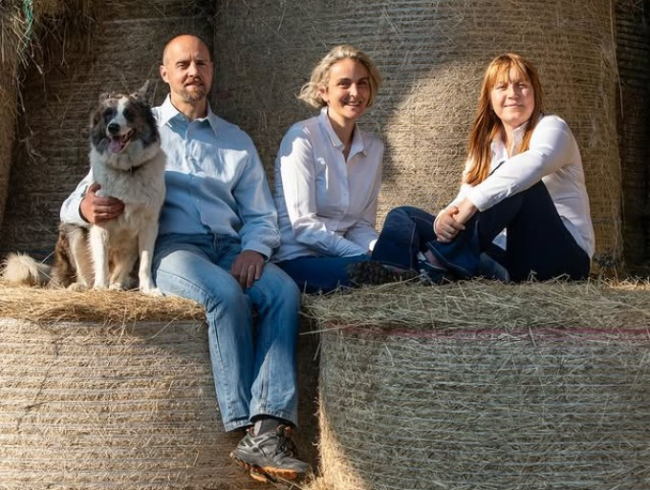
A Family Partnership
The management of Alpe Burki is shared by three partners: Cristina Rainelli, her husband, and her sister-in-law, each bringing unique skills to the operation.
“My husband and sister-in-law are the historical heirs of the company. I come from the same valley, about fifteen kilometers away, but I’m the external hire, the outsider,” Rainelli said.
“I am a molecular biologist. I used to work at the San Raffaele Hospital in Milan, and then I dedicated myself to agriculture, changing the course of my life, transferring the laboratory to the cheese factory. I started teaching and then took over the cheese factory, turning it into a very dynamic situation because I really like to experiment, do, and work.”
Her husband, Alessio, is a mechanical technician with a degree in sociology. He is responsible for the mechanical repair of machinery and tools, as well as performing various tasks, from the stable to the agritourism kitchen.
Her sister-in-law holds a degree from IULM University in Milan and focuses on public relations and marketing, handling administration, sales, grant applications, and e-commerce.
Having a diverse range of skills, Rainelli explained, provides valuable resources for responding to challenges and leveraging connections from previous studies or work experiences. This allows the farm to diversify its offerings and find solutions to problems as they arise.
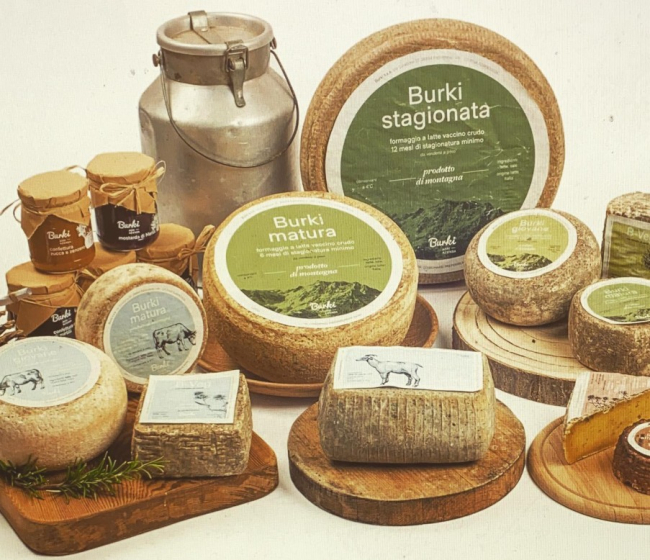
Flexible Production and Consumer Needs
“In a small business like ours, not being tied to a specific PDO (Protected Designation of Origin) or production contract allows me to shift production if a product isn’t working at the moment,” Rainelli explained. “I’m not saying that someone who makes alpine cheese will suddenly start making mozzarella, but they can certainly offer a wide range of solutions. If a large business is very specialized and has fixed its production on a certain type of product, it’s difficult to change course quickly.”
With the combined expertise of the three partners, Alpe Burki pays close attention to consumer interests. “If demand decreases in one area and increases in another, I try to understand the solutions that best meet the needs of my market.” Compared to large companies, which are often exposed to international competition and global market fluctuations, the dynamics affecting Alpe Burki occur on a smaller, more manageable scale.
Rainelli described instances where production is redirected to meet consumer preferences. “We introduced the use of vegetable rennet years ago because I had customers who wouldn’t buy cheese due to animal rennet, so I started introducing a coagulant extracted from thistle, and from that, a product was born that now sells well.”
“Then there was the issue of lactose. Many customers have this need to eat cheese but have problems with lactose. We did several tests with different bacterial cultures within our production. Whether they are exogenous or endogenous doesn’t matter, but acidification leads to the metabolization of lactose by the bacteria. Thus, lactose transforms into lactic acid and is consequently eliminated, making the products naturally lactose-free.”
Communicating the research behind a product to customers is perhaps the most complex part of this process. “There are many tests beforehand that need to be explained and shared. The fact that we have direct interaction with the customer offers us – and I say this generally to everyone who has a direct sales business – the advantage of being able to engage the customer and help them understand certain aspects. Affiliating a consumer with our products means ensuring that the market continues to exist.”
This, according to Rainelli, is another significant advantage of mountain businesses, which are inextricably linked to tourism. “It happens that customers from the alpine pasture, who may have met you in the summer, want to get your products again in the winter. E-commerce allows us to maintain a relationship with them, although most people tell us they prefer to come here in person to buy them.”
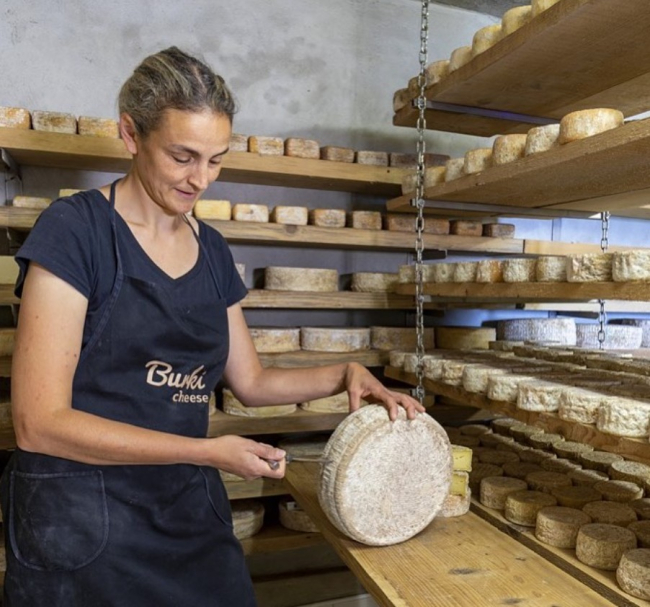
The Association of Farm Cheesemakers
As mentioned, Cristina Rainelli is also president of the Association of Farm Cheesemakers, which was founded in Piedmont in 2002 and has a number of representatives in the Piedmont region. While many members are from the northwest of Italy, the project has broad reach: “we have members from the far north of Trentino to the province of Ragusa.”
Rainelli is in constant contact with these businesses and says she hasn’t perceived any difficulties of this kind. “I would say that all small businesses have other kinds of difficulties at the moment: bureaucratic burdens, the raw milk issue, and marketing. I would say that the problems are related, more than to market fluctuations, to the managerial and business apparatus and the generational change.”
In Rainelli’s view, the dynamics within small agricultural businesses are completely different from those in large production companies. The coming years will be crucial in finding new or different approaches to work, with the preparation and multidisciplinarity of new cheesemakers being a central focus.
“The substance is that today you have to bring together many skills, even within microscopic companies: this is the key node. You can no longer say that you are a farmer because you don’t want to study; this is no longer sustainable. A company, regardless of whether it is agricultural, is a company. Therefore, each skill, of any kind, will give you a series of additional possibilities to interact with the rest of the world, whatever your market and your customers.”
