
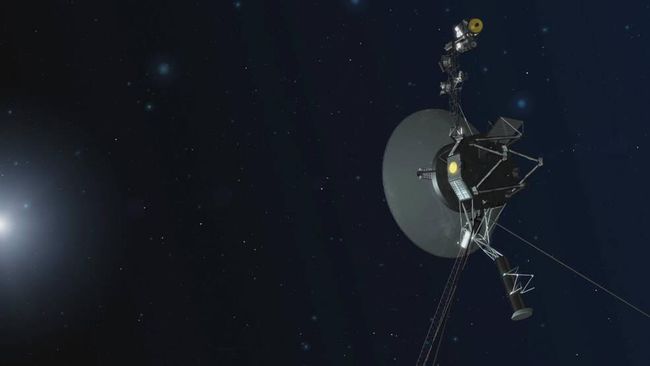
Launched in 1977, NASA’s Voyager 1 is on the verge of an unprecedented achievement: becoming the first human-made object to reach interstellar space at a distance of one light-year from Earth, expected in November 2026. This remarkable journey, initially intended as a planetary mission, continues to yield invaluable data about the vast cosmos beyond our solar system and demonstrates extraordinary engineering endurance. Despite facing dwindling power supplies, Voyager 1 remains a testament to human exploration and ingenuity, even as its operational lifespan nears its end.
NASA’s Voyager 1 spacecraft is poised to make history, becoming the first human-made object to reach a distance of one light-year from Earth – an expected milestone in November 2026. This achievement marks a significant step in our exploration of interstellar space and provides invaluable data about the universe beyond our solar system.
Launched on September 5, 1977, just weeks after Voyager 2, the Voyager 1 mission was initially designed to study the planets in our solar system. However, its journey has extended far beyond its original scope.
NASA engineers strategically launched the spacecraft when planetary alignments were optimal, utilizing what’s known as a gravity assist maneuver – leveraging the gravitational pull of planets to accelerate and redirect the probe’s trajectory for greater distances.
Currently traveling at approximately 38,000 miles per hour (61,115 kilometers per hour), Voyager 1 is now over 15.67 billion miles from Earth and 2.61 billion miles ahead of Voyager 2.
After nearly half a century in space, Voyager 1 is set to reach one light-year – equivalent to 16.09 billion miles – next year, according to Slashgear. This milestone underscores the incredible longevity and resilience of the spacecraft.
Around 2036, roughly 11 years from now, Voyager 1 is expected to reach the limits of its communication range as its power supply diminishes. Eventually, the spacecraft will cease to function entirely.
Voyager 1 previously achieved a landmark feat on August 25, 2012, when it crossed the heliopause and entered interstellar space – the region between our solar system and the rest of the galaxy.
The heliopause marks the boundary where the Sun’s influence weakens, and the flow of interstellar radiation and cosmic objects from the Milky Way galaxy becomes dominant.
Even beyond the heliopause, Voyager 1 continues its long journey through the cosmos. It will take approximately three centuries to reach the inner edge of the Oort Cloud, a vast collection of comets and small bodies believed to be remnants from the formation of our solar system.
Completing a full passage through the Oort Cloud is estimated to take 30,000 years, after which the spacecraft will continue toward the constellation Ophiuchus.
By 40,272 M, Voyager 1 will be 1.7 light-years from a star within the constellation Ursa Minor.
(dem/dem)
Next Article
Warga RI Bisa Nonton Langsung Aksi Astronaut, Begini Caranya
