
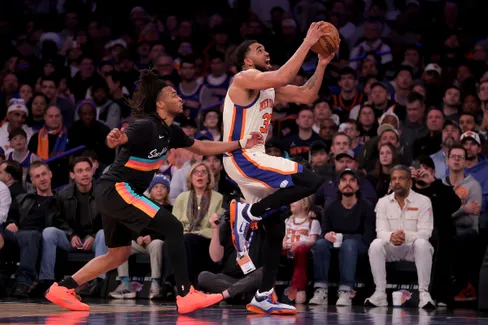
The New York Knicks are entering the 2026 NBA Finals with a defensive strategy designed to exploit the mismatch between their 7-foot-2 center Karl-Anthony Towns and the Spurs’ Victor Wembanyama, a duel that could define the series. With the Spurs’ MVP-caliber French center dominating the Western Conference playoffs, the Knicks’ plan hinges on using Towns’ size, shooting range, and playmaking to neutralize Wembanyama’s physical advantages—while forcing the Spurs to adapt to a high-octane offense. The stakes couldn’t be higher: a victory would hand the Knicks their first championship since 1973, while a loss would leave questions about their ability to compete with the league’s most dominant big man.
The Knicks’ Towns Gambit: How They Plan to Neutralize Wembanyama
The Knicks’ approach to Wembanyama isn’t about direct confrontation. Instead, they’ll rely on a mix of positional mismatch and offensive firepower to keep the Spurs off balance. As Mike Brown, the Knicks’ head coach, put it to reporters: “We don’t expect Wemby to defend on KAT. They’ll likely use smaller players against him often, and our job is to make sure he’s always moving.” The strategy revolves around Towns—who has emerged as the Knicks’ primary playmaker in the playoffs—using his 6-foot-11 frame, 48.9% three-point shooting in the postseason, and elite passing (5.9 assists per game) to create chaos for San Antonio’s defense.
/https%3A%2F%2Fmedia.basketusa.com%2Fmain%2F2026%2F06%2FUSATSI_27530571.jpg "cluster (priority): Basket USA")
Towns isn’t just a scorer; he’s become the Knicks’ second-best playmaker behind Jalen Brunson, dishing out 5.9 assists per game in these playoffs while shooting 48.9% from three. That long-range threat forces defenses to account for him even when he’s not handling the ball, and his ability to roll to the rim or spot up after setting screens has made him nearly unstoppable in the postseason. The Spurs, meanwhile, have spent the entire playoffs adjusting to Towns’ versatility—first against Julius Randle and Rudy Gobert in the first round, then Chet Holmgren and Isaiah Hartenstein in the Western Conference Finals.
The Towns-Wembanyama Duel: Why Size Alone Won’t Decide It
Wembanyama’s 7-foot-4, 265-pound frame gives him a physical advantage over nearly every NBA player, but the Knicks aren’t planning to let him dictate the matchup. Instead, they’ll use Towns’ elite shooting and playmaking to force Wembanyama out of the paint, where his defensive impact is most pronounced. As Landry Shamet, the Knicks’ sixth man, explained: “The pick-and-roll between Jalen and KAT, with a big shooter who can also create in the post and make pocket passes—you can’t just ignore that. There’s always an advantage, and we’ll exploit it.”

The key for the Knicks is keeping Wembanyama on his heels. The Spurs’ usual strategy—assigning their best defender to the opponent’s weakest shooter—won’t work here because Towns is both a high-volume three-point threat and a primary initiator. If Wembanyama chases Towns off the ball, the Knicks’ perimeter shooters (like Shamet and Mitchell Robinson) can attack the rim or hit open threes, while Towns can roll to the basket or reset the offense. The Spurs’ defense will have to decide: Do they let Towns shoot uncontested, or do they risk giving up easy buckets to smaller guards?
The Spurs’ Weakness: Wembanyama’s Fatigue and the Knicks’ Bench
San Antonio’s biggest vulnerability isn’t just Wembanyama’s defense—it’s his stamina. Jeremy Sochan, the Knicks’ wing who spent three seasons with the Spurs, offered a blunt assessment: “He’s so big, he gets tired. You’ve got to mix up the defense, run him, and make him work for his shots.” Sochan, who played 28 minutes per game for San Antonio in 2025-26 and 25 minutes in 2024-25, knows firsthand how Wembanyama’s endurance can fade as the series progresses. The Knicks’ plan is to exhaust him early with relentless ball movement, forcing him to guard multiple screens and transition plays.
Sochan’s insight is critical because he’s already guaranteed a championship ring—regardless of who wins the Finals. Under NBA rules, players who spend any time on a champion’s roster during the season receive a ring. Sochan played 16 games for the Knicks in 2025-26 after being traded from San Antonio in February, meaning he’ll get a ring even if the Spurs win. The last player to pull off this move was Torrey Craig in 2021, who joined the Bucks midseason and still got a ring when they won the title.
Who Will Defend Wembanyama? The Knicks’ Options
The Knicks have two primary candidates to guard Wembanyama: OG Anunoby and Mitchell Robinson. Anunoby, the team’s best perimeter defender, is 23 centimeters shorter than Wembanyama but makes up for it with 7-foot-2 wingspan, 240 pounds of muscle, and elite lateral quickness. He’s been tasked with guarding Wembanyama in the regular season, and while he’s held his own, the size difference still gives the Spurs an advantage on close-range drives. Robinson, meanwhile, is 213 centimeters tall—closer to Wembanyama’s height—but lacks Anunoby’s defensive versatility.
/https%3A%2F%2Fmedia.basketusa.com%2Fmain%2F2026%2F06%2FUSATSI_28375033_168380190_lowres.jpg "cluster (priority): news.google.com")
TrashTalk’s analysis highlights the trade-offs for both matchups:
- Anunoby’s advantage: His length and athleticism allow him to contest shots and disrupt Wembanyama’s rhythm, especially on the perimeter.
- Anunoby’s weakness: Inside the paint, Wembanyama’s strength and reach give him the upper hand in post-ups.
- Robinson’s advantage: His size and rebounding make him a better fit in the low post.
- Robinson’s weakness: He’s less mobile than Anunoby, making it harder to stay in front of Wembanyama on drives.
The Bigger Picture: What’s at Stake Beyond the Duel
This isn’t just about Towns vs. Wembanyama—it’s about two entirely different basketball philosophies colliding. The Spurs rely on defensive positioning and Wembanyama’s dominance, while the Knicks thrive on speed, spacing, and Towns’ versatility. If the Knicks can force Wembanyama into isolation or exploit his lack of post moves, they could turn the series into a perimeter shooting duel. But if San Antonio adjusts by playing zone or double-teaming Towns, the Knicks’ offense could stall.
The Knicks’ biggest wild card is how quickly they can adapt. They’ve already faced two elite big men in the playoffs (Randle/Gobert, Holmgren/Hartenstein), but Wembanyama is in a league of his own. If they can limit his impact to 15-20 points per game—similar to how they contained Holmgren in the Western Conference Finals—they’ll have a real shot. But if Wembanyama averages 30+ points and 15+ rebounds while Towns struggles to create, the Spurs could run away with the series.
What Happens Next: The Knicks’ Path to a Title
The Knicks’ road to a championship hinges on three key factors:
- Exploiting Wembanyama’s fatigue: If the Knicks can wear him down in the first two games, his impact in Games 3-5 will drop.
- Maximizing Towns’ playmaking: Towns must average at least 6 assists per game to keep the Spurs’ defense honest.
- Bench production: Players like Sochan, Shamet, and Robinson must contribute in transition to prevent the Spurs from settling into half-court sets.
The 2026 NBA Finals aren’t just about Towns vs. Wembanyama—they’re about whether the Knicks can outsmart the league’s most dominant big man. If they succeed, they’ll add their first championship since 1973. If they fail, they’ll be left wondering if they’re truly elite enough to compete with the Spurs’ dynasty in the making.
