
Newly appointed director General robert Schwartz is outlining a vision for reform at Radio Romania, one that prioritizes independence, modernization, and a renewed focus on public service journalism. In a wide-ranging interview with HotNews, Schwartz addressed concerns over budgetary constraints – with 65% of funds allocated to salaries and 28% to transmission – and a perceived culture of deference within teh institution. He also discussed the need for increased investigative reporting and a more robust connection with listeners, particularly younger audiences.
“There’s this ‘Yes, sir!’ attitude in public institutions in Romania that really bothers me,” says Robert Schwartz, the new director of Radio Romania.
- When “deputy-deputies” from political parties come to Radio Romania to discuss with citizens during election campaigns, “that means you have a problem,” Schwartz explains.
Sixty-five percent of the annual budget goes towards the salaries of the institution’s 1,800 employees, and 28% goes to the national radio communications company, explains Robert Schwartz, in an interview with HotNews, outlining why he believes the institution should receive more funding, even in times of austerity.
A former journalist with experience at Deutsche Welle, where he led the Romanian-language section for 20 years, Schwartz was appointed Director General of the Romanian Broadcasting Corporation at the end of November, at the proposal of USR.
“It’s not an island of bliss at public radio”
Table of Contents
- “It’s not an island of bliss at public radio”
- About “a breach of decorum”
- “The Radio building is 73 years old. A seismic risk analysis has not been completed”
- “We’re hanging by a spider’s thread, with the budget”
- “The average age at Radio Romania is around 50 and something. We lack young people”
- About performance criteria
- “We don’t have enough reporters”
- Firm about salaries: “They are confidential and I want them to remain confidential”
- “Public radio is worth 500 million lei a year”
- What Robert Schwartz says about the tax
- “I asked my colleagues to tell me if there is a sign of political intervention”
- “There’s this ‘Yes, sir!’ attitude that bothers me”
- Documentary by Recorder broadcast by TVR: “The best idea Adriana Săftoiu had”
- Two concrete examples
- Radio Romania receives “deputy-deputies” from parties
- Why public radio doesn’t do investigations
- How he views the appointment of the Government spokesperson in the radio leadership
- “Romania is the West”
– Mr. Schwartz, during your parliamentary hearings, you said exactly this: “I worked for 30 years at Deutsche Welle and I never even took the first step towards politicization.” How politicized did you find Romanian Public Radio?
– Robert Schwartz: I’ve been in this position for two weeks and a few days. For now, I can say the same thing: I don’t feel any politicization. But I do feel some pressure from the budgetary side. Because the budget is decided every year, we lack the tool to have a predictable, multi-year budget plan.
I am convinced that from January we will be able to have important meetings with representatives of the Government, and with those of the Senate, the Chamber of Deputies, because I have the impression that there is not a very clear understanding of the mission of Public Radio.
This public mission needs solid financial support, not just in times of crisis, such as now with the war of aggression by Russia in Ukraine, but also with the whole package of fake news, conspiracies, populism, rampant nationalism, xenophobia, attacks against all kinds of minorities and so on.
– You say that Public Radio should have a mission to combat these types of narratives. Let me give you an example: the public radio station in Iași, went through a scandal earlier this year, after the editor-in-chief expressed on Facebook that the rejection of Călin Georgescu’s candidacy was without argument, without evidence.
– Well, it’s not an island of bliss at public radio.
About “a breach of decorum”
– But how are such events handled?
– These are personal deviations, and if he wrote it on his private wall, we respect freedom of opinion. There is no censorship at Public Radio, but we can have discussions about how we post privately, because we have an obligation.
We are not 100% private individuals; we are part of the mission of Public Radio and when we go home, and when we go on vacation.
At the beginning of the year, I will go to the territory to meet with colleagues from the regional and local editorial offices, I want to listen to them, find out what their challenges are and we will obviously discuss these kinds of issues as well.
– And what happened on this specific subject? Was any sanction given?
– I don’t know. But I repeat, it’s a personal opinion, I find it hard to believe that anyone could be sanctioned for private opinions. But we will definitely have a discussion to understand what is behind such a breach of decorum.
“The Radio building is 73 years old. A seismic risk analysis has not been completed”
– You talked about budget pressure. If I’m not mistaken, the radio’s budget for this year was 446 million lei, almost 100 million euros, which is a very large sum for Romania. I don’t know of any other media institution in Romania with such a sum. Where does this money go?
– For the Romanian Broadcasting Corporation, the budget is not huge. We proposed a budget of 480 million lei, starting from the needs of all departments, and we received 7.6% less.
65% of the budgetary allocation goes towards salaries, and 28% goes to SNR (National Radio Communications Company – those who transmit our signal to reach our listeners).
Calculate for yourselves how much remains for other things, namely investments, digitization, innovation, modernization.
The Radio building is 73 years old. A seismic risk analysis has not been completed. I’m told off the record that any seismic risk study would generate a red stamp on the building. If we received a red stamp, the Romanian Government would be obliged to provide us with a headquarters within 30 days. We have a responsibility to our employees.
“We’re hanging by a spider’s thread, with the budget”
– The last time I looked at the ratings, I saw that public radio was in 6th place nationally, that is, not in the top 3, in the 18-55 age group…
– Yes, but let’s not exclude those from 55 to 79. On the other hand, we certainly have more national frequencies, we have Radio Romania Actualități, Radio Romania Cultural, which is very listened to, Antena Satelor, the other studios, Radio Romania Musical… And we have a few treasures: the archives, the National Radio Theater, we have orchestras, musical ensembles.
So we could, I’m sure, open the radio to the community and try to find more interesting partnerships, to become more visible. Through these partnerships we can create projects that bring us visibility, but that don’t cost us money.
We’re hanging by a spider’s thread, with the budget. For example, for the payment to SNR, the money lasts us until the end of September each year. From there, we start to supplement, either from our own sources or from budget revisions. So the budget is extremely tightly calculated.
“The average age at Radio Romania is around 50 and something. We lack young people”
– We are also in a period when public institutions are under pressure from austerity. You said that 65% of the money goes to salaries. The radio has around 2,000 employees…
– 1,800 employees. And external contributors.
– Can’t you touch the number of employees, the salaries? Can’t you make more savings there?
– I think that if you want to make savings, you can do it everywhere. But having 19 radio stations, the staff doesn’t seem so bloated. Then there are departments where people are missing, especially young people, because we don’t have the possibility to open positions for competition.
The average age at Radio Romania is around 50 and something, which is very good because you have people with a certain professional integrity and experience, but you lack young people who should come after to learn. So, we are blocked.
Returning to the number of 1,800 employees, there are probably some departments where we could think about professional retraining. As I said during the parliamentary hearings, there will be no layoffs, but professional retraining, reorientation.
About performance criteria
– Mr. Bolojan has been talking for months about performance criteria in state institutions. That is, those who perform remain, those who don’t, leave. He was talking at the level of the entire budgetary apparatus. How do these principles apply to the radio?
– Considering that we are missing people from the organizational chart, the reductions have been made naturally, so to speak. Reform will come, certainly, but it will be done through innovation, professional retraining, transparency.
Because there are some departments where people are needed, we should be able to convince colleagues that, through a refresher course, even if this course leads in a different direction than they were in before, they would have a better chance to learn something new and find a place perhaps more interesting than the one they had. So we will certainly have performance and reorientation criteria.
“We don’t have enough reporters”
– Let’s talk concretely about what professional retraining means in a radio? For example, a show host become a field reporter?
– We don’t have enough reporters. And when we talk about reporters, we want younger people because younger people are much more mobile and we lack them.
We also lack moderators with a younger voice to attract young people to listen to Radio Romania from time to time. Because many young people have left. And let me give you another example: technical staff are often scared when we talk about “self” studios.
Firm about salaries: “They are confidential and I want them to remain confidential”
– That is, to set up your show yourself?
– Not only to set it up, but even in live to start the music, the jingles (a melody of a few dozen seconds that announces a show), the microphones. I know how to do that, but not every show host has this talent to start the buttons themselves.
So there will certainly be at least one operator on duty in each “self” studio to assist those who cannot.
And the other operators will be included in a package of professional reform because there is a need in broadcasting, and there we are missing people, there is a need for maintenance, there is a need for permanent technical staff, because even the studios are not the newest.
– How are the salaries? Are they at market level?
– They are below market level, but they are confidential and I want them to remain confidential.
“Public radio is worth 500 million lei a year”
– You said that you would need more money. You have worked for a long time in a public media institution. The question is whether the annual budget of a media institution is correlated with the relevance of that institution?
– These are the little grievances of the competition. I think public radio is relevant, if we remain in absolute figures, around 500 million lei. Then I think that would be a fair budget, not only for what we propose to do, but for what we must do. We have a public mission, and in a crisis situation, public radio is the only one that has the obligation and can continue the operation of informing the population, 24/7, throughout the country, on all frequencies. Radio and public television have strategic importance.
What Robert Schwartz says about the tax
– ARD in Germany is funded by each household with 18.36 euros per month. Until 2017, there was also such a tax in Romania. Do you think it would help if we returned to that system?
– Some say yes, others say no. I am still in the process of listening to all positions and I want to draw a conclusion after that and start working in one direction or another. With the tax, things move differently and the entire bureaucratic procedure is simplified when you are funded by tax.
– But that would require people to listen. Because someone could say: “I haven’t listened to Radio Romania Actualități for 10 years, why should I pay the tax?”
– You are absolutely right and that is why, but not only for that reason, any introduction of additional taxes at this time and from now on will be impossible to argue. But if there is a desire in the public to continue to be informed correctly, with verified and verifiable information, then we could think about another formula. For now, we have this budgetary allocation.
“I asked my colleagues to tell me if there is a sign of political intervention”
– We have examples of public institutions, public radios that are truly relevant in the West. National Public Radio, BBC, ARD in Germany, Radio France. The first question here would be: what do you think would be a good model for Radio Romania Actualități? And the second: what is missing from the Romanian radio to reach that level?
– I asked my colleagues to tell me immediately if there is a sign of political intervention, a sign that could put us in a situation to interpret that there is political pressure. Regardless of whether we are talking about Bucharest or the other studios.
As for the model, it would be easiest for me to say Deutsche Welle, because I know it best, but if we exclude it, I would say that the model is BBC. It is the most solid model of public radio and I am glad that we have colleagues and colleagues in the radio who went to BBC school and that is felt. There are also colleagues who attended the Deutsche Welle Academy and that is felt.
These international partnerships mean a transfer of expertise and I will continue to support the idea of a solid construction.
“There’s this ‘Yes, sir!’ attitude that bothers me”
– What is missing from Romanian radio to be at those standards?
– A vision, I think. If you have a vision that you also articulate and you can take your team and after you see what the opinions of colleagues are, together you can bring that engine back to maximum revs.
And there’s something else. In some situations, in public institutions in Romania, I can observe a kind of subordination of the kind “Yes, sir!” We don’t need that. We are colleagues. I am a journalist, first of all. So let’s talk normally, openly.
Many people talk normally at Radio Romania, but there is this “Yes, sir!” attitude that bothers me.
Documentary by Recorder broadcast by TVR: “The best idea Adriana Săftoiu had”
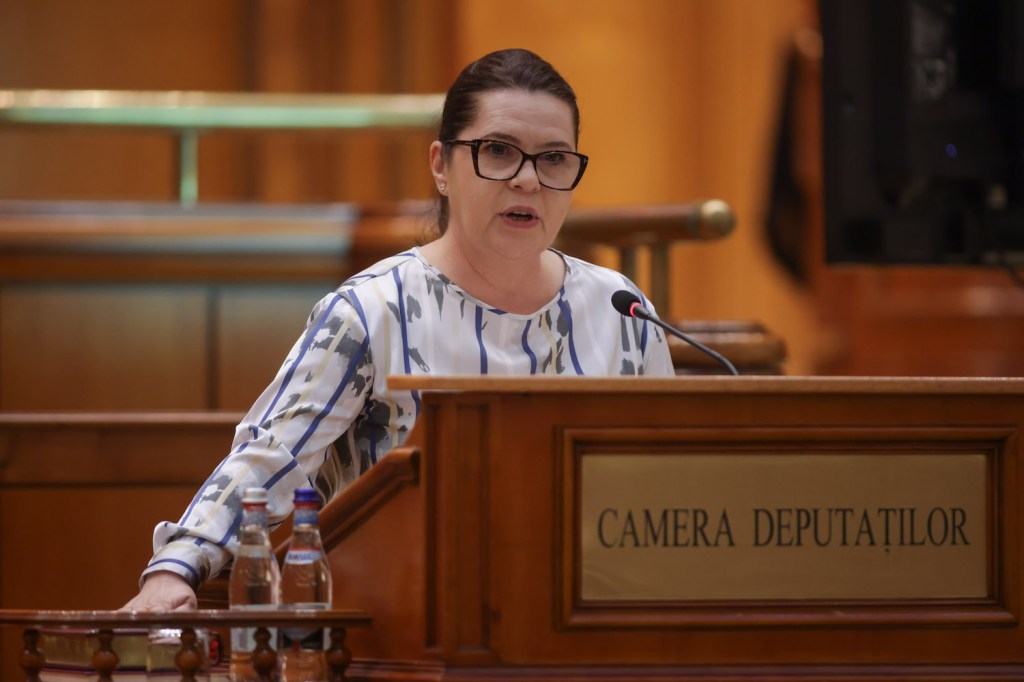
– I spoke with colleagues from the radio, from your station, and discussed the decision of TVR to broadcast the Recorder documentary….
– The best idea Adriana Săftoiu had.
– And these colleagues from the radio told me that “we, as an institution, would never have made such a decision, out of a feeling of not wanting to disturb, which exists in public radio.”
– It’s not true that such a decision would not have been made. Regarding the feeling, yes, that’s what I referred to. We incorporated the Recorder video into the news about this subject. And we had it in the news bulletins.
But it’s true, and I criticized it, that for example on Monday, after the elections, at the 9 o’clock news, when some people wake up later and turn on Radio Romania Actualități to get informed, because it’s the most serious station that comes with verified information, the first news was that the Minister of Environment would be invited to hearings in Parliament. And the second, third and fourth news followed. No news about the election results in Bucharest. Obviously, I called the team and asked why? I don’t intervene editorially, they are professionals, but I want to understand.
And I saw reactions of justification and evasion of the kind: we had the news at 7, at 8, at 8:30, at 10. We didn’t have it at 9 because we didn’t have it… nobody knew why we didn’t have it. It was obviously a mistake that we take responsibility for.
Two concrete examples
– So if someone woke up on Monday at 9 and turned on the radio, they wouldn’t find out who won the elections in Bucharest.
– Exactly how I argued. Because that’s how every normal listener argues.
The second story: some understand the word “debate” differently than I do, as it appears in Dex. I’ll give you an example now, not a very good one and an excellent one.
At Radio Romania at lunchtime, the audience is very good. After the Recorder investigation, the well-prepared host had five guests. But not all in the studio, not all on the phone at once, but we had five interviews, one after another, without any connection between what the first said, with what the second said, and with the fifth. That’s not a debate.
Today, in the car, I listened to a debate with two top guests, Iulia Joja and Emil Hurezeanu, with host Alexandra Andon, and it was a discussion you could listen to on BBC, Deutsche Welle or Radio Romania Actualități.
So we don’t realize, we shouldn’t hide. We are good and very good, but we need to understand what we want to do.
And let me give you another example. We have our reports which are very important, through which we prove political equidistance, but it is a quantitative equidistance. In these reports we pass what party, what organization, what politician (appeared on the air), but there is no qualitative analysis anywhere.
Because one thing is to have a top politician and another is to have a deputy of a deputy, of a deputy, from an institution or a party. Another is the responsibility.
So I am interested in the quality of this message, not just the correct and justifiable quantity according to the algorithm that exists.
Radio Romania receives “deputy-deputies” from parties
– How do politicians relate to public radio at the moment?
– During the Bucharest election campaign last year, I was told that representatives of the parties, deputy-deputies, came. So, when you realize that you, as a public radio, are not sought after by political decision-makers to deliver their message, that means you have a problem.
– Of relevance.
– Of relevance, on the one hand, or you didn’t know how to invite them and explain why it’s important to come, if they somehow forgot.
That’s one thing. On the other hand, I see and I’m glad that when the messages are very important, we are sought after. Which is okay. When there are important statements and we are present.
Why public radio doesn’t do investigations
– The press must not be comfortable. Often it must be very uncomfortable, it must also do investigations. Do you know of any investigations done by Radio Romania Actualități in the last period, which have stirred up reactions? I haven’t heard, but maybe I’m wrong.
– You couldn’t possibly know the questions I asked there in the first two days. But repeat some common-sense things that I felt the need to say there. And the answer was: “we would have, but we don’t.”
– What stops them? What has stopped them so far?
– The simplest explanation would be the budgetary one, that you cannot create a team (of investigations) because you lack the money. But I think that through a vision and modernization you can have an investigation team, because that’s the only way to stay relevant. Otherwise, you somehow get lost in information that you can eventually find on news sites.
That is, we don’t repeat what we find. We want to generate information. Returning to investigations, I never thought that we should be comfortable journalists.
On the contrary, we must not fall asleep at all. We are on barricades 24/7 and that’s where we have a problem because we need younger, more courageous, more incisive teams and I am convinced that we will have them because that’s what we aim for.
How he views the appointment of the Government spokesperson in the radio leadership
– There has been a debate in the public space regarding the appointment of Ms. Dogioiu to the radio leadership. Two media-specialized NGOs, ActiveWatch and the Center for Independent Journalism, criticized her appointment to the Board of Directors. What is your opinion? Does the fact that she is the Government spokesperson affect the credibility of the radio in any way?
– It doesn’t affect it, neither negatively nor positively, I think, because Ms. Dogioiu is a professional, she knows how to draw a line between the two activities. If it were a positive influence, we wouldn’t be discussing a budget revision that isn’t coming. The simplest thing would be to call Ms. Dogioiu and ask her to ask… God forbid, these are two clearly different things. And I understood from Ms. Dogioiu that there is no conflict of interest.
– Legally.
– Legally.
– Some questions can still be raised… that the Government spokesperson is in the radio leadership.
– When the Government spokesperson starts to behave as a member of the Radio’s CA at the Government or vice versa, then there would really be a problem. But Ms. Dogioiu knows how to draw the line between the two activities and I have great confidence in what she does.
“Romania is the West”
– What do you see as the role of Public Radio in the coming period? Will we get closer to the good examples we see in the West?
– I wouldn’t make a difference between Romania and the West anymore. Romania is the West. The eastern periphery of the European Union and NATO has become the center.
– I agree with you, only Radio Romania Actualități is not yet BBC. Sure, Romania is the West, but…
– I hope it won’t be BBC. I hope it remains Radio Romania, but a solid pillar in society and you can’t be a solid pillar without trust from the public and from the public.
And that’s why, when we somehow lose the normal discourse and when we lose the radio as an instrument of truth and accurate information, then we would have a problem.
But seeing what the pluses are, I am convinced that public radio has the capacity to remain a trusted partner of listeners in Romania and outside of Romania because we also have a Radio Romania International in several languages, we have Radio Chișinău in the Republic of Moldova, we have listeners around Romania who stay and listen to Radio Romania Cultural, Antena Satelor, Radio Romania Actualități, Musical and the other studios.
We want to modernize the site as well, we want to appear as a public service media unit. And not as fragmented sections.
