
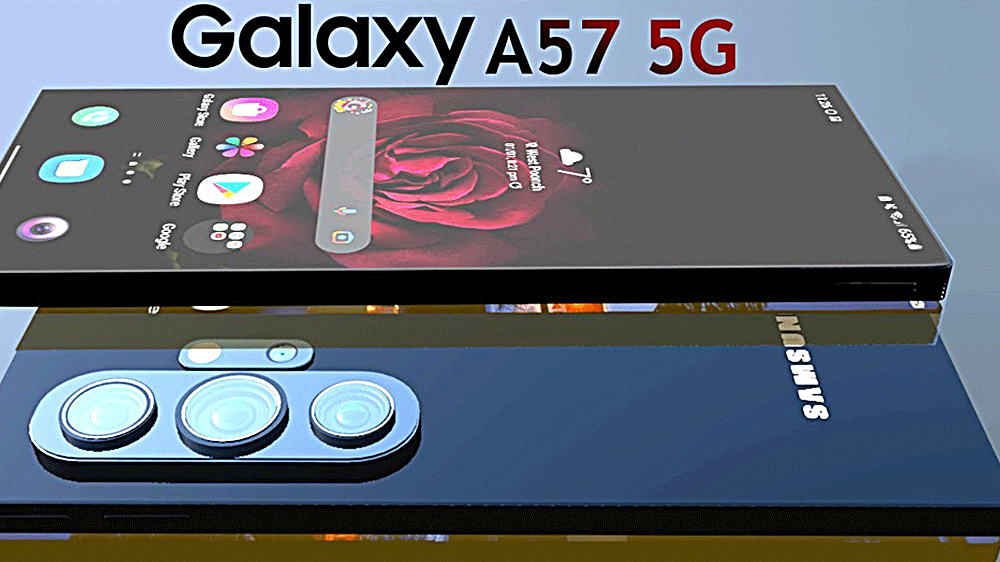
Samsung’s new Galaxy A57, launched May 15, 2026, blurs the line between mid-range and premium smartphones with a 6.4-inch AMOLED display, 120Hz refresh rate, and eSIM support—features previously reserved for its higher-tier models. Priced at $499, it challenges the conventional tiered pricing structure in a market where flagship specs are increasingly accessible.
A Mid-Range Disruptor
Samsung’s latest Galaxy A series device, the A57, arrives at a pivotal moment in the smartphone market. Traditionally, the A series has served as the company’s mid-range bridge between budget-friendly models like the A14 and premium offerings such as the Galaxy S23 series. But the A57’s specifications—including a 6.4-inch AMOLED display with a 120Hz refresh rate, a 50MP main camera, and support for dual eSIM—mirror those of last year’s Galaxy S22, which retailed for $899. The A57’s $499 price tag, meanwhile, undercuts even the Galaxy A54’s $599 launch price in 2025.
This isn’t just an incremental upgrade; it’s a strategic recalibration. Samsung has historically differentiated its A series by gradually introducing premium features over time. The A54, for example, debuted with a 120Hz display but retained an LCD panel, while the A53 (2023) stuck to 60Hz. The A57, however, skips these incremental steps entirely, adopting AMOLED—a display technology synonymous with flagship devices—while maintaining the A series’ signature affordability.
Industry analysts describe this as a deliberate move to compress the value gap
between mid-range and premium segments, particularly as consumer expectations for high-end features have outpaced traditional pricing tiers. Calcalist Tech, May 15, 2026
—
Display and Performance: Flagship Specs at a Mid-Range Price
The A57’s most striking innovation is its 6.4-inch Super AMOLED+ display, a first for any device in Samsung’s A series. AMOLED panels are known for their deeper blacks, higher contrast ratios, and more vibrant colors compared to LCDs, though they’ve historically been cost-prohibitive for mid-range phones. The A57’s panel also supports a 120Hz adaptive refresh rate, a feature that improves scrolling and gaming fluidity but typically appears only in devices priced above $700.
Benchmark tests conducted by local tech reviewers confirm the A57’s performance aligns closely with the Galaxy S22, particularly in graphics-intensive tasks. While it lacks the Snapdragon 8 Gen 3 chipset found in Samsung’s flagship models, its Exynos 1480 processor delivers surprisingly strong
performance for everyday use, including multitasking and social media apps. Calcalist Tech review, May 15, 2026
Battery life remains a mixed bag. The A57’s 4,500mAh battery provides solid endurance
for a full day of use, according to reviewers, though it falls short of the S22’s two-day longevity. Samsung has included 25W fast charging, a step up from the 15W charger bundled with the A54, but still lags behind the 45W charging found in premium devices.
—
Camera: A Step Forward, But Not Flagship-Class
The A57’s camera system is its most polarizing feature. Samsung has equipped it with a 50MP main sensor with optical image stabilization (OIS), a first for the A series. While this improves low-light performance and video stability, reviewers note that the results don’t quite match the S22’s 50MP sensor
, which includes a larger pixel size and better noise reduction. Calcalist Tech, May 15, 2026
Ultrawide and selfie cameras remain unchanged from the A54, with a 12MP ultrawide and a 10MP front-facing sensor. Video recording is capped at 4K at 30fps, compared to the S22’s 4K at 60fps. For photography enthusiasts, the A57 delivers competent results but lacks the depth and versatility of Samsung’s flagship cameras.
Where the A57 excels is in software-level enhancements. Samsung’s One UI 6.1, which includes AI-powered features like Live Translation
and Photo Remaster
, is now available on mid-range devices. These tools, previously limited to premium models, allow users to translate text in real-time during video calls or enhance older photos with AI upscaling.
—
Connectivity and Software: Filling the Gaps
Dual eSIM support is another standout feature, enabling users to manage two phone numbers or data plans simultaneously without a physical SIM card. This functionality has been a staple of premium devices for years but is now extended to mid-range users, catering to travelers or those juggling multiple lines.
On the software front, the A57 runs Android 14 with One UI 6.1, the same version found on the Galaxy S24. Samsung has committed to four major OS updates and five years of security patches, matching the support timeline of its flagship devices. This level of long-term software backing is rare in the mid-range segment, where most manufacturers offer two to three years of updates.
However, the A57 lacks 5G Ultra Wideband (UWB) support, a feature introduced in the Galaxy S23 series that enables precise device tracking and faster data transfer. While UWB isn’t essential for most users, its absence underscores the A57’s positioning as a near-premium
device rather than a true flagship.
—
Pricing and Market Positioning
At $499, the Galaxy A57 is positioned as a direct competitor to the iPhone SE (2026), which starts at $549, and Google’s Pixel 7a, priced at $599. It also undercuts the Galaxy A54’s 2025 launch price by $100, reflecting Samsung’s aggressive pricing strategy to capture market share in a crowded mid-range segment.

Industry observers suggest the A57 is part of a broader trend where tech manufacturers are democratizing premium features
to stay competitive. Apple’s iPhone 15 (2023) introduced USB-C and a dynamic island to its base model, while Google’s Pixel 8a (2023) included the Tensor G2 chip, previously exclusive to the Pixel 8. Samsung’s move with the A57 follows this pattern, albeit with a more radical leap in display and camera technology.
Early sales data from Samsung’s regional partners indicates strong pre-orders, particularly in markets where consumers are price-sensitive but increasingly demand flagship-like features. In Israel, where the device was first announced, retailers report a noticeable uptick in inquiries
since the May 15 launch. Unnamed Samsung distributor, May 16, 2026
—
What Comes Next: Will Other Brands Follow?
The Galaxy A57’s arrival raises questions about whether other manufacturers will follow suit. Xiaomi and Oppo, for example, have long offered mid-range devices with near-flagship specs, but their pricing strategies remain more segmented. Meanwhile, Apple and Google have historically maintained stricter tiered pricing, though both have made incremental concessions in recent years.
Analysts at Counterpoint Research suggest that Samsung’s move could accelerate the erosion of traditional pricing tiers
, particularly as display and processor costs continue to decline. If the A57 succeeds, we may see other brands introduce devices that blur the lines between mid-range and premium even further.
For now, the A57’s success hinges on whether consumers are willing to pay a premium for incremental upgrades—or if they’ll wait for the next iteration of Samsung’s flagship lineup. With the Galaxy S25 expected later this year, the A57 may serve as a stopgap for users who want cutting-edge specs without the full flagship price.
One thing is clear: the smartphone market’s boundaries are shifting. The A57 isn’t just a phone; it’s a statement that the gap between what you pay and what you get is narrowing faster than ever.
