
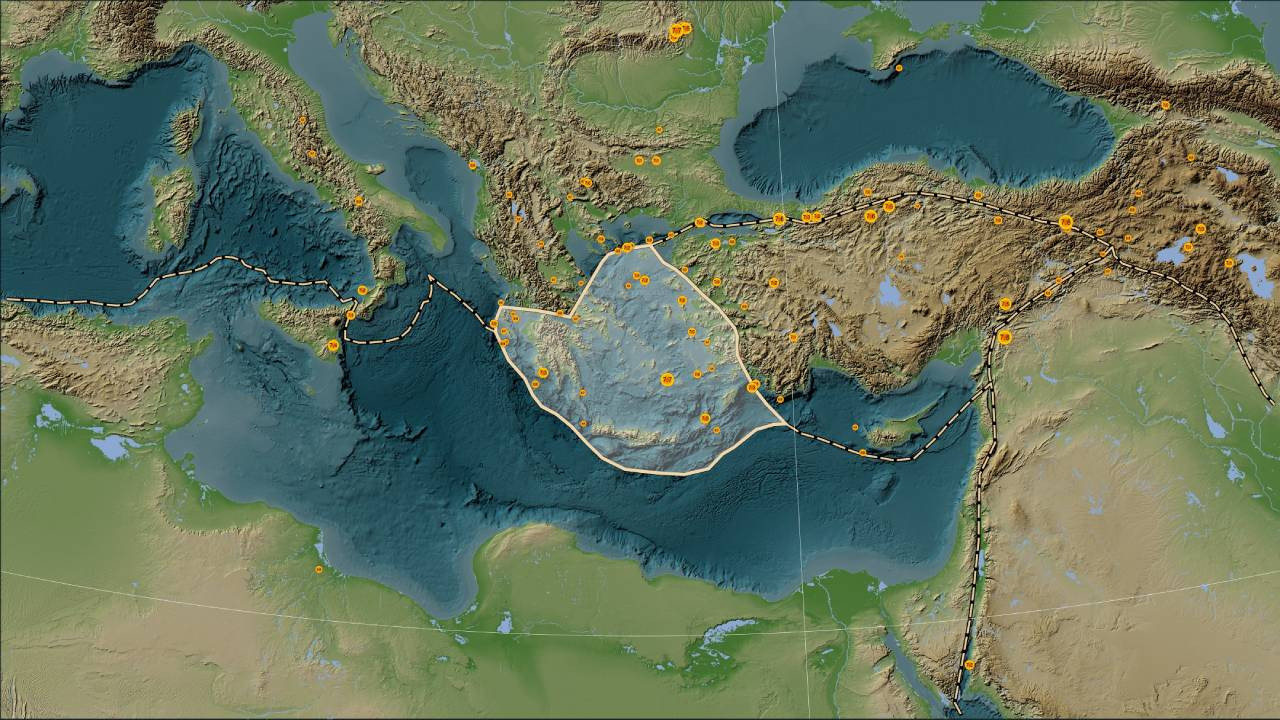
A prolonged swarm of earthquakes-numbering in the tens of thousands-has impacted the Greek islands of Santorini, Amorgos, adn Anafi as January, raising fears of volcanic unrest in the historically active region. The unusual seismic activity initially prompted evacuations and anxieties over a potential eruption of the Kolumbo submarine volcano, recalling the devastation of the 1956 earthquake [[1]]. Now, new research utilizing a novel approach to seismic data analysis has pinpointed the source of the tremors and offered insights into the potential for future activity, while scientists are also monitoring ongoing, though decreased, activity [[1]], [[2]], [[3]].
A swarm of tens of thousands of earthquakes has rattled the Greek islands of Santorini, Amorgos, and Anafi since January 2025, prompting concerns about potential volcanic activity and a repeat of a devastating 1956 quake. The unusual seismic activity has led some tourists to leave the region, while locals fear a possible eruption of the Kolumbo submarine volcano.
Scientists have now mapped the area around Santorini in three dimensions, attributing the prolonged seismic activity to the movement of magma beneath the islands. Their research, published in the journal Science, utilized the earthquakes themselves as a “virtual sensor” network to understand the stresses within the Earth’s crust.
Magma Flow Identified as Trigger
The research team determined that the earthquakes were triggered by magma flowing through a 30-kilometer (18.6-mile) horizontal channel located 10 kilometers (6.2 miles) beneath the seabed. Researchers estimate the volume of magma to be equivalent to roughly 200,000 Olympic-sized swimming pools. This movement fractured layers of rock, resulting in the thousands of recorded tremors.
“The earthquakes are behaving as if devices deep within the Earth are sending us data,” explained Anthony Lomax, a member of the research team. “The patterns we analyzed correlate very well with the horizontal movement of magma.”
The findings offer a new approach to monitoring and understanding volcanic systems, potentially improving hazard assessment in seismically active regions worldwide. The development underscores the importance of advanced monitoring techniques in areas prone to both earthquakes and volcanic eruptions.
Activity Appears to Have Subsided
Currently, the seismic activity appears to have ceased, according to researchers. “The magma stalled at a depth of 8 kilometers (5 miles) below the surface,” said Dr. Stephen Hicks. “While magma can rise quickly to the surface, it most likely cooled and solidified at depth, given that the activity has stopped.”
However, scientists caution that volcanoes can enter prolonged and unpredictable periods of activity, citing recent volcanic events in Iceland as examples.
Could AI Improve Predictions?
The study suggests that combining artificial intelligence with data on the physical movements of the Earth’s crust could lead to better monitoring, understanding, and prediction of volcanic activity. This method could serve as a valuable tool for ensuring the safety of people living in seismically active areas.
“When we observe a cluster of earthquakes, this data can be used to determine a likely cause,” Dr. Hicks stated. “Ultimately, this can be developed into a predictive tool.”
The research highlights the potential for leveraging naturally occurring seismic events to gain insights into subsurface geological processes, offering a novel approach to volcanic hazard assessment.
Source: Gazete Oksijen
