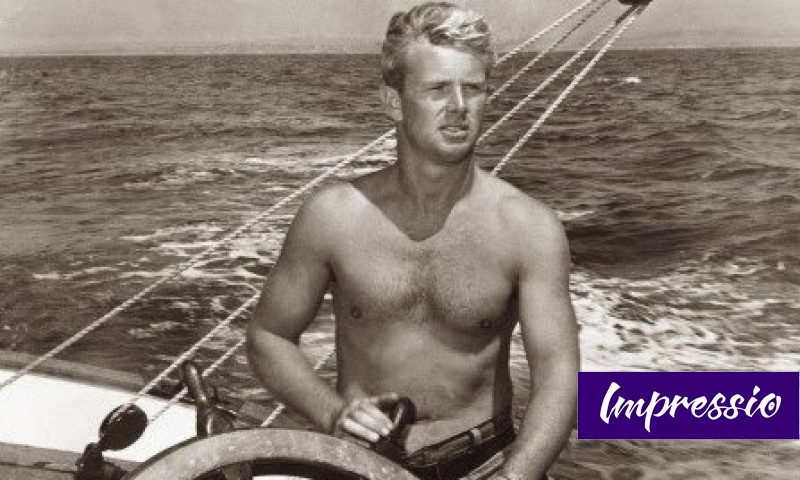
Sterling Hayden, the American actor and writer who famously navigated a career spanning four decades, died of cancer in May 1986 at the age of 70. Known for his rugged on-screen presence, Hayden transitioned from being labeled the “most beautiful man in Hollywood” to a lifelong passion for the sea, eventually leaving the film industry behind to work as a sailor.
From Hollywood Stardom to the Open Sea
Born Sterling Relyea Walter on March 26, 1916, Hayden’s life was marked by a distinct lack of vanity that seemed at odds with his status as a major film star. By 1982, having spent 40 years in the industry, he chose to abandon the spotlight. His career was not defined by the typical accolades of a leading man, but rather by a series of iconic performances and a genuine, often-cited commitment to maritime life. According to reporting on his legacy, Hayden was rarely the recipient of major awards, despite being one of the most sought-after “typecast” actors from the 1950s through the 1970s.
Instead of acting trophies, Hayden’s life was punctuated by his service for the Office of Strategic Services (OSS) and his military honors. His filmography remains a testament to his range, featuring roles in foundational American cinema. He appeared in John Huston’s 1950 classic The Asphalt Jungle, Stanley Kubrick’s The Killing in 1956, and later in Robert Altman’s 1973 film The Long Goodbye. Perhaps most famously, he provided a chilling, memorable performance as the ultra-nationalist General Jack D. Ripper in Kubrick’s 1964 satire Dr. Strangelove.
A Legacy of Iconic Roles and Military Service
Hayden’s ability to embody complex, often turbulent characters earned him critical recognition, including a nomination for Best Foreign Actor at the British Academy Film Awards (BAFTA) for his turn in Dr. Strangelove. In 1972, he also took on a pivotal, albeit brief, role in Francis Ford Coppola’s masterpiece, The Godfather. Despite these successes, he viewed cinema primarily as a source of income rather than his life’s calling.
“Actors from the 50s to the 70s of the last century. There are more of his military awards. American actor and writer Sterling Hayden (1916 – 1986) in the role of Major Wanguey Lindberg on the set of the British fantasy science fiction thriller ‘The Last Program’, Great Britain, January 25, 1973. Photo: Getty Images. Leaves six children from a total of three marriages and cult films like (1950) by John Huston, ‘Dr. Strangelove’ (1964) by Stanley Kubrick, ‘The Long Goodbye’ (1973) by Robert Altman, etc. For his magnificent incarnation as the ultra-nationalist General Ripper in the cult ‘Dr. Strangelove’ he was nominated for best foreign actor at the British BAFTA awards.”
Indonesian activist Andrie Yunus attacked with acid | ABC NEWS
Source: Impressio, via news.google.com
Hayden’s departure from Hollywood was not merely a career pivot but a return to his roots as a merchant mariner and a dedicated sailor. His literary contributions, including his 1963 autobiography Wanderer and the 1970 novel Voyage, documented his profound connection to the ocean, a theme that consistently eclipsed his interest in film production. Throughout his later years, Hayden maintained a residence in Paris and spent significant time on his schooner, the Wanderer, reinforcing the persona of a man who found the constraints of the film industry incompatible with his personal values.
The Interplay of Personal History and Public Record
The duality of Hayden’s life—the public-facing actor and the private, seafaring individual—is mirrored in the way his records are preserved. His professional life involved contracts, film credits, and international distribution agreements that necessitated precise documentation. His work in British productions, such as the 1973 film The Last Program (also known as The Final Programme), required coordination between American talent and British studio infrastructure, a process that demanded rigorous adherence to administrative standards.
Maritime Passion
The documentation surrounding his personal life, including his three marriages and his six children, further highlights the intersection of public fame and private legacy. As historical archives continue to catalog the work of mid-century actors, the precision with which his filmography is maintained serves as a benchmark for how industry figures are remembered. The efforts to track his career across different decades and international markets rely on the same attention to detail that Hayden himself applied to his maritime navigation.
Understanding Formal Documentation and Numerical Systems
Beyond his cinematic career, the preservation of names and figures—whether in film credits or formal documentation—relies on standardized systems. In modern administrative contexts, such as financial records or official filing, the use of uppercase characters and specific numerical representations is vital for clarity. As noted by technical guidance on character usage, the proper capitalization of letters and the use of formal Chinese financial characters—such as 壹 (one), 贰 (two), and 叁 (three)—are essential for preventing errors in accounting and legal documentation.
These formal systems of notation, ranging from 壹 to 拾 (ten) and up to 亿 (hundred million), mirror the precision that Hayden sought in his own life away from the camera. While the actor navigated the shifting tides of the Pacific, modern institutions continue to navigate the complexities of data integrity and standardized reporting, ensuring that records remain as indelible as the performances Hayden left behind. The transition from the tangible, physical logs of a ship to the digital, standardized databases of today represents a continuation of the same human pursuit of order that characterized Hayden’s post-Hollywood life.
Daniel Lee is the Entertainment Editor at Headlinez.News, covering the ever-changing world of film, television, music, and celebrity culture. With over a decade of experience reporting from Hollywood and major international festivals, Daniel brings a sharp eye for stories that define pop culture. His background in digital media and entertainment journalism allows him to blend exclusive insights with SEO-driven storytelling that keeps readers informed and engaged.
Expertise: Film and television, celebrity news, pop culture analysis, entertainment trends, digital storytelling.
Location: Los Angeles, California, USA