

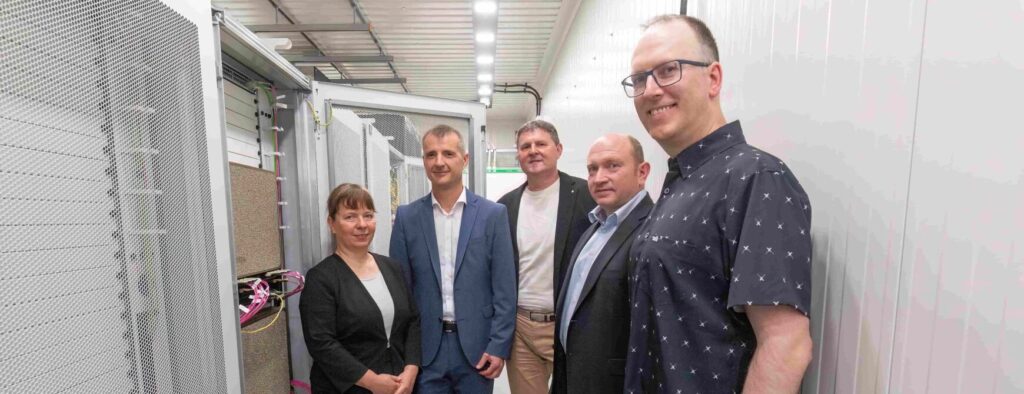
The University of Ljubljana’s Faculty of Computer Science and Informatics officially launched FRIDA, a high-performance computing infrastructure, this week to accelerate artificial intelligence and large-scale data research. Designed as a modular container data center, the system features 104 GPU accelerators and aims to reduce AI model training times from weeks to mere hours.
Technical Specifications and Computing Power
The FRIDA supercomputer represents a significant leap in Slovenian computational capacity. According to reporting from w.media, the system utilizes 104 GPU accelerators spanning seven distinct generations. The architecture is anchored by 64 latest-generation units, specifically incorporating NVIDIA Blackwell B200 and B300 graphics processing units.

To manage the intense thermal output generated by these high-density AI servers, the facility employs a hybrid cooling strategy. This configuration combines traditional air cooling with liquid cooling applied directly to the chips. In terms of raw performance, the infrastructure is designed to deliver up to 708 petaflops for lower-precision operations, with a theoretical peak performance reaching 1.42 exaflops.
The transition to modular containerized data centers is a growing trend in high-performance computing (HPC). Unlike traditional, fixed-structure server rooms that require extensive building modifications, modular containers offer a pre-integrated solution that can be deployed faster and scaled with greater ease. By housing the hardware in a modular environment, the University of Ljubljana can manage the high power density required by modern GPU clusters, which often demand significantly more electricity and specialized cooling per rack than standard enterprise servers.
Strategic Goals for Slovenian Research and Industry
The university intends for the platform to serve as a hub for both academic exploration and commercial prototyping. By providing this infrastructure, the Faculty of Computer Science and Informatics (UL FRI) seeks to support the development of complex projects, including the advancement of the Slovenian large language model, GaMS.

“FRIDA directly supports the mission of FRI, one of the key carriers of technological development in Slovenia, as it connects top research knowledge with state-of-the-art infrastructure and enables breakthroughs in the field of UI and supercomputing,” Associate Prof. Dr. Mojca Ciglarič, Dean, UL FRI.
Beyond academic output, the project is positioned as a competitive asset for the broader Slovenian economy. Dr. Ciglarič emphasized that the system provides a specialized environment for interdisciplinary teams to test future technologies in collaboration with business partners and societal stakeholders. This approach mirrors the “triple helix” model of innovation—a framework that encourages collaboration between university, industry, and government to drive economic growth through technological advancement. By offering this resource, the university aims to bridge the gap between theoretical AI research and practical, market-ready applications.
Integrating Into European High-Performance Networks
The launch of FRIDA is not an isolated effort but is intended to complement existing European high-performance computing initiatives. By offloading complex workloads to this dedicated AI-focused system, researchers expect to see a drastic reduction in development cycles. Training times that previously required weeks are now projected to be completed within hours or days, depending on the specific computational demands of the model.
The European Union has placed significant emphasis on building a sovereign AI infrastructure, with initiatives like the EuroHPC Joint Undertaking (EuroHPC JU) working to pool European resources. FRIDA fits into this broader European landscape, where institutions are increasingly tasked with maintaining hardware that can handle the massive datasets required by modern foundational models. This requires not only raw computing power but also high-speed interconnects that allow GPUs to communicate with minimal latency, a critical factor in the performance figures cited for the new system.
While other regional research hubs, such as the Virginia Science and Technology Campus, focus on broad cross-disciplinary STEM collaboration, the Ljubljana initiative is uniquely optimized for the specific hardware requirements of modern machine learning. The university’s commitment to these standards aligns with broader institutional mandates regarding research transparency and compliance, similar to the policy frameworks maintained by institutions like George Mason University in the United States.
As the system comes online, the immediate priority for the University of Ljubljana will be the onboarding of industry partners who have expressed interest in utilizing the platform for AI application testing. The facility remains the most powerful AI-focused computing system currently operating within Slovenia, setting a new benchmark for the country’s high-performance computing sector. The project serves as a critical test case for how smaller European nations can leverage specialized, high-density infrastructure to remain competitive in a field that is increasingly dominated by massive, global-scale data centers.
Find more reporting in our Tech section.
