
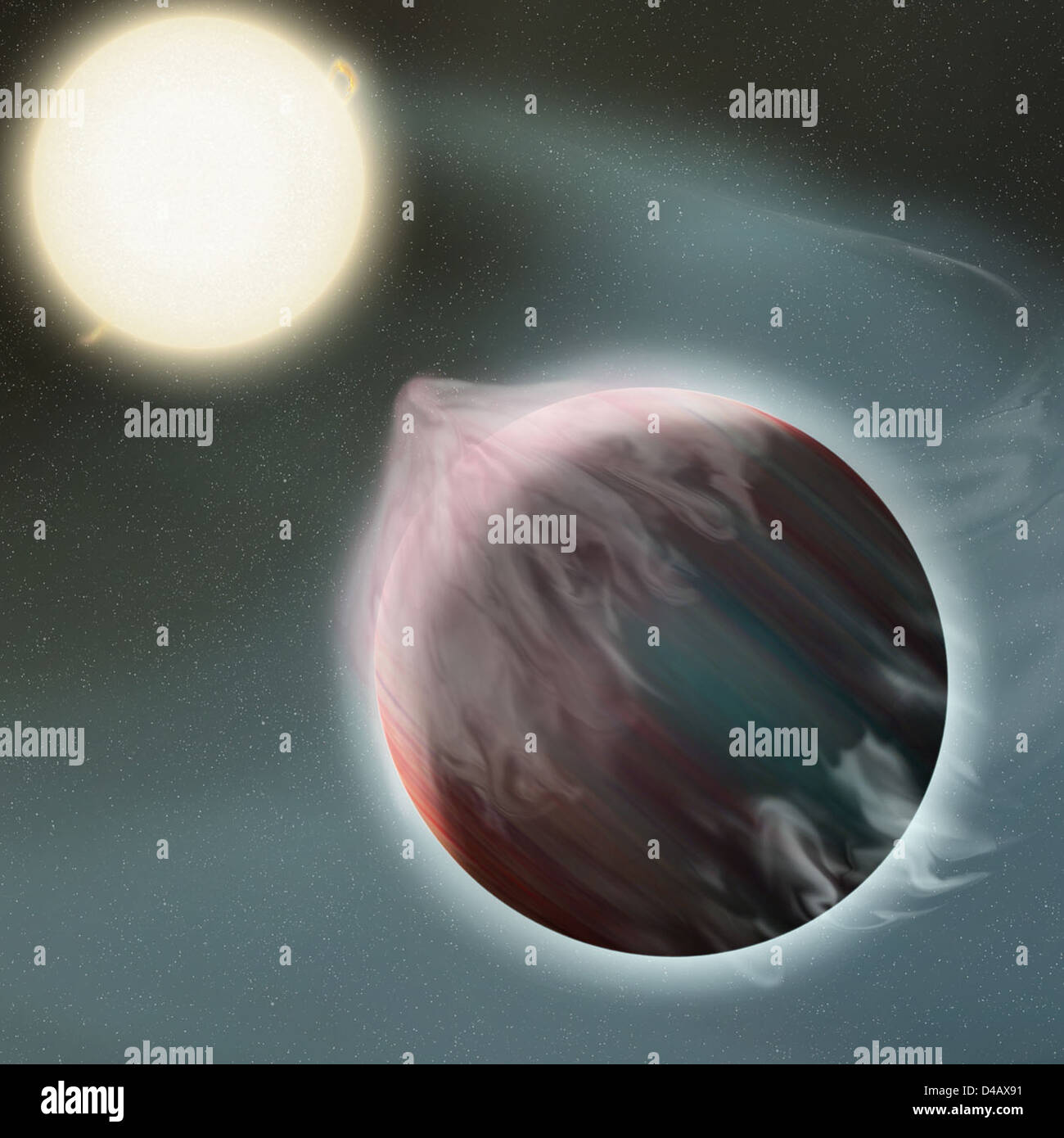
Researchers analyzing close-in exoplanets have determined that tidal gravity and planetary rotation significantly alter the interpretation of atmospheric spectral data. By accounting for the non-spherical shape of planets distorted by their host stars, scientists can now more accurately retrieve chemical abundances, preventing systematic errors in identifying water, methane, and carbon dioxide in exoplanetary atmospheres.
Accounting for Tidal Distortion in Spectral Analysis
Astronomers studying close-in exoplanets—planets that orbit extremely close to their host stars—have identified that standard atmospheric retrieval models often fail to account for the physical deformation of the planet itself. Because these planets are subjected to intense tidal forces, they do not maintain a perfect spherical shape. Instead, they become elongated, or “prolate,” along the axis pointing toward the star.
According to a study published in the Monthly Notices of the Royal Astronomical Society, failing to model this non-spherical geometry leads to inaccurate estimates of atmospheric composition. When a planet is distorted, the path length of starlight passing through its atmosphere changes depending on the observation angle. If researchers assume a spherical planet, they incorrectly calculate the transit depth, which leads to biased results when attempting to quantify the abundance of trace gases like water vapor or methane.
This challenge arises from the fundamental way exoplanets are detected: the transit method. As a planet passes in front of its host star, it blocks a small fraction of the star’s light. By measuring the dip in brightness, astronomers can infer the size and atmospheric composition of the planet. Traditionally, these models assumed a simple sphere. However, for planets in ultra-short-period orbits, the gravitational pull of the host star is so immense that the planet’s fluid interior and gaseous envelope are pulled into an egg-like shape. This deformation changes the silhouette presented to the telescope, altering the timing and depth of the transit signal.
The Role of Planetary Rotation and Obliquity
Planetary rotation adds further complexity to the retrieval of atmospheric data. As a planet rotates, its shape is influenced not only by the host star’s gravity but also by centrifugal forces. When these factors are combined—a phenomenon known as tidal-rotational deformation—the planet’s radius varies across its surface.
Research indicates that even small variations in the planet’s radius can significantly shift the transit light curve. For “hot Jupiters” and other gas giants in tight orbits, the deviation from a spherical model can be large enough to mimic or obscure the signals of specific chemical species. By integrating the Roche potential—a mathematical framework that describes the shape of a body under gravitational and centrifugal forces—into atmospheric retrieval codes, scientists can now isolate the true chemical signature from the signal caused by the planet’s physical shape.
The Roche potential approach allows researchers to calculate the equilibrium shape of a planet by considering the gravitational potential of the star and the rotation of the planet itself. In standard modeling, the radius is treated as a single parameter. In reality, the planet is an oblate or prolate spheroid. Because the light from the star filters through different atmospheric depths depending on the planet’s orientation during the transit, failing to account for this geometry results in an inaccurate “transmission spectrum.” This spectrum is the primary tool scientists use to identify chemical species, as different molecules absorb light at specific wavelengths.
Implications for Future Space Observations
The necessity of these corrections has become increasingly urgent with the deployment of advanced observatories. The James Webb Space Telescope (JWST) provides high-precision infrared spectra that require sophisticated models to interpret correctly. Without accounting for tidal gravity, the high signal-to-noise ratio provided by the JWST could lead to high-confidence, yet incorrect, conclusions about the habitability or chemical makeup of a planet.

The JWST, through its Near-Infrared Spectrograph (NIRSpec) and Near-Infrared Imager and Slitless Spectrograph (NIRISS), captures data with unprecedented sensitivity. While this allows for the detection of subtle spectral features, it also means that minor modeling errors—such as assuming a spherical planet—can be amplified. If the model is off by even a fraction of a percent, it can lead to a misidentification of the gas concentration, potentially leading researchers to overestimate or underestimate the presence of greenhouse gases or water vapor.
The current consensus among planetary scientists is that the next generation of atmospheric retrieval software must treat the planet’s radius as a function of latitude and longitude rather than a single constant value. This shift in methodology is essential for characterizing planets in the “hot” regime, where tidal locking and extreme radiation are the norm. Tidal locking occurs when the gravitational gradient is so strong that the planet always presents the same face to the star, creating permanent day and night sides. This interaction is the primary driver of the tidal distortion addressed in the recent research.
The precision of these models is paramount for future missions, as the community seeks to move beyond mere detection and toward the detailed chemical mapping of exoplanetary atmospheres. As telescopes grow more capable, the limiting factor in discovery is shifting from the hardware’s ability to collect photons to the researchers’ ability to mathematically decode the complex physical reality of these distant, deformed worlds.
The inclusion of tidal-rotational deformation is a necessary step to avoid systematic biases in the retrieved abundances of the most common molecules in the atmospheres of close-in exoplanets. Dr. Julian C. B. H. M.
Find more reporting in our Tech section.
