
Financial markets experienced a broad-based pullback in equities, coupled with declines in metals, while oil prices rose on Wednesday, March 25, 2026. The movement followed reports of diplomatic efforts to de-escalate the conflict between the United States and Iran, including the presentation of a 15-point peace plan and a proposed ceasefire. However, initial optimism waned after Iran rejected the proposal and outlined its own conditions for ending hostilities.
Despite the rejection, the United States indicated it is still awaiting an official response from Iran. Simultaneously, the Iranian Foreign Minister reiterated that no direct negotiations are currently underway, while acknowledging the exchange of messages through mediators, clarifying that these exchanges do not constitute formal negotiations. President Donald Trump reportedly told his advisors he intends to achieve a swift resolution to the conflict, estimating it could be in its final stages and hoping to close a deal in the coming weeks.
Israeli media reported that President Trump may announce a ceasefire with Iran as early as Saturday, even without a definitive agreement. Meanwhile, Houthi rebels in Yemen are reportedly prepared to intervene and take control of the Bab al-Mandab Strait. The White House confirmed that the President will hold a cabinet meeting today, which could provide further clarity on the evolving situation.
Source: xStation
Key News
Geopolitics: The situation between the United States and Iran remains marked by mixed signals. President Donald Trump maintains that Iran is seeking a deal and aims to resolve the conflict soon, but internal tensions and pressure to take a harder line persist. While a possible ceasefire announcement is speculated, even without a full agreement, military operations have significantly reduced Iran’s offensive capabilities. You’ll see also indications of a willingness to engage in dialogue from both sides, in a context where internal unity in Iran and tactical decisions, such as temporarily excluding certain leaders from targeting, may reflect a potentially decisive phase of the conflict.
U.S.: On the economic front, members of the Federal Reserve are highlighting difficulties in measuring inflation and signs of a sustained weakening in the labor market, suggesting the economy may require further monetary support. Discussions are also underway within the Treasury Department regarding potential changes to its relationship with the Fed, inspired by international models. Rising oil prices are causing concern for consumers and authorities, while there is no clear evidence of a spiraling inflationary effect. The White House is maintaining an active schedule with key cabinet meetings.
Currencies: The foreign exchange market remains contained, with the EUR/USD under pressure due to geopolitical and energy risks, despite recent messaging from the European Central Bank. The GBP/USD is also failing to sustain a recovery, affected by the adverse international context and a lack of significant support from recent data. In contrast, the USD/JPY is showing greater firmness, driven by dollar strength and the rebound in oil prices.
Bonds: U.S. Treasury bonds with a 10-year maturity are experiencing declines, with yields rising due to higher oil prices and a significant offering in the market. In Europe, Bunds continue to fall amid geopolitical uncertainty, while Japanese Government Bonds (JGBs) are also weakening, reflecting expectations of monetary policy normalization and inflationary pressures from rising energy costs.
Europe: The European Central Bank is assessing the impact of the energy shock stemming from the conflict in Iran, stating that policy decisions will depend on the duration of the conflict. Christine Lagarde indicated that it is still too early to quantify the effects, but stability in interest rates is contemplated if the impact is temporary, or potential increases if pressures persist.
Japan: The Japanese index showed declines amid the oil price rally, increasing concerns about inflation and growth, given the country’s high energy dependence. Despite releasing strategic reserves, pressures remain, while the Bank of Japan reaffirms its commitment to price stability and continues to adjust its policy. Inflation data for services showed a slight increase above expectations.
China: Chinese markets are facing pressure from corporate earnings and growing concerns about the real estate sector, particularly due to new debt payment delays by major developers such as Vanke, reinforcing structural financial risks.
Oil: Oil prices are maintaining an upward trend in an environment of high geopolitical uncertainty and conflicting messages regarding potential negotiations between the United States and Iran. Additional factors, such as incidents at energy infrastructure, risks in key routes like the Strait of Ormuz, and measures taken by countries like Japan to stabilize supply, are reinforcing volatility. Energy security is positioning itself as a central pillar for global stability.
Metals: Metals are showing weakness, with gold pressured by rising yields and oil prices, while copper is facing lower demand in an environment of risk aversion, particularly from China. Supply-side events, such as export restrictions from Russia and logistical disruptions in Australia, are adding further uncertainty to the market.
Want to know more? Connect to our Intraday analysis (10:15 AM GMT -3)
US100 Analysis
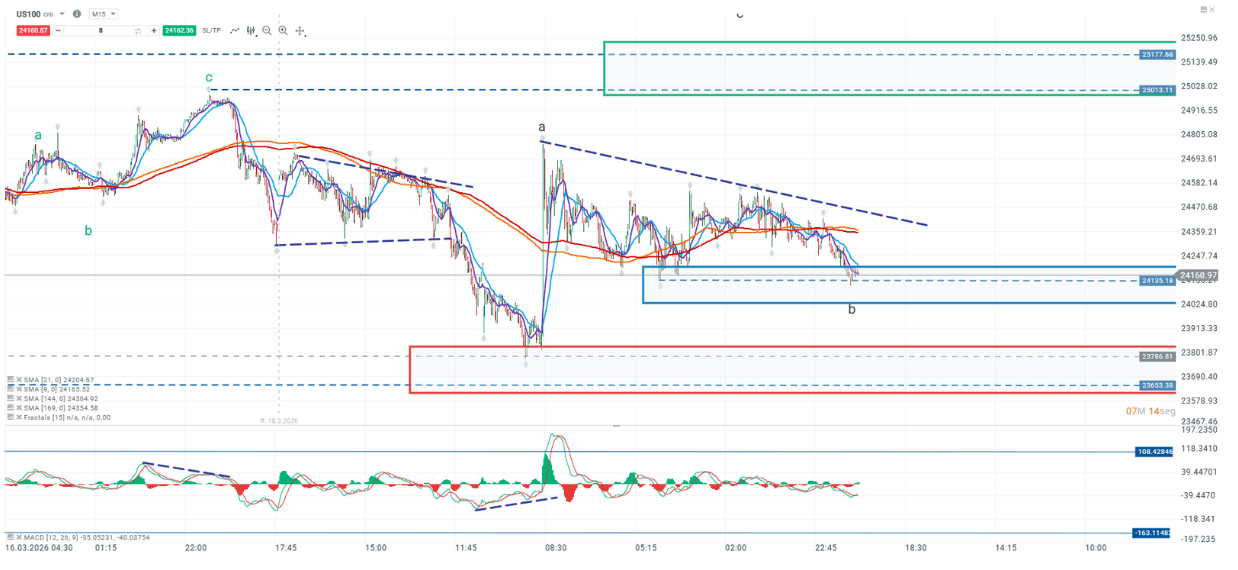
The price continues to develop a sideways structure, supported by the moving average around the support level of 24,135 points. Within this context, the formation of a triangle is identified, which reflects a phase of market consolidation. The area near 24,135 points remains a key reference.
If the price manages to hold above this level, it could resume the previous trend, towards the upper resistance located around 25,000 points. Conversely, a break below this support would increase the likelihood of an extension of the corrective movement, with the next relevant support level being the area of 23,653 points.
🔹 Key Point: 24,135
🔺 Bullish Scenario: 25,000
🔻 Bearish Scenario: 23,653
Source: xStation
Chart of the Day
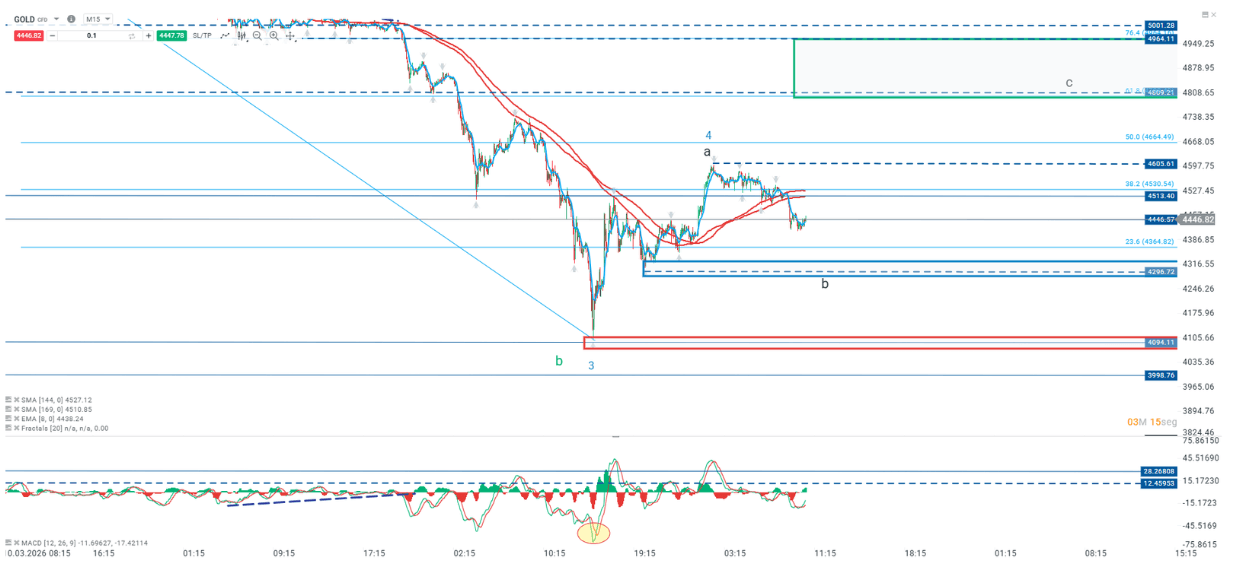
The price of gold has continued to come under pressure in an environment of increasing geopolitical uncertainty, where the appreciation of the dollar has pushed up yields, negatively affecting its price. From a technical point of view, a corrective decline structure is observed, with characteristics that could correspond to a “B” type correction. Currently, the key support is located in the area of 4,296 points, a level that acts as a main reference, while momentum remains bearish with the price trading below its long-term moving average.
However, as long as the price holds above this level, the possibility of a technical rebound seeking to approach the resistance located around 4,800 points remains open. Conversely, a sustained break below 4,296 points would reinforce the scenario of continued decline, where the major support is located in the area of 4,094 points.
🔹 Key Point: 4,296
🔺 Bullish Scenario: 4,800
🔻 Bearish Scenario: 4,094
Source: xStation
“This report is provided for general information and educational purposes only. Any opinion, analysis, price or other content does not constitute investment advice or a recommendation in understanding the law of Belize. Past performance is not necessarily indicative of future results, and anyone acting on this information does so at their own risk. XTB will not accept liability for any loss or damage, including, without limitation, any loss of profit, which may arise directly or indirectly from the use or reliance on such information. Contracts for Difference (“CFDs”) are leveraged products and carry a high level of risk. Ensure you understand the risks involved.”
